
⚡ Quick Facts
HVAC motor failures cost businesses in emergency repairs and system downtime every year. A single undetected winding defect can cascade into complete motor failure, leaving facilities without climate control during critical periods. The solution: implementing surge testing as part of your preventive maintenance strategy. This guide covers which surge tester specifications and configurations fit different HVAC applications, helping you protect your investment and ensure uninterrupted operation.

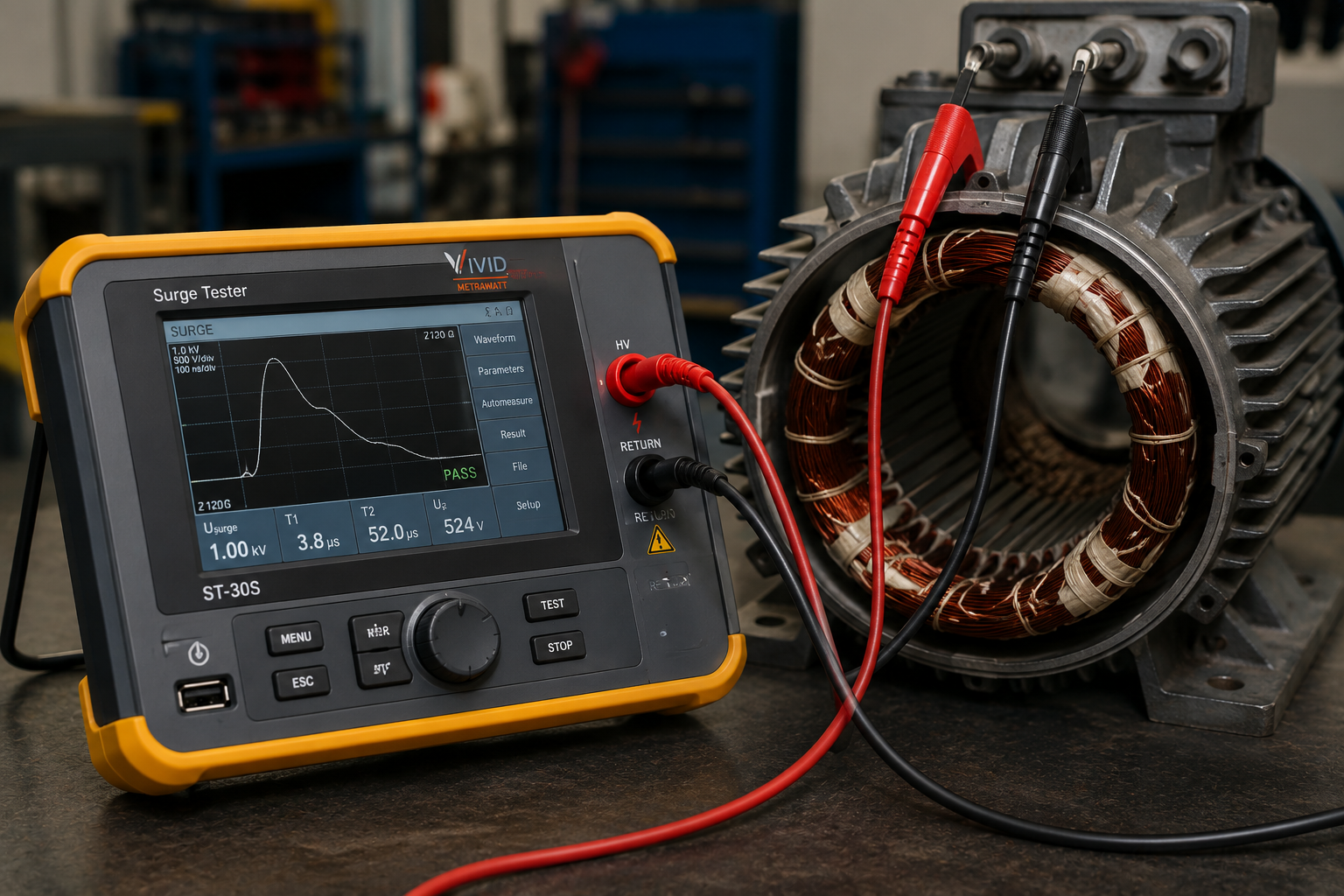
Surge testing represents the gold standard for detecting insulation weaknesses in motor windings before they cause catastrophic failures. Unlike basic resistance measurements, surge testing applies a controlled high-voltage pulse to windings, revealing defects invisible to conventional testing methods.
How Surge Testing Works:
For HVAC applications, surge testing becomes particularly critical because these motors operate continuously under varying load conditions, temperature fluctuations, and environmental stresses that accelerate insulation degradation. Understanding how surge generators work provides useful background before selecting equipment.
HVAC motors face unique operational challenges that make standard motor testing insufficient:
Temperature Cycling: HVAC motors experience dramatic temperature swings during startup, operation, and shutdown cycles. These thermal stresses cause insulation materials to expand and contract repeatedly, creating micro-fractures that conventional resistance tests cannot detect.
Moisture Exposure: Condensation, humidity, and occasional water intrusion compromise insulation integrity. Moisture penetration creates conductive pathways that may not register on basic continuity tests but will reveal themselves during surge testing.
Contamination Issues: Dust, debris, and chemical exposure in HVAC environments deposit on windings, creating potential failure points. Understanding motor winding failure signs helps technicians identify when surge testing becomes necessary.
The benefits of using surge testers become apparent when considering the operational cost of unexpected HVAC failures versus planned maintenance interventions. Establishing the right testing interval also matters — see Motor Insulation Testing Frequency for a criticality-based schedule.
Voltage Range and Adjustability
Waveform Analysis Capabilities
Sensitivity and Detection Accuracy
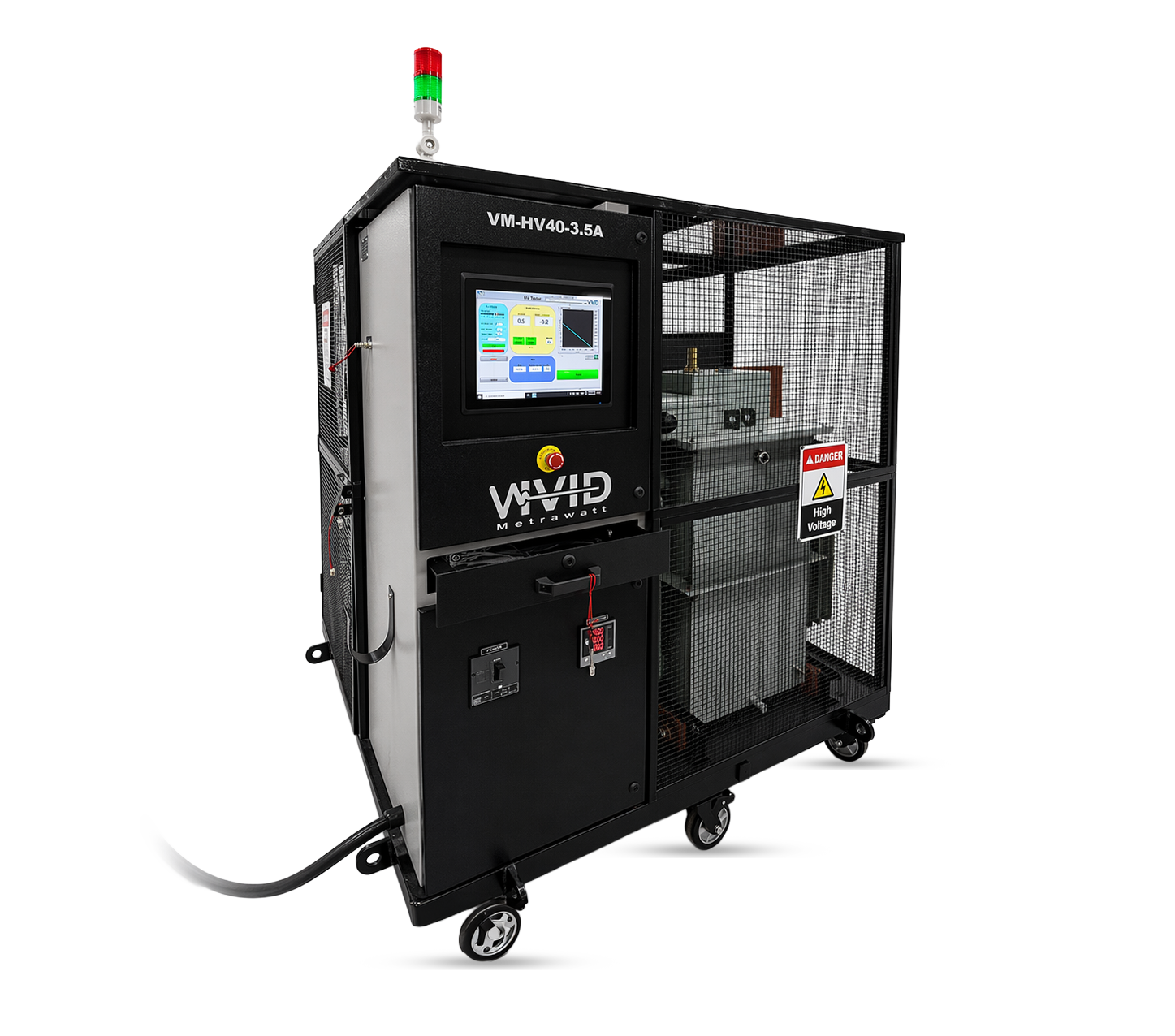
Modern surge testers should feature high-resolution color displays showing multiple waveforms simultaneously, with intuitive touchscreen controls that simplify operation in challenging environments. For field service work, prioritize units under roughly 25 lbs, with ruggedized housing, battery operation, and an organized carrying case.
Look for pre-programmed test sequences designed for HVAC motor types, built-in memory for thousands of test results, USB or wireless data export, and — on premium models — multi-function capability combining surge testing with insulation resistance (megohm) and Hi-Pot testing in one instrument.
Rather than shop by price point, the more reliable approach is matching the instrument’s voltage range and feature set to the motors you actually service. Here’s how that maps across HVAC segments:
Typical motors: furnace blowers, air handler motors, condenser fan motors, heat pump compressors — mostly single-phase, occasionally small three-phase
What to prioritize: portability, quick test modes, battery operation, voltage range comfortably covering 100–2500V
Fits well: the VM5K/VM6K Digital Surge Tester or a 3 KV Digital Armature Surge Tester for smaller single-phase units
Typical motors: rooftop package units (5–75 HP), chiller motors (10–200 HP), large air handlers and supply fans, VFD applications
What to prioritize: three-phase testing, advanced waveform analysis, extensive data logging
Fits well: the 6 KV with Bar-to-Bar Test or 5 KV/6 KV with DC Hi-Pot configuration — the latter combines surge and insulation resistance testing in a single production-friendly instrument
Typical environments: hospitals, data centers, pharmaceutical facilities, manufacturing plants — where applications of digital surge testers extend beyond pass/fail testing into full condition monitoring
What to prioritize: multi-channel testing, network connectivity for predictive maintenance systems, trending analysis, compliance documentation
Fits well: the 10 KV/12 KV/15 KV Digital Surge Tester range, or the Hi-Pot integrated variant for facilities requiring combined acceptance test reports
If your facility spans more than one of these tiers, Which Digital Surge Tester Do You Need? A Buyer’s Guide by KV Rating & Application maps the full 1 KV–50 KV range against every application type in detail.
💬 A note on pricing
[Contact our team](https://vividmetrawattglobal.com/contact/) for a quote matched to your specific HVAC motor population.
Precision and Documentation: Digital surge testers provide quantifiable measurements with numerical deviation percentages, eliminating subjective interpretation — valuable for baseline measurements on new motors, tracking insulation degradation over time, warranty claim documentation, and quality control standards.
Advanced Analysis Capabilities: Digital platforms incorporate algorithms that identify specific failure modes — turn-to-turn faults, phase-to-phase failures, ground wall insulation breakdown, and contamination-induced tracking.
Data Management: Modern digital testers store comprehensive test histories, enabling trend analysis across motor populations, predictive failure modeling, automated compliance reporting, and fleet-wide maintenance optimization.
While digital technology dominates modern HVAC testing programs, analog surge testers retain a role in specific scenarios: fewer electronic components to fail, no software compatibility issues, minimal training requirements, and lower ongoing maintenance cost. They tend to suit very small service operations doing basic pass/fail diagnostics rather than trend-based predictive maintenance.
Safety Protocols: ensure the motor is completely de-energized and locked out, all power sources disconnected (including control circuits), motor leads accessible and identified, testing area clear of personnel, and proper PPE worn.
Motor Preparation: disconnect the motor from its driven load if possible, remove it from the VFD circuit (test at motor terminals, not VFD output), verify nameplate data, document ambient conditions, and perform a visual inspection for obvious damage.
Troubleshooting common surge tester errors ensures accurate results and prevents misdiagnosis.
Single-Phase Motors: test between start winding, run winding, and common terminal, comparing impedance values against manufacturer specifications.
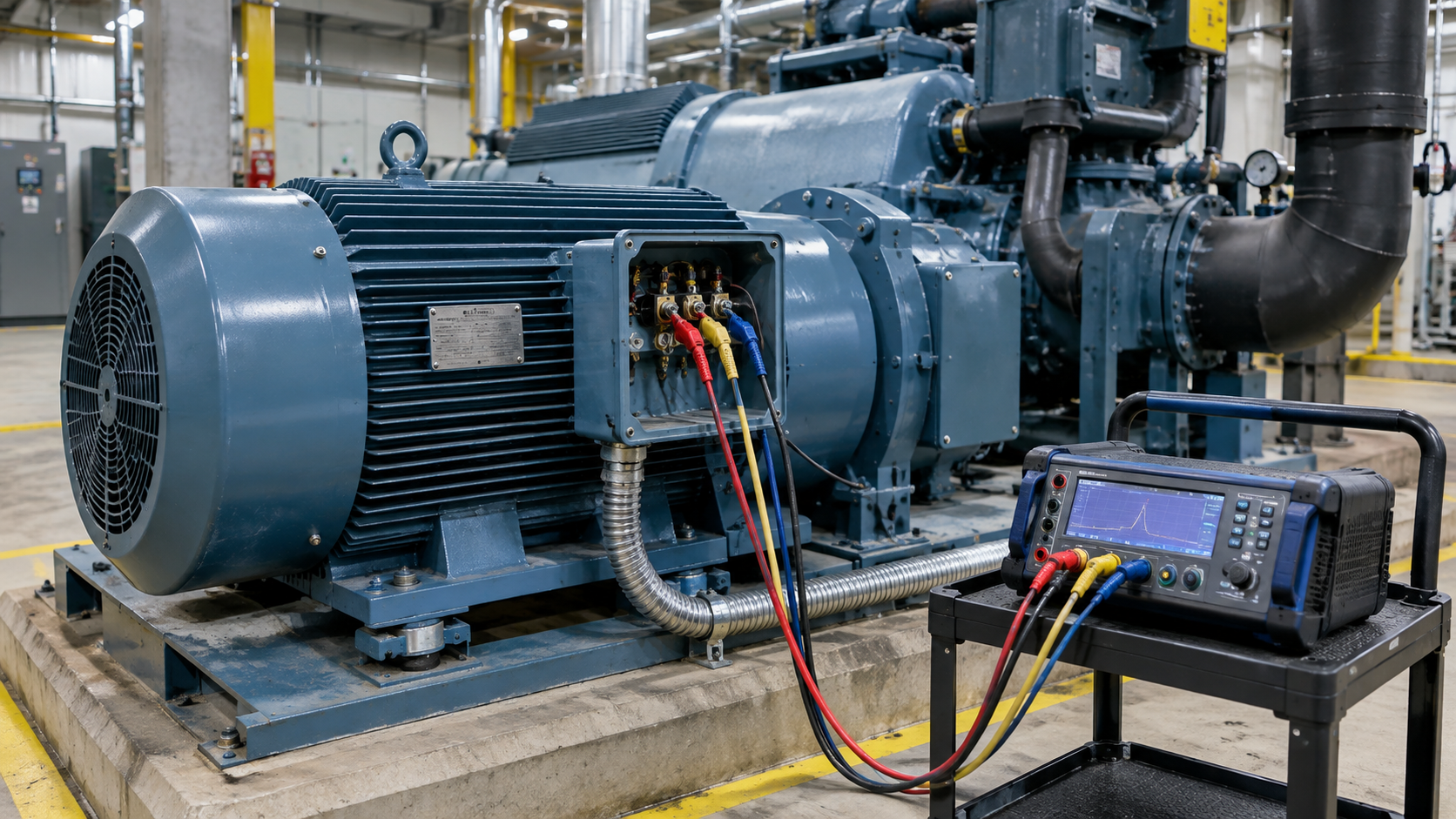
Three-Phase Motors: test all six possible winding combinations — Phase A to B, B to C, C to A, and each phase to ground.
Variable Speed Motors: VFD-duty motors require special consideration due to enhanced insulation systems — test at standard voltages but interpret results using VFD motor-specific criteria. See also the difference between megger and surge testing for windings for how the two methods complement each other on VFD-duty motors.
Surge testing excels at identifying turn-to-turn shorts that create subtle changes in winding inductance, producing waveform distortions showing reduced peak voltage and altered time constants. Typical HVAC causes: voltage spikes from VFD switching, thermal cycling stress, bearing-induced vibration, and manufacturing defects. Turn-to-turn shorts typically begin with just a few shorted turns, gradually expanding until they create phase-to-phase or phase-to-ground faults — early detection prevents complete motor failure.
Shows significant deviations when comparing affected phases; the surge tester reveals asymmetry that standard resistance tests might miss until the fault becomes severe. HVAC-specific causes: moisture ingress from condensate exposure, chemical contamination from refrigerant leaks, mechanical damage during installation or service, and end-turn abrasion from vibration.
Surge tester insulation failure detection proves particularly valuable for identifying ground wall problems before they cause catastrophic failures — indicated by reduced breakdown voltage to ground, leakage current, asymmetric ground capacitance, and progressive deterioration across multiple tests. HVAC environments accelerate this through condensation, temperature extremes, airborne contaminants, and age-related insulation embrittlement.
Surge testing reveals contamination paths that create partial discharge sites, appearing as irregular waveform patterns and reduced breakdown voltages. Regular testing identifies contamination before it creates permanent damage, allowing for preventive cleaning, environmental control improvements, and modified maintenance intervals.
Emergency Repair Avoidance: Emergency HVAC motor replacement typically costs several times more than a planned replacement once you factor in after-hours technician rates, expedited parts shipping, lost productivity during downtime, and potential damage to connected equipment.
Extended Motor Life: Surge testing enhances motor reliability and efficiency by enabling targeted interventions — early detection allows for rewind vs. replacement decisions, scheduled maintenance prevents secondary damage, and optimized replacement timing maximizes motor life while reducing spare parts inventory requirements.
📊 Illustrative example (not a specific customer result)
This is a directional example to illustrate how the payback math works, not a guaranteed return — actual payback depends on your motor population, failure history, and local labour/parts costs. We removed the previous version’s precise dollar figures and named ROI percentage, since those numbers weren’t tied to a real, citable case study.
Tenant Satisfaction: reliable climate control directly impacts tenant retention in commercial properties.
Energy Efficiency: motors with degrading windings operate less efficiently, consuming more energy — early detection and replacement improve overall system efficiency.
Compliance and Documentation: comprehensive testing records support warranty claims, insurance documentation, regulatory compliance in critical facilities, and quality assurance programs.
Daily Care: inspect test leads for damage, clean display and controls, verify battery charge, check for housing damage.
Monthly Procedures: test on a known reference motor for consistency, update firmware, back up stored data, clean ventilation openings.
Annual Service: maintaining and calibrating your digital surge tester ensures continued accuracy — factory calibration, complete diagnostic verification, test lead replacement, software updates.
Calibration frequency: annual minimum for most applications, semi-annual for critical facilities, mandatory after any repair, and verification before important testing campaigns. Maintain records of calibration date, standards used, before/after measurements, adjustments made, and next due date.
Test Lead Maintenance: high-voltage leads are the most frequently replaced component — inspect for insulation cracks, connector integrity, continuity, and strain relief; replace immediately at the first sign of damage, intermittent connection, or arcing.
✅ Key Takeaways
The standard formula is 2× rated voltage + 1000V, with a maximum not exceeding the motor’s specified test voltage. For a 460V motor, this would be (2 × 460) + 1000 = 1920V. Always consult the motor manufacturer’s specifications for exact testing voltages.
+When performed correctly at appropriate voltages, surge testing does not damage healthy motors. However, motors with severely degraded insulation may experience breakdown during testing — which prevents future catastrophic failure during operation rather than causing new damage.
Recommended frequencies vary by application: critical facilities quarterly, commercial systems semi-annually, residential systems annually or during major service, new installations before commissioning, and after any significant environmental event.
Surge testing applies high-voltage pulses to detect turn-to-turn shorts and winding asymmetries, while megger testing applies DC voltage to measure insulation resistance to ground. Both tests provide complementary information.
Always disconnect motors from VFDs before surge testing. The high-voltage test pulses can damage VFD electronics. Test at the motor terminals, not at the VFD output.
Yes. Training should cover high-voltage safety procedures, proper connection techniques, result interpretation, equipment operation, and documentation requirements.
Motor identification and nameplate data, test date and technician, test voltages applied, waveform comparisons or deviation percentages, ambient conditions, test equipment used, and recommendations or follow-up actions.
Choosing the best surge tester for HVAC motor testing requires matching your specific voltage range, motor types, and facility criticality to the right instrument configuration — not simply picking the cheapest or most expensive option available.
Key Selection Factors: application scope, portability needs, budget reality, must-have vs. nice-to-have features, and manufacturer support/training quality.
Ready to implement surge testing in your HVAC maintenance program? Browse Vivid Metrawatt’s digital surge tester range or contact our technical team for a configuration recommendation matched to your specific motor population.
Don’t wait for unexpected motor failures to disrupt your operations. Implement advanced surge testing to detect winding faults early, improve system reliability, and reduce costly downtime in HVAC applications. Our experts at Vivid Metrawatt Global can help you choose the right testing solution for your maintenance strategy.
⚡ Explore professional HVAC surge testing solutions
🔧 Get expert guidance for selecting the right tester for your application
📊 Improve predictive maintenance and reduce unexpected breakdowns