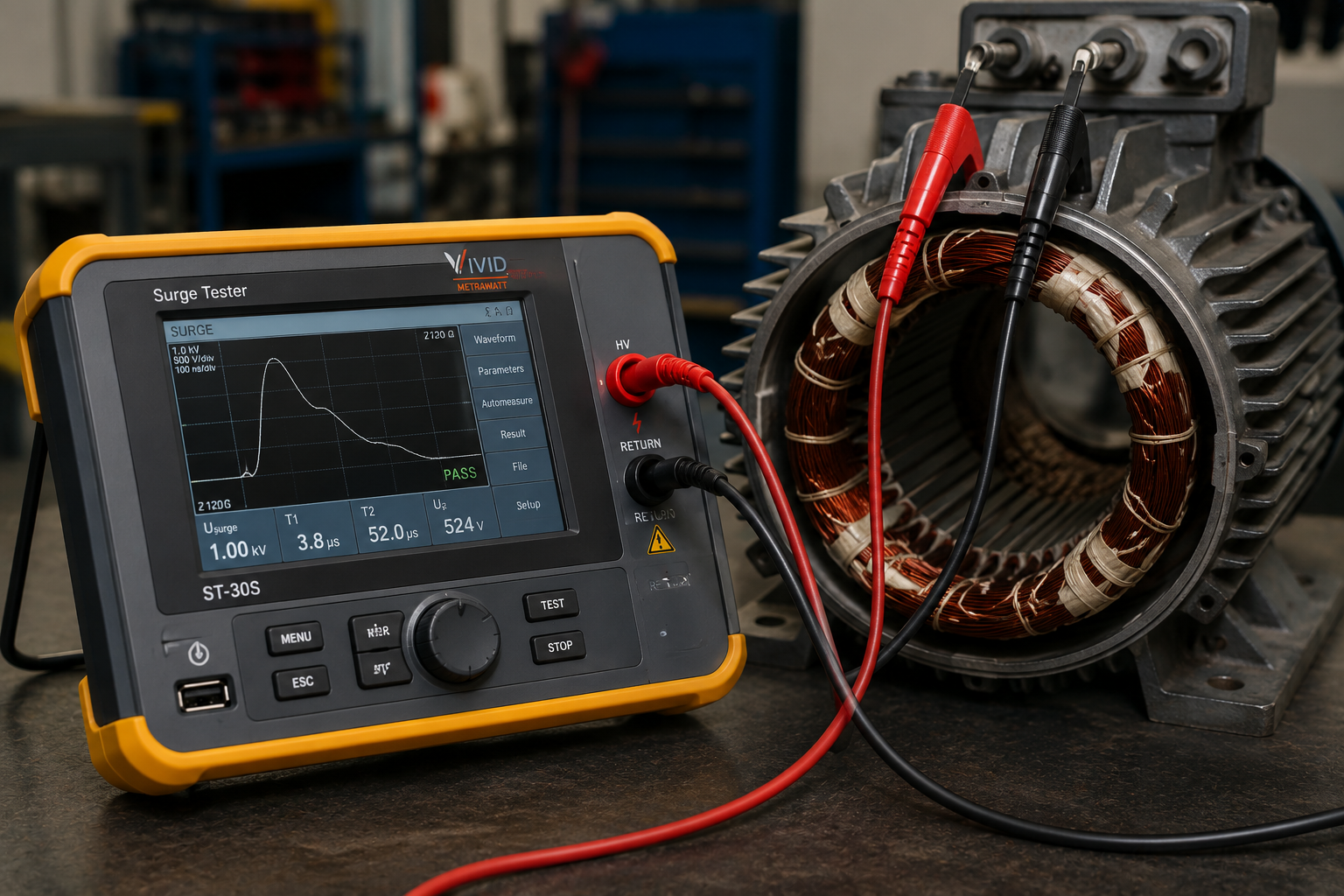

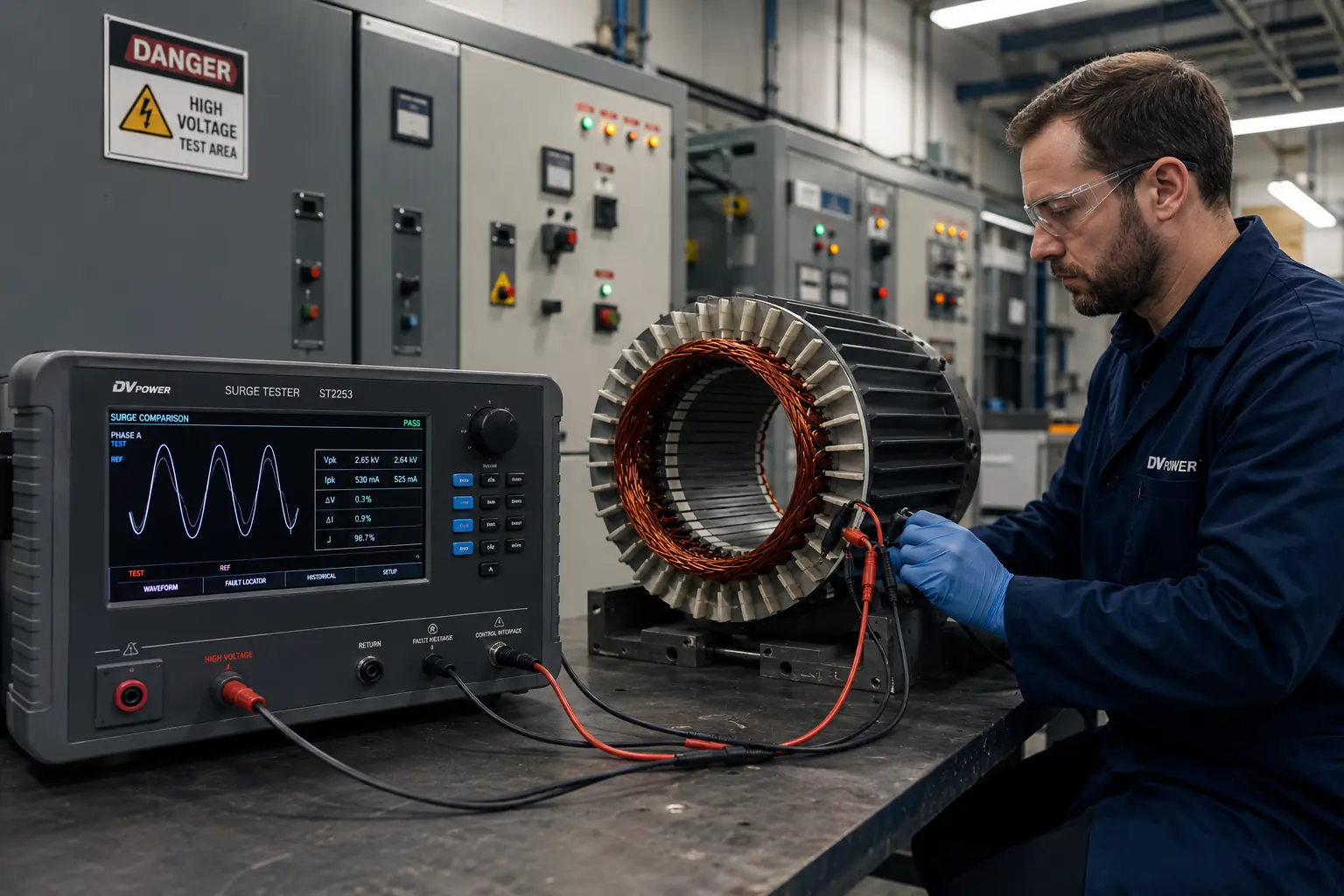
Selecting the wrong surge tester is a costlier mistake than most engineers anticipate. Under-test a winding and latent insulation faults slip through quality control — returning as catastrophic field failures. Over-test a winding and you introduce damage to insulation that was previously healthy. Choosing the right digital surge tester by KV rating is the most consequential decision in any winding quality assurance process. This complete buyer’s guide maps every KV class from 1KV to 50KV to its correct application, industry, and configuration — so you can purchase with confidence and test with precision.
Table of Contents
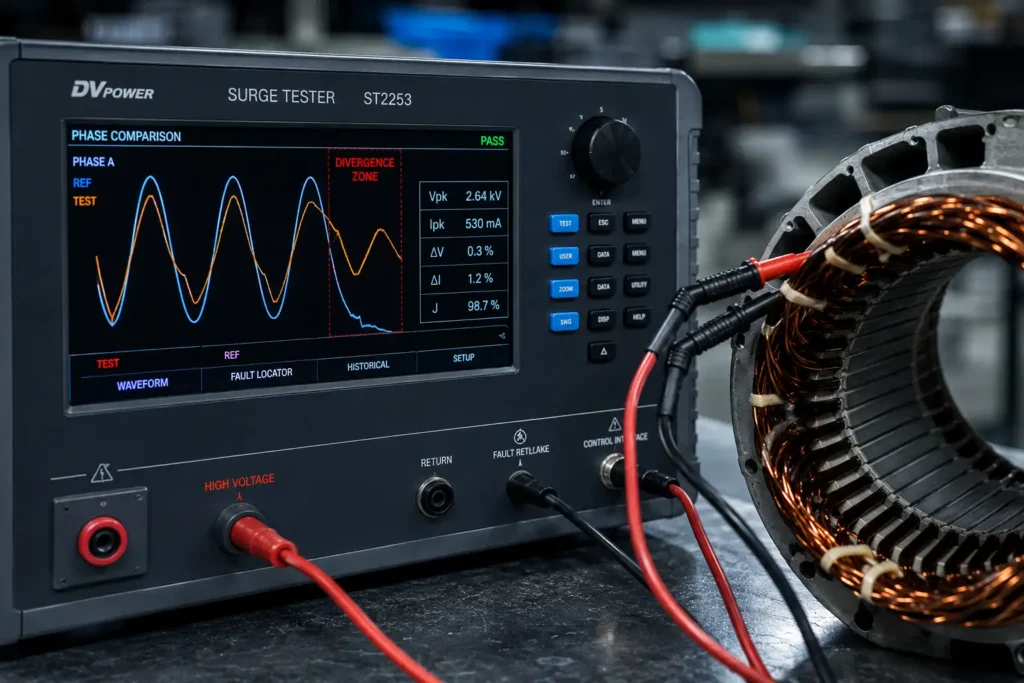
A digital surge tester applies a high-voltage impulse — a fast-rising, oscillating wave — across the winding under test. The instrument captures the resulting waveform and compares it against a reference. When both sides of a winding are healthy and matched, their waveforms overlap with precision. Any deviation — a waveform shift, frequency change, or amplitude collapse — reveals an insulation weakness, a turn-to-turn short, or a developing fault within the coil.
The parameter that determines how much electrical stress is applied to the insulation is the peak surge voltage, measured in kilovolts (KV). This single value controls:
The standard formula for surge test voltage — as defined by IEC 60034-15 and IEEE 522 — is typically set at 2× to 3× the rated operating voltage of the winding, with a practical minimum test voltage applied as a safety floor. Understanding this relationship is the foundation of every correct KV selection decision.
Key Principle: Applying too little voltage produces an inconclusive test — insulation faults are not stressed sufficiently to reveal themselves. Applying too much voltage risks introducing dielectric damage into a winding that was previously healthy. The correct KV selection is not a preference — it is a test integrity requirement.
Use this table as a rapid-reference guide before reading the detailed sections below. Match your winding’s operating voltage class to the appropriate surge tester KV rating and primary configuration.
| KV Rating | Winding Voltage Class | Primary Application | Best For |
|---|---|---|---|
| 1 KV | Up to 230V AC / DC | Armature & small DC motors, bar-to-bar commutator test | Service centres, small motor repair, appliance OEMs |
| 3 KV | Up to 690V AC | General workshop winding test, low-voltage stators | Motor rewinding shops, MRO facilities |
| 5 KV / 6 KV | Up to 2.4 KV AC | Industrial stators, HVAC motors, transformers | OEM production lines, process plant MRO, HVAC contractors |
| 10–15 KV | Up to 6.6 KV AC | Medium-voltage motors & generators | Utilities, oil & gas, water treatment, power generation |
| 25–40 KV | Up to 15 KV AC | Traction motors, large generators, HV transformers | Railways, power generation, mining, heavy industry |
| 50 KV | Up to 22 KV AC | Ultra-HV rotating machines & power transformers | Aerospace, defence, major utilities, OEM transformer manufacturers |
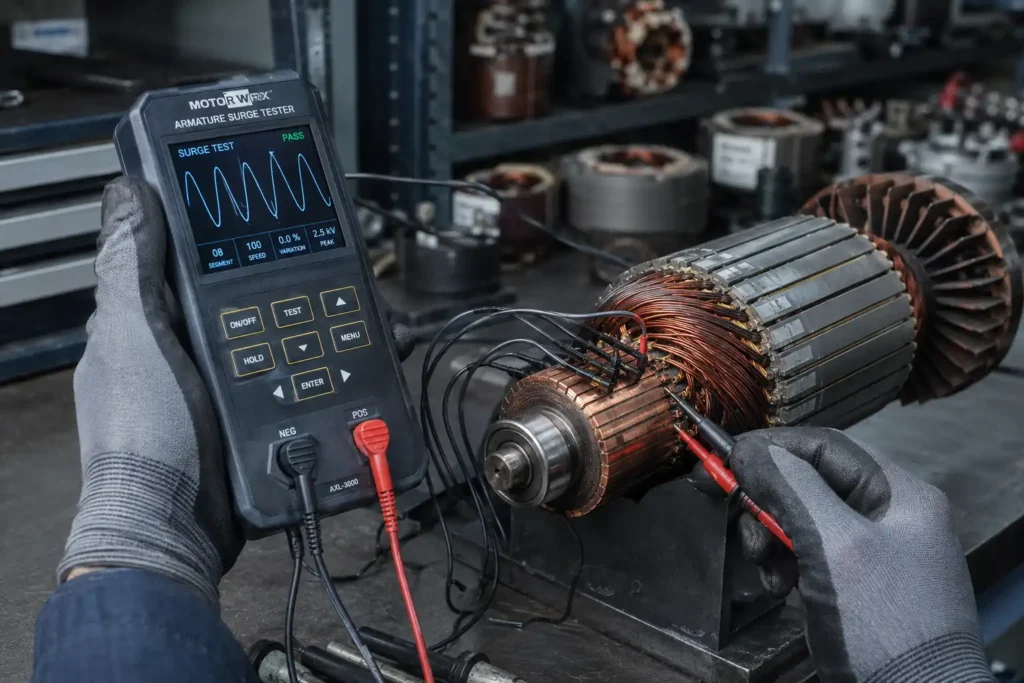
The 1 KV digital armature surge tester is designed for testing low-voltage DC armature windings, fractional horsepower motors, and small single-phase wound components. It is the entry point for service centres and motor repair workshops that handle consumer appliances, power tools, automotive starters, and small industrial equipment operating at voltages up to 230V.
The primary test function at this level is bar-to-bar commutator testing — applying the surge impulse between adjacent commutator segments to detect turn-to-turn shorts within armature coils. This is a test that cannot be adequately performed by a standard stator surge tester, making the 1 KV armature-specific instrument the right choice for workshops that regularly handle DC machines.
Recommended for:
The Vivid Metrawatt 1 KV Digital Armature Surge Tester is built specifically for this application, delivering precise low-voltage impulse testing with clean waveform comparison on a clear digital display.
The 3 KV class covers the dominant voltage class of global industrial motor populations — 415V three-phase, 440V, and 690V — with comfortable headroom for appropriate insulation stress without over-testing. It is the most commonly purchased tier for general motor rewinding businesses and covers the majority of motors found in manufacturing plants, pumping stations, HVAC systems, and commercial facilities.
Both automatic and manual variants are available in this class, giving buyers the flexibility to choose by workflow rather than being locked into a single operating mode.
| Feature | Manual 3 KV | Automatic 3 KV |
|---|---|---|
| Voltage control | Manual operator ramping | Programmable test sequences |
| Test throughput | Lower (operator-paced) | Higher (production-friendly) |
| Repeatability | Operator-dependent | Consistent and documented |
| Best use case | Repair workshops, training environments | OEM production lines, batch testing |
Vivid Metrawatt offers both a 3 KV Automatic Surge Tester for production environments and a 3 KV Digital Armature Surge Tester for workshop applications.
Expert Tip: Even at the 1 KV level, always verify the actual peak voltage output specification — not just the nominal rating. Some instruments labelled as “1 KV” deliver only 800–900V peak. Confirm the actual peak surge voltage against the test standard requirements for your specific winding class.
The 5 KV and 6 KV range is where the majority of serious industrial motor testing occurs. This tier covers medium-voltage motors up to approximately 2.4 KV operating voltage — motors that drive compressors, fans, pumps, and conveyors in process plants, power utilities, HVAC systems, and large commercial and industrial facilities.
What distinguishes this class is the diversity of configurations available — allowing buyers to precisely match instrument capability to their specific testing requirements rather than accepting a one-size-fits-all specification.
| Configuration | Key Differentiator | Ideal Use Case |
|---|---|---|
| 6 KV LCD Surge Tester | Simplified LCD display interface | Field service, less complex testing environments |
| 6 KV with Bar-to-Bar Test | Dual-mode: stator surge + commutator bar-to-bar | Motor repair shops handling both AC and DC machines |
| 6 KV High-Power | Higher pulse energy output | Large wound components with high winding capacitance |
| 5 KV Automatic Surge Tester | Programmable automatic test sequences | OEM production lines, high-throughput batch testing |
| 5 KV / 6 KV with DC Hi-Pot | Surge + insulation resistance (Hi-Pot) in one instrument | Quality labs, stringent QC, compliance-critical production |
Recommended for:
Expert Tip: If your facility tests both AC stators and DC armatures regularly, the bar-to-bar test configuration at 6 KV is a significant operational advantage — it eliminates the need for two separate instruments on the same bench and reduces capital outlay without any compromise in test capability.
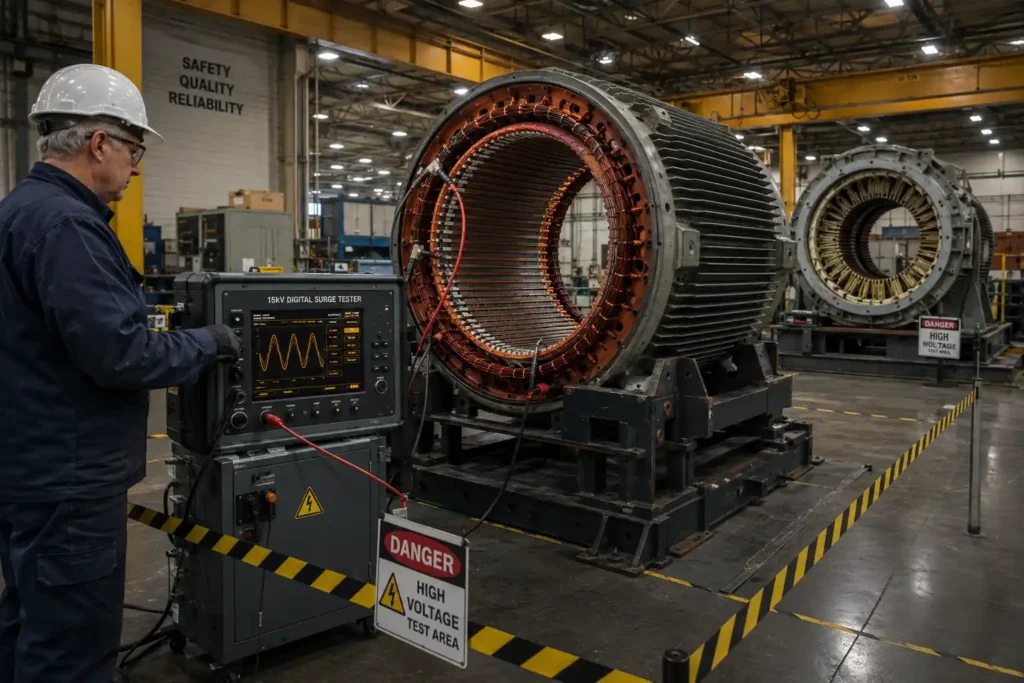
Once your motor and generator population extends into the 3.3 KV, 4.16 KV, or 6.6 KV operating voltage class, a 5 KV or 6 KV instrument is no longer adequate. The 10 KV–15 KV range is purpose-engineered to meet the demanding insulation qualification requirements of higher-voltage wound machines — machines where insulation failure carries not just production consequences, but potential safety risks.
This is the territory of large process-critical equipment in oil and gas, petrochemicals, water treatment, power generation, and heavy manufacturing — applications where the cost of an undetected fault far exceeds the cost of the testing instrument.
Standard 10 / 12 / 15 KV Digital Surge Tester
Core surge waveform testing with precision voltage control across the full KV range. The standard model is suited to repair facilities and quality laboratories with experienced operators testing varied winding types.
10 / 12 / 15 KV with Bar-to-Bar Test
The bar-to-bar variant adds commutator segment testing for large DC traction machines — essential for rail and heavy traction motor repair operations where both AC and DC machine types are serviced.
10 / 12 / 15 KV with Hi-Pot Test
The Hi-Pot integrated model combines surge testing with DC Hi-Pot, enabling comprehensive insulation qualification in a single test session. This is the most widely specified configuration in utility and power generation workshops, where a single-instrument acceptance test report covering both waveform comparison and ground insulation is typically required.
High-Power 10 / 12 / 15 KV Variant
The high-power variant delivers elevated energy per pulse — essential when testing large stators with high winding capacitance, where a standard energy output would produce an under-stressed, inconclusive test result.
Recommended for:
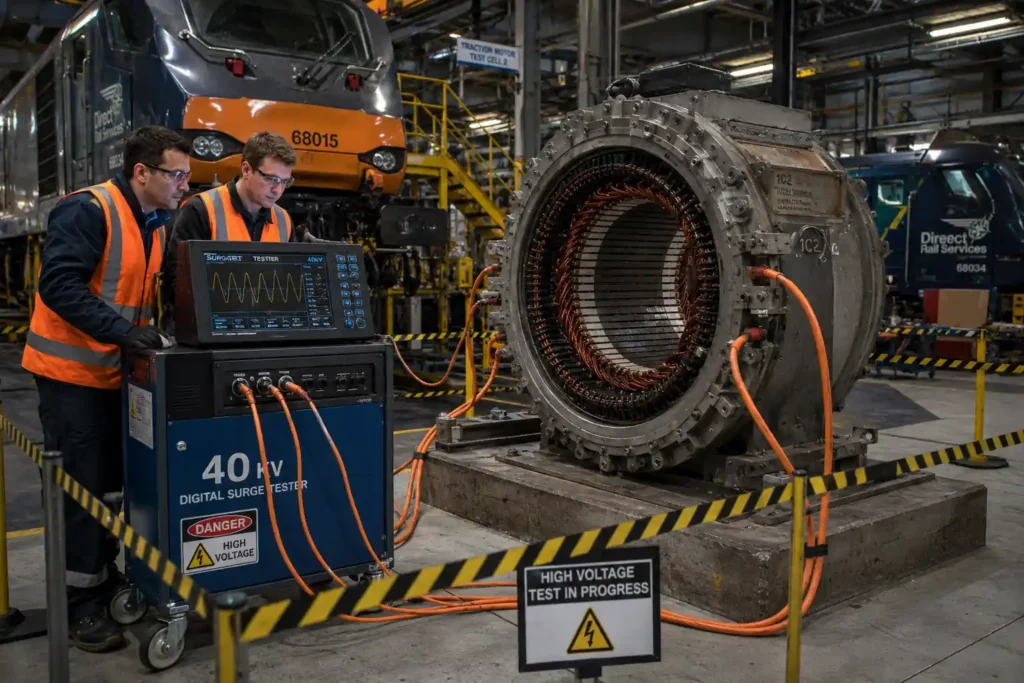
The 25 KV to 40 KV range occupies a specialised and technically demanding segment of the surge tester market. The engineers and procurement teams who specify instruments at this level are operating in industries where machine reliability is non-negotiable and where the testing process must meet formal audit and compliance requirements.
At this voltage level, the physics of impulse testing change materially. The instrument must manage extremely high-energy pulses without dangerous voltage overshoot, provide fine-increment voltage control across the full operating range, and deliver waveform capture with sufficient resolution to resolve subtle fault signatures in large, high-capacitance windings.
Who specifies this class:
Both standard and DC Hi-Pot integrated configurations are available:
Key Consideration: At 25–40 KV, DC Hi-Pot integration is not merely convenient — it is typically mandatory. Most large motor and generator acceptance test routines require both surge waveform data and DC Hi-Pot insulation resistance results in the final test certificate. A combined instrument eliminates the need for two separate setups, two sets of connections, and two separate instrument calibration records.
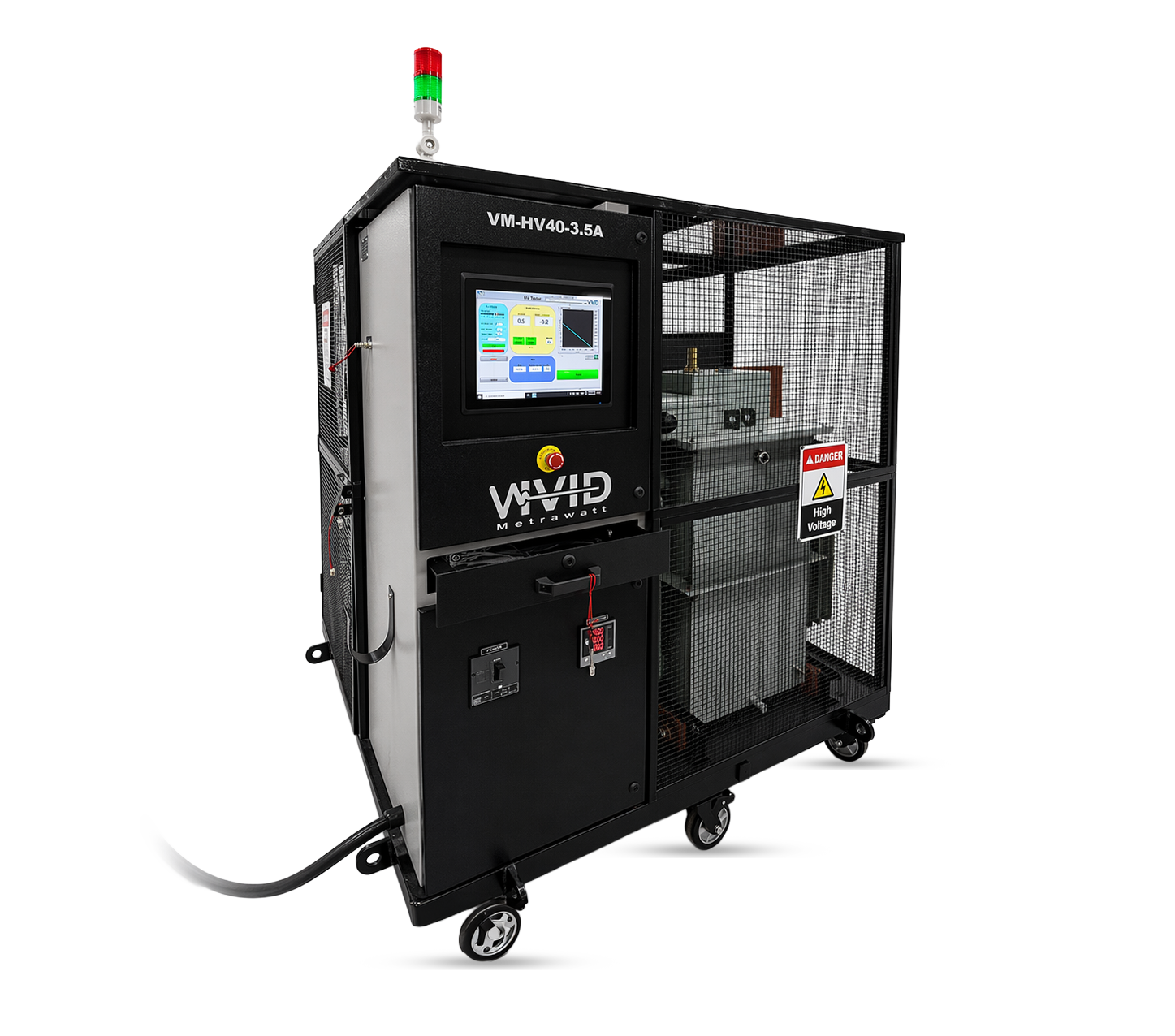
The 50 KV Digital Surge Tester represents the peak of Vivid Metrawatt’s surge testing capability. This is an instrument for organisations that routinely test very large rotating machines, high-voltage power transformers, or specialised electrical equipment operating at system voltages above 15 KV — where the consequences of an undetected insulation fault are severe and where the testing process itself must be treated as a safety-critical procedure.
Safety Note: At 50 KV, operator safety infrastructure is as important as the instrument specification. Formal written safety procedures, shielded test enclosures or designated HV test bays, authorised personnel requirements, and a second-person safety protocol are all standard requirements at this voltage class — independently of the instrument used.
KV rating is the starting criterion — not the end of your evaluation. The following checklist covers the features that separate a production-grade professional instrument from a basic tester at the same nominal voltage rating.
Rather than selecting purely on voltage specification, the most effective approach maps your instrument choice to your actual operational context, test throughput, and compliance requirements. Use this guide as a starting framework.
Recommended range: 1 KV – 6 KV (depending on the operating voltage class of motors served)
Key requirements: Versatility across mixed winding types, bar-to-bar test capability, compact bench footprint, intuitive interface for operator training
Best fit: 3 KV Digital Armature Surge Tester or 6 KV with bar-to-bar test option
Recommended range: 3 KV – 15 KV
Key requirements: Automatic test sequences, production-line speed, data logging for quality records, operator-to-operator repeatability
Best fit: 5 KV Automatic Surge Tester or 10 / 15 KV with Hi-Pot integration
Recommended range: 10 KV – 50 KV
Key requirements: High-power output for large stators, DC Hi-Pot integration, waveform storage for test reports, standards compliance (IEC / IEEE)
Best fit: 15 KV High-Power or 25–40 KV with DC Hi-Pot
Recommended range: 15 KV – 40 KV
Key requirements: Bar-to-bar test for DC traction armatures, DC Hi-Pot integration, robustness for depot environments, test record documentation
Best fit: 25 / 30 / 40 KV Digital Surge Tester with DC Hi-Pot
Recommended range: 3 KV – 15 KV
Key requirements: High test throughput for production line volumes, precise voltage control, waveform comparison accuracy for high-density winding architectures
Best fit: 5 KV Automatic Surge Tester or 10 KV Digital with Hi-Pot integration
Recommended range: 1 KV – 6 KV
Key requirements: Portability for field testing, ease of use for non-specialist operators, reliable pass/fail output
Best fit: 3 KV or 5 KV Digital Surge Tester
This question arises consistently at the 3 KV and 5 KV class — and the answer depends almost entirely on your operating environment and workflow priorities, not on technical performance. Both types deliver the same fundamental surge test function; what differs is how that function is controlled and integrated into your process.
| Consideration | Choose Manual | Choose Automatic |
|---|---|---|
| Winding variety | High variety — many different winding types tested each day | Low variety — consistent winding type tested at volume |
| Operator experience | Experienced, trained technicians | Mixed operator skill levels — repeatability is a priority |
| Test documentation | Manual recording is acceptable | Formal QA records required — automated data logging needed |
| Budget priority | Lower capital cost is important | Throughput and repeatability justify the higher investment |
| Best environment | Repair workshop, field service, training | OEM production line, batch quality control |
For a 415V three-phase industrial motor, a 3 KV surge tester is typically sufficient. Per IEEE 522, surge test voltage is generally set at two to three times the operating voltage plus 1000V — placing the required peak voltage comfortably within the 3 KV range. A 5 KV or 6 KV instrument also covers this class with additional headroom, and may be preferred if the same instrument must serve a wider motor voltage range.
Yes — but only if the instrument allows precise voltage reduction to the appropriate test level. Applying the full 15 KV or 40 KV output of a high-range instrument to a 415V motor winding would cause destructive insulation damage. Always confirm that the instrument’s minimum selectable voltage is below your required test level for the winding class in question before purchasing.
A surge tester applies a high-voltage impulse waveform to detect turn-to-turn and coil-to-coil insulation faults through waveform comparison. A Hi-Pot (High Potential) tester applies a sustained DC or AC voltage to test the integrity of insulation between winding and ground. These tests are complementary — surge testing reveals internal winding faults; Hi-Pot tests the ground insulation barrier. Many Vivid Metrawatt models integrate both functions in a single instrument.
Only if you regularly test DC machines with commutators — DC motors, traction motors, armatures, and similar equipment. Bar-to-bar testing applies the surge voltage between adjacent commutator segments to detect shorts in armature coil turns. For facilities testing purely AC stator windings, this function is not required and need not influence your selection.
If you are testing large stators or generator windings with high winding capacitance, a standard energy output may produce a pulse that is insufficiently stressed to reliably trigger fault signatures. The symptoms are inconclusive waveforms or excessively damped oscillation on large windings. High-power variants increase the available pulse energy to compensate. If uncertain, contact Vivid Metrawatt’s technical team with your winding parameters — they can advise on whether a high-power configuration is necessary for your application.
No. These are separate tests with different voltage levels and different purposes. Surge test voltage is typically 2–3× operating voltage, applied as a fast oscillating impulse. DC Hi-Pot voltage is typically 1.5–2.5× operating voltage, applied as a sustained constant DC level. Both are defined separately in IEC 60034-1 and IEEE 43 — and both appear in the acceptance test reports required by most utility and industrial standards.
Error Area Ratio is a quantitative metric — expressed as a percentage — that measures the proportional area difference between two compared waveforms. Rather than relying on an operator’s visual judgement of whether two waveforms “look the same,” EAR provides an objective numerical value that can be compared against a defined acceptance threshold. This is critical for production environments where consistent, operator-independent pass/fail decisions are required and where test results must be documented for quality records.
For most industrial applications, annual calibration is the standard recommended interval, maintaining traceability to national or international measurement standards. Instruments deployed in safety-critical environments, nuclear facilities, or high-throughput production lines where calibration drift has direct product liability implications may warrant semi-annual calibration. Always confirm the calibration requirement against the applicable test standard or your internal quality management system requirements.
Find the Right Surge Tester for Your Application
KV rating is the foundation — the right configuration, output energy, and ancillary functions make the difference between a capable instrument and the right instrument for your specific winding class, industry, and testing volume. Vivid Metrawatt’s complete range covers every application from 1 KV armature repair to 50 KV ultra-high voltage qualification.
→ View 1 KV Digital Armature Surge Tester
→ View 5 KV Automatic Surge Tester
→ View 25 KV / 30 KV / 40 KV with DC Hi-Pot
→ View 50 KV Digital Surge Tester
→ Explore the Complete Digital Surge Tester Range at Vivid Metrawatt