
Picture this: a critical pump motor in a petrochemical plant fails at 2 AM on a Sunday. By Monday morning, the unplanned downtime has cost the facility upwards of ₹15–20 lakhs — not just in repair costs, but in halted production, emergency labour, and replacement parts shipped express.
This is not a rare scenario. Motor failures account for a significant share of unplanned industrial downtime globally, and the painful truth is that most of these failures are entirely preventable.
The leading cause? Winding insulation breakdown — a fault that develops silently over months, invisible to standard resistance tests or even a conventional megger check. By the time your motor trips or burns, the damage is already catastrophic.
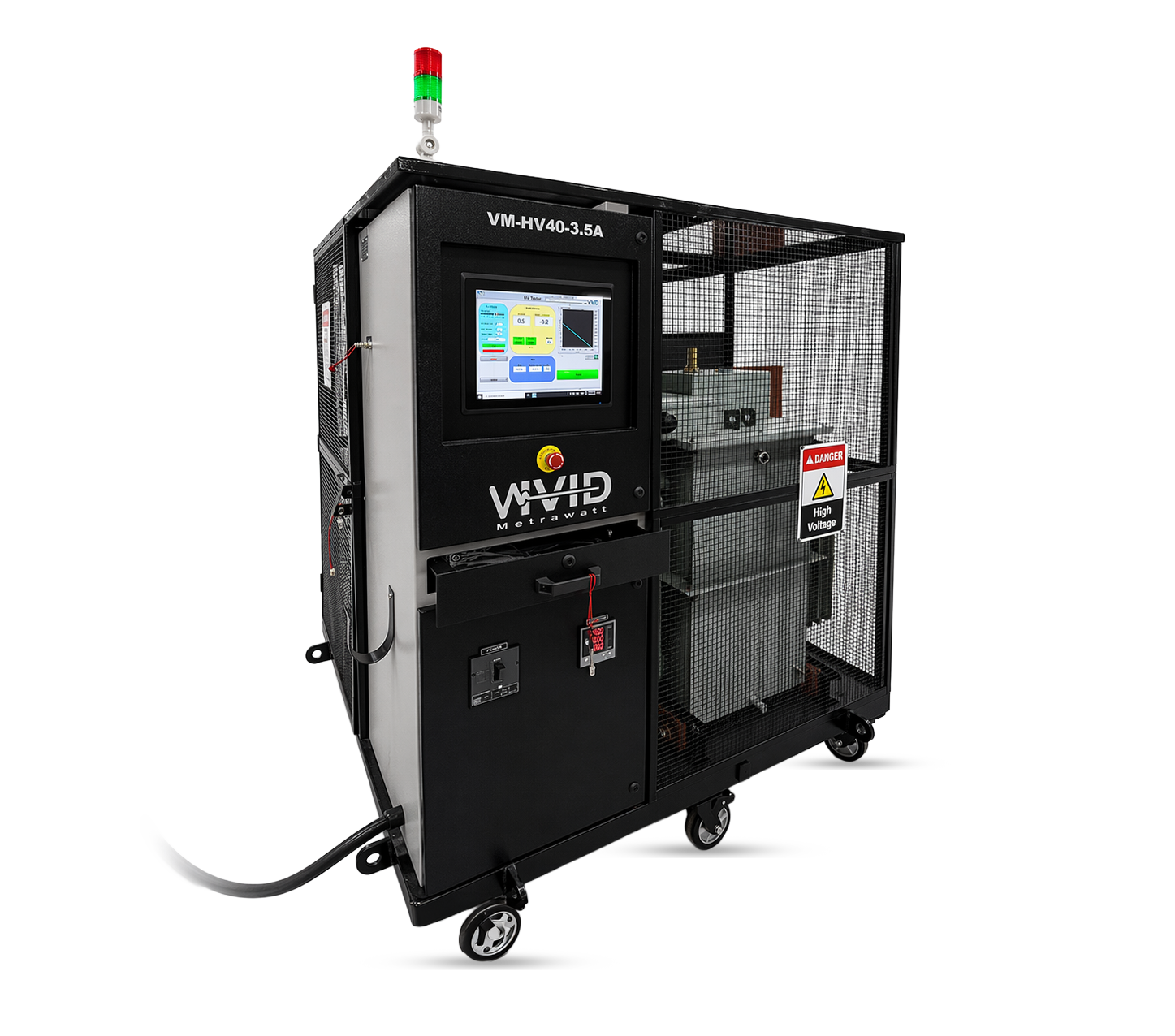
That is precisely where the 50KV digital surge tester steps in. It is the most reliable method currently available for detecting early-stage insulation weaknesses in high-voltage motor windings — before they escalate into failures.
If your facility operates motors rated 6kV, 11kV, or higher, not using a high-voltage surge tester in your maintenance cycle is not cost-saving — it is risk accumulation.
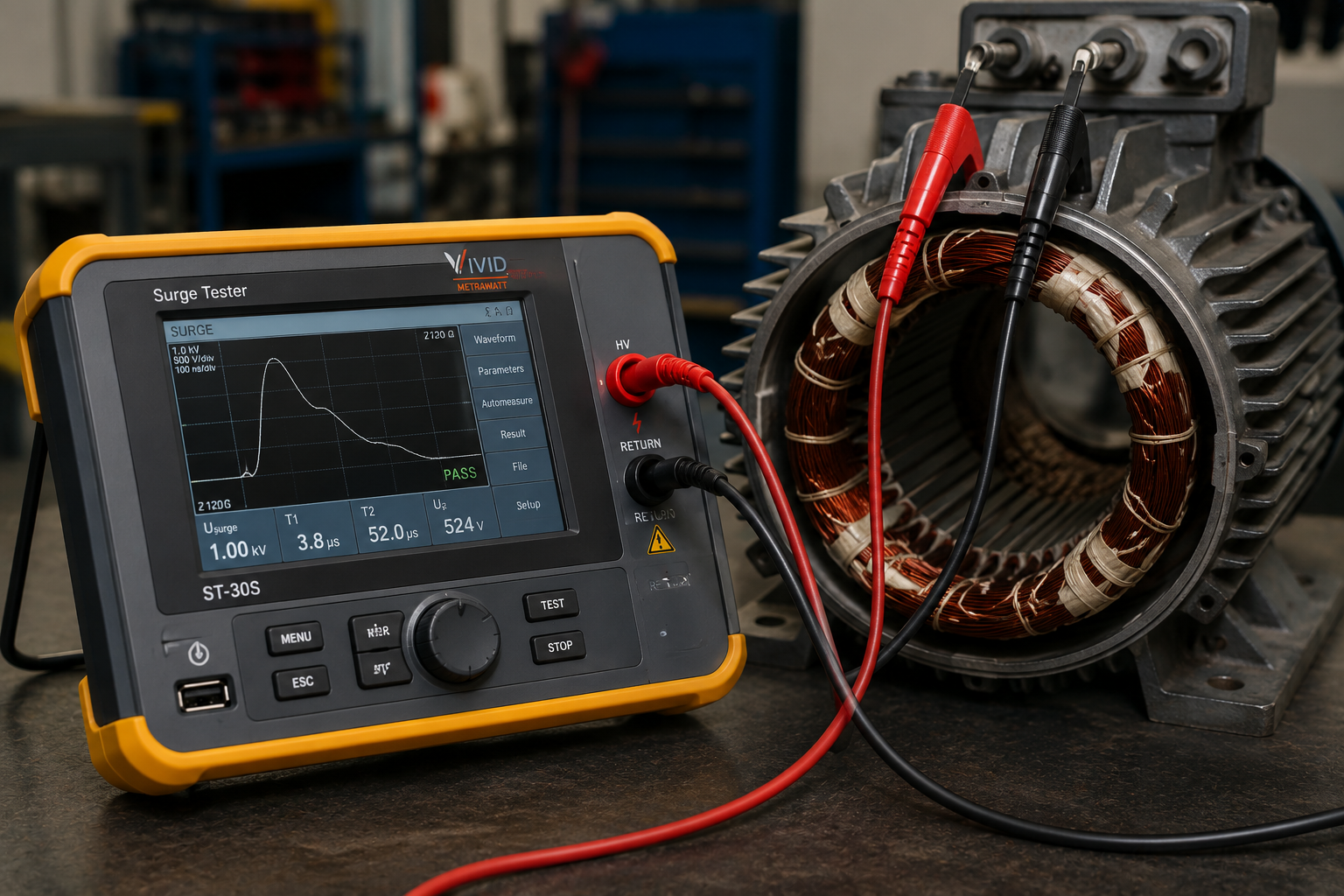
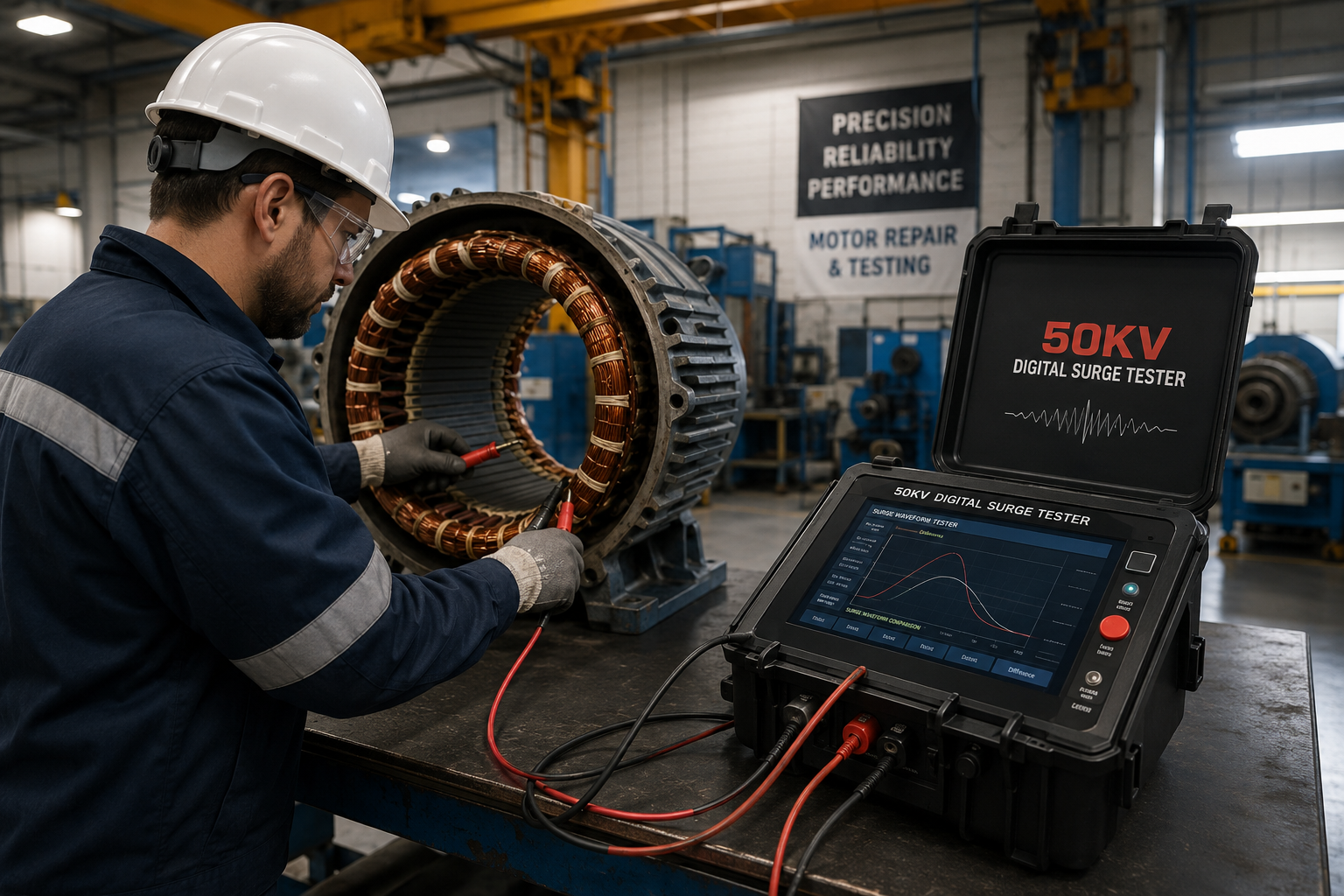
A surge tester is a precision diagnostic instrument that applies a high-voltage impulse to motor windings and compares the resulting waveforms between coils or phases. Any deviation in waveform shape or area indicates an insulation fault — even at a microscopic level.
A 50KV surge tester operates at a peak output voltage of 50,000 volts, making it specifically engineered for:
Understanding how surge generators work is foundational here. The instrument charges a capacitor bank to the set voltage and then discharges it as a controlled high-frequency impulse through the winding under test. The impulse travels through the coil, and a DSP-driven oscilloscope captures the resulting waveform.
When all phases or coil groups are healthy, their waveforms overlap perfectly. When there is a turn-to-turn short, coil-to-coil fault, or ground insulation weakness, the waveform of the affected winding diverges. The difference is quantified using the Error Area Ratio (EAR) — a standardised metric for assessing fault severity.
Key capabilities of a 50KV surge tester include:
If you are new to surge testing fundamentals, read our detailed guide on what is a surge tester before proceeding.
Before a motor fails completely, the winding insulation deteriorates through one or more of these fault types. Surge testing at 50KV is designed to catch all of them:
The most common and most dangerous fault. When the enamel insulation between adjacent turns within the same coil breaks down, current bypasses the turns, causing localised overheating. Standard resistance tests cannot detect this — surge testing can.
Insulation breakdown between two separate coils within the same phase group. Often caused by mechanical damage during winding or by thermal cycling fatigue.
When insulation between two different phases weakens, it creates the risk of an arc flash — one of the most destructive motor failure events. 50KV surge testing can expose this weakness well before arcing occurs.
The winding-to-core insulation weakens due to contamination, moisture, or thermal stress. This is the classic fault detected by a megger test — but surge testing finds weaknesses the megger misses. For a comprehensive comparison, see our guide on the difference between megger and surge test for windings.
Partial conductor breakage in multi-strand windings causes resistance imbalance and localised hot spots. Waveform analysis during surge testing reveals these subtle anomalies.
Understanding these fault types connects directly to the motor winding failure signs that manifest before complete breakdown — making surge testing a critical early warning tool.
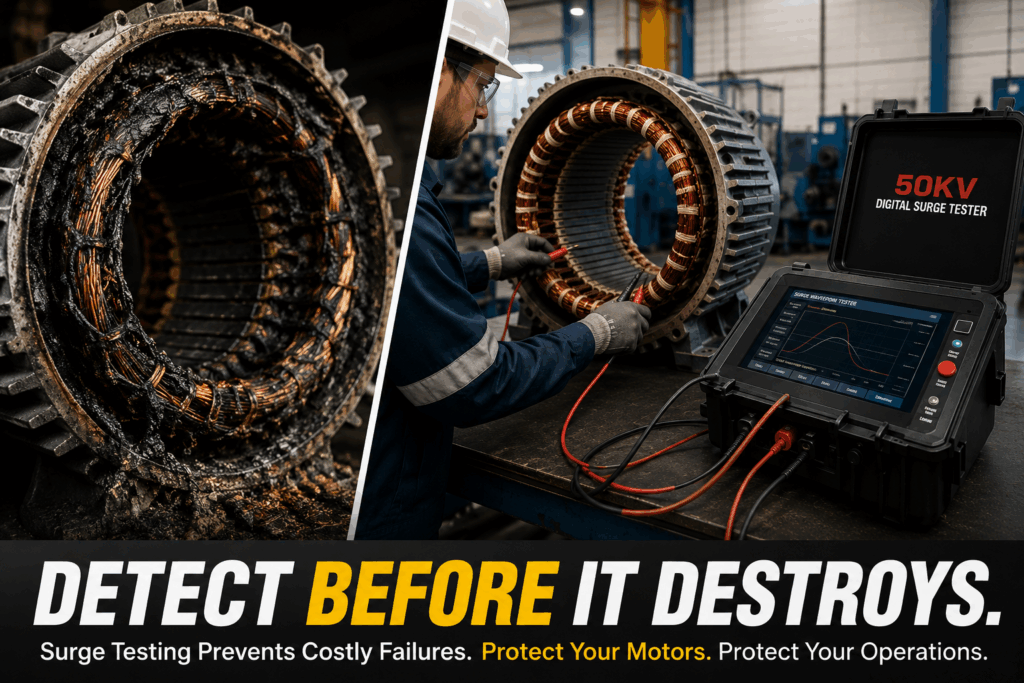
The prevention logic is straightforward: find the fault while the motor is still repairable, not after it has burned.
Here is how systematic surge testing with a 50KV instrument breaks the failure cycle:
During rewind validation: After a motor rewind, surge testing confirms that the new coils are correctly insulated and free from winding defects introduced during rewinding. This is especially critical for high-voltage motors where a single turn short can destroy hours of rewinding work. Read more about surge testing insulation failures to understand the full scope.
During periodic maintenance: Routine surge testing as part of a predictive maintenance schedule creates a baseline waveform for each motor. Future tests are compared against this baseline — any drift indicates developing degradation, even before the motor shows operational symptoms.
Before recommissioning: Motors returning from storage, repair, or transport should always be surge tested before being put back into service. Mechanical handling can introduce winding distortions that are invisible to visual inspection.
Post-fault investigation: After a motor trips on overcurrent or thermal protection, surge testing identifies whether the root cause was a winding fault — allowing maintenance teams to make informed decisions about repair vs replace.
The business case is clear. The cost of a 50KV digital surge tester is recovered within one or two prevented unplanned motor failures. For more context, see how surge testing enhances motor reliability and efficiency across industrial applications.
Performing surge testing on high-voltage motors requires both the right equipment and the correct procedure. Here is a practical workflow:
Perform a megger test to establish baseline insulation resistance. A very low IR value (below 1 MΩ) may indicate the winding is too degraded for safe surge testing at full voltage.
For 50KV surge testing, the test voltage is typically set between 125% to 175% of twice the rated winding voltage. For an 11kV motor, this could mean testing at 25–40kV. Always follow the motor manufacturer’s specification and applicable standards (IEC 60034-15 or IEEE 522).
Connect the high-voltage output leads to the winding terminals. For a 3-phase motor, test each phase pair individually (U-V, V-W, W-U) or use a sequencing function if supported.
Apply the impulse and observe the waveform display. Compare the waveforms of each phase. Use the Error Area Ratio (EAR) value to quantify any deviation. For detailed guidance on waveform interpretation, refer to our guide on waveform analysis in surge testing.
| EAR Value | Interpretation |
|---|---|
| < 5% | Healthy — winding is sound |
| 5%–10% | Marginal — monitor closely, schedule follow-up |
| 10%–15% | Suspect — inspect physically, retest |
| > 15% | Fault confirmed — do not energise |
Save all waveform data and EAR values. A digital surge tester with data logging stores results for historical comparison — essential for trend-based predictive maintenance.
If your facility also uses footswitch-based hands-free testing, our guide on how to use a footswitch for surge testing covers the workflow in detail.
Not every motor requires 50KV testing. The right test voltage depends on the motor’s rated insulation class and operating voltage. Here is how the range breaks down:
| Motor Rated Voltage | Recommended Surge Test Voltage | Suggested Tester Model |
|---|---|---|
| Up to 690V (LV motors) | 2kV – 5kV | VM5K/VM6K Digital Surge Tester |
| 1kV – 3.3kV | 6kV – 10kV | 6KV Digital Surge Tester |
| 3.3kV – 6.6kV | 10kV – 15kV | 10KV–15KV High Power Surge Tester |
| 6.6kV – 11kV | 25kV – 40kV | 25KV–40KV Digital Surge Tester |
| 11kV – 33kV | Up to 50kV | 50KV Digital Surge Tester |
For facilities testing motors across multiple voltage classes, our guide on choosing a surge tester by KV rating provides a comprehensive selection framework.
The 50KV model is not a luxury — for industries operating 11kV and 33kV motors, it is the only instrument capable of stress-testing the insulation at voltages that replicate real operating conditions and transient surge events.
Understanding the difference between surge tester vs hipot tester also clarifies why surge testing provides richer diagnostic information than hi-pot alone for winding faults.
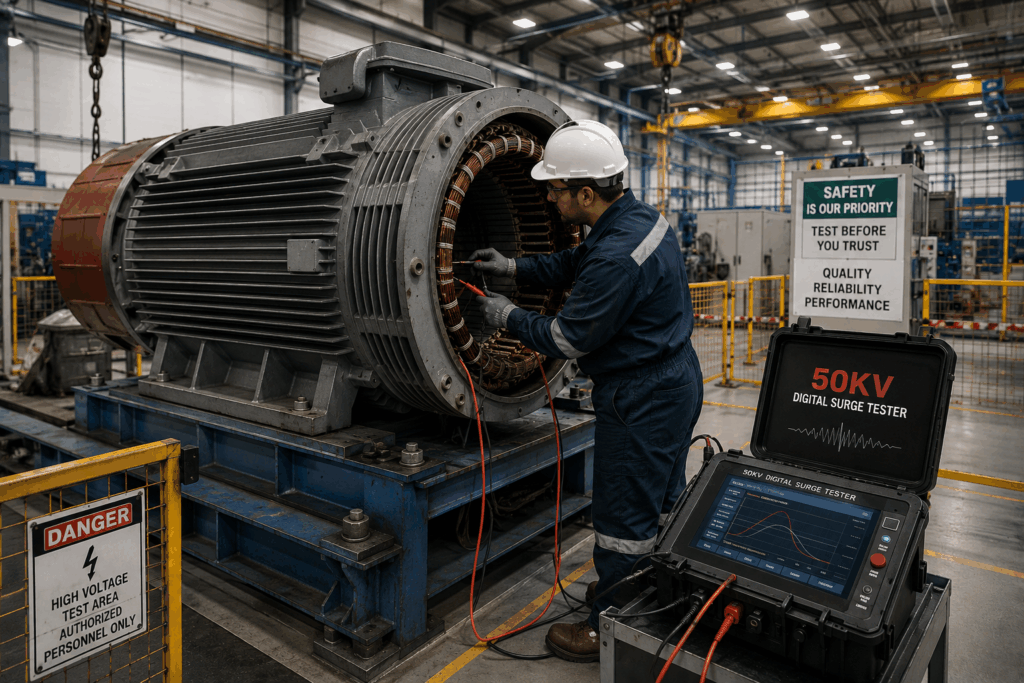
High-voltage surge testing at 50KV is not a niche requirement. Multiple critical industries depend on it for motor reliability:
Generator stator windings in thermal, hydro, and gas turbine plants operate at 11kV–33kV. Surge testing during outage maintenance catches developing insulation faults before the next operating cycle. For more on this, read our guide on generator surge testers.
Submersible pump motors, compressor drives, and critical process motors operate in harsh environments with high thermal stress. 50KV surge testing is essential during periodic shutdown maintenance.
Traction motors in locomotives and metro systems operate at high voltages and experience significant electrical stress. Our guide on EV motor testing covers overlapping principles relevant to traction and drive motor testing.
Large drive motors for mills, crushers, and conveyors often operate at 6.6kV and 11kV. Unplanned failures here cost lakhs per hour in lost production.
Large HVAC drives and pump motors — particularly in district cooling plants and water utilities — benefit from regular high-voltage surge testing. See our dedicated guide on surge testers for HVAC motor testing.
Not all 50KV surge testers are created equal. When evaluating options, focus on these specification-driven features:
1. Voltage Output Range and Resolution The tester should offer fine voltage adjustment — not just broad steps — so you can match the exact test voltage to the motor’s specification without over-stressing the insulation.
2. DSP-Based Waveform Display A high-resolution digital signal processor ensures accurate waveform capture. The display should allow simultaneous overlay of reference and test waveforms for direct comparison.
3. EAR (Error Area Ratio) Calculation Automated EAR calculation removes subjectivity from fault assessment. This is the industry standard quantitative method for fault determination.
4. Data Storage and PC Connectivity Test results, waveform images, and EAR values should be storable on the instrument and exportable via USB or RS-232/RS-485 for integration into maintenance software. Understanding how to maintain and calibrate your digital surge tester is equally important for long-term accuracy.
5. Integrated DC Hi-Pot Testing Models with combined DC Hi-Pot capability (like the 25KV–40KV digital surge tester with DC Hi-Pot) offer both winding fault detection and dielectric strength verification in one instrument. Learn more about what is hipot in digital surge testers to understand how combined testing strengthens your diagnostic protocol.
6. Auto vs Manual Testing Mode For motor rewinding shops testing large volumes, an automatic sequencing mode increases throughput significantly. Read our comparison of manual vs automatic surge testers to determine which mode suits your application.
7. Safety Interlocks and Operator Protection At 50KV, operator safety is non-negotiable. Look for: automatic discharge after test, output enabled indicator lights, interlocked lid/cover sensors, and grounding verification circuits.
Surge testing delivers maximum value when embedded into a structured predictive maintenance (PdM) programme — not used reactively after a motor trips.
Here is a recommended maintenance integration framework:
For facilities managing multiple critical assets, pairing surge testing with electrical signature analysis and automated motor testing systems creates a comprehensive condition monitoring framework that dramatically reduces unplanned failures.
Also consider your testing portfolio: for motors being tested for turn-to-turn faults alongside bar-to-bar checks on DC armatures, the 10KV–15KV digital surge tester with bar-to-bar test complements the 50KV model for broader workshop coverage.
Motors rated above 6.6kV — typically 11kV, 22kV, or 33kV machines — require surge testing at voltages up to 50KV to adequately stress the insulation system. For lower-voltage motors, models rated at 10–15KV or 25–40KV are more appropriate.
Not typically. Over-testing an LV motor with 50KV can itself damage the insulation. Always select the test voltage based on the motor’s rated operating voltage and relevant standards (IEC 60034-15, IEEE 522).
A hi-pot test checks the ability of insulation to withstand a sustained high voltage — it is primarily a pass/fail dielectric test. A surge test detects turn-to-turn and inter-coil faults that a hi-pot cannot find. For a detailed comparison, read surge tester vs hipot tester.
Industry best practice recommends annual surge testing as part of planned maintenance, plus testing after any repair, rewind, or unusual fault event.
An EAR above 10–15% typically indicates a confirmed winding fault — either a turn-to-turn short, coil damage, or phase insulation breakdown. The motor should not be energised until the fault is investigated and rectified.
Yes — when conducted using an instrument with proper safety interlocks, PPE, and following isolation procedures. The discharge duration is extremely short (microseconds), and modern testers include automatic discharge circuits and output safety controls.
Surge testing is not designed as a primary partial discharge (PD) measurement tool, but severe PD activity correlates with waveform distortions detectable during surge testing. For dedicated PD measurement, see our partial discharge testing guide.
Motor failures in high-voltage applications are never truly sudden — they are the end result of insulation degradation that builds silently over months or years. The tragedy is that this degradation is entirely detectable with the right instrument.
A 50KV digital surge tester is not optional equipment for facilities operating 6.6kV, 11kV, or 33kV motors — it is the single most effective diagnostic tool available to prevent catastrophic winding failures, costly unplanned downtime, and premature motor replacement.
The investment calculates simply: one prevented motor failure in a critical application recovers the full cost of the instrument and then some. More importantly, it keeps your operations running, your team safe, and your maintenance programme positioned as a proactive rather than reactive function.
If you are ready to evaluate the right high-voltage surge testing solution for your facility, Vivid Metrawatt’s 50KV digital surge tester is engineered precisely for this purpose — combining precision waveform analysis, EAR quantification, and robust data management in a single professional instrument.
Don’t wait for the next unplanned shutdown to take action.
Vivid Metrawatt’s 50KV Digital Surge Tester is built for industrial professionals who demand precision, reliability, and actionable diagnostics—every test, every time.