

Motor insulation does not fail overnight. It degrades gradually — attacked by heat, moisture, vibration, electrical stress, and chemical contamination — over months and years. The insulation that was perfectly healthy at your last scheduled test may be dangerously compromised six months later.
Test too rarely and you miss the degradation window before catastrophic failure. Test too often and you risk introducing mechanical stress, wasting labour, and creating unnecessary downtime. The optimal testing frequency is the one that catches developing faults early — without over-burdening your maintenance team.
For context on how insulation failures develop, read: Motor Winding Failure Signs You Should Not Ignore
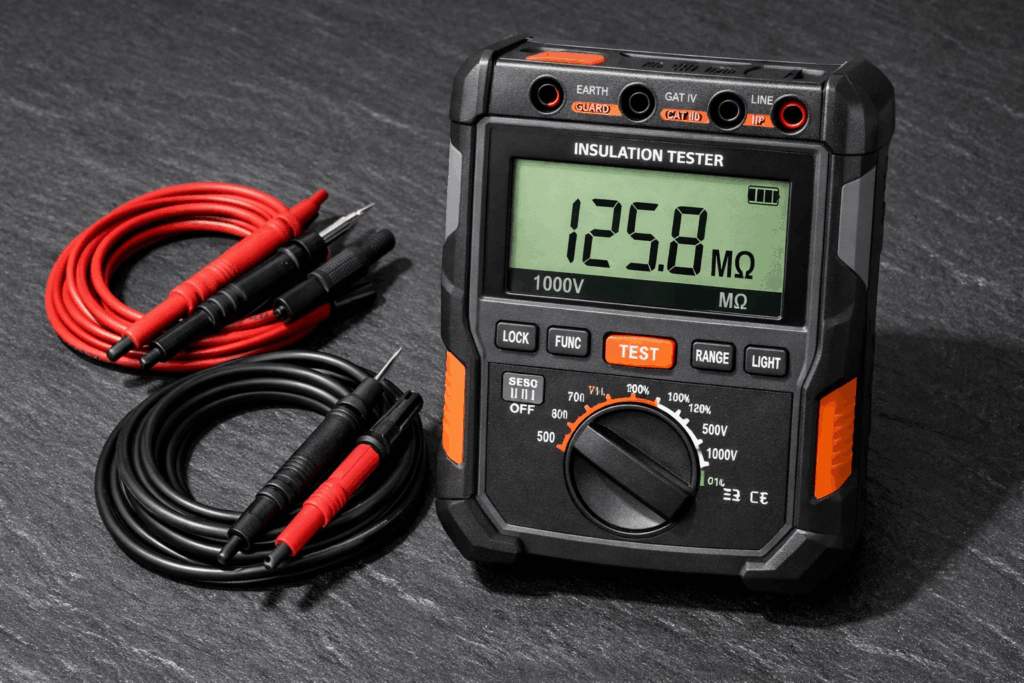
Insulation Resistance (IR / Megger) Test
The most fundamental insulation test. A DC voltage (typically 500V, 1000V, or 2500V depending on motor rating) is applied between the winding and ground, and the resulting resistance is measured in MΩ or GΩ. Values below 1 MΩ per kV of rated voltage (IEEE 43) indicate serious degradation.
Master the full procedure: What Is a Megger Test and How to Perform It?
Polarisation Index (PI) Test
An extension of the IR test — comparing the insulation resistance at 1 minute versus 10 minutes. A PI below 2.0 signals moisture contamination or insulation breakdown. This test takes slightly longer but provides far more information about insulation condition.
Surge (Impulse) Test
A high-voltage impulse is applied to the winding, and the resulting oscillating waveform is compared between phases. Any asymmetry indicates turn-to-turn or coil-to-coil insulation failure — defects that IR testing cannot detect.
Understand surge vs megger testing: Difference Between Megger and Surge Test for Windings
For waveform interpretation guidance: Waveform Analysis in Surge Testing
Hipot (High-Potential) Test
A sustained high voltage (AC or DC) is applied between the winding and ground to verify that insulation can withstand overvoltage conditions without breakdown. Primarily used post-rewind and post-repair.
AC vs DC hipot — which should you use? AC Hipot vs DC Hipot Testing Explained
Full guide: What Is Hipot Testing in a Digital Surge Tester?
Major standards organisations publish guidance on testing frequency. The table below summarises key recommendations:
| Test Type | IEEE 43 / NEMA MG1 | IEC 60034 | Vivid Metrawatt Recommendation |
| Insulation Resistance (IR) | Annually (minimum) | Annually | Every 3-6 months for critical motors |
| Polarisation Index (PI) | Annually | Annually | Annually or before return to service |
| Surge / Impulse Test | Post-repair / annually | Post-repair | Annually + after any winding work |
| Hipot Test | Post-rewind only | Post-rewind | Post-rewind and after major repairs |
| Winding Resistance | Annually | Annually | Every 6 months for high-duty motors |
Key Takeaway:
Standards set minimum intervals. Your actual environment, duty cycle, and motor criticality will almost always demand more frequent testing than the standard minimum.
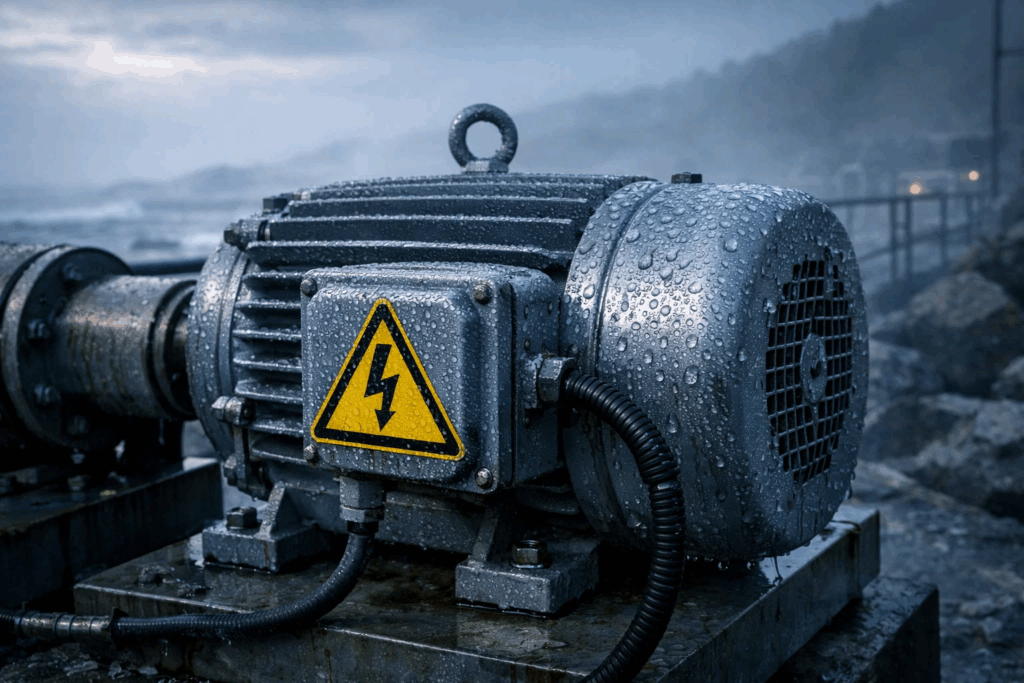
The following conditions should prompt you to test more often than the standard minimum:
If your motors operate on VFDs, see: Surge Tester Insulation Failures — Causes and Solutions
Critical Process Motors (pumps, compressors, fans on continuous duty)
General-Purpose Motors (moderate duty, redundancy available)
Standby / Spare Motors (rarely operated)
High-Voltage Motors (above 3.3 kV)
For high-voltage surge testing guidance: How to Choose a 50kV Surge Tester
Understanding partial discharge: Partial Discharge Testing — A Complete Guide
A realistic motor testing schedule balances thoroughness with practical resource constraints. Here is a proven framework for a mid-size industrial facility:
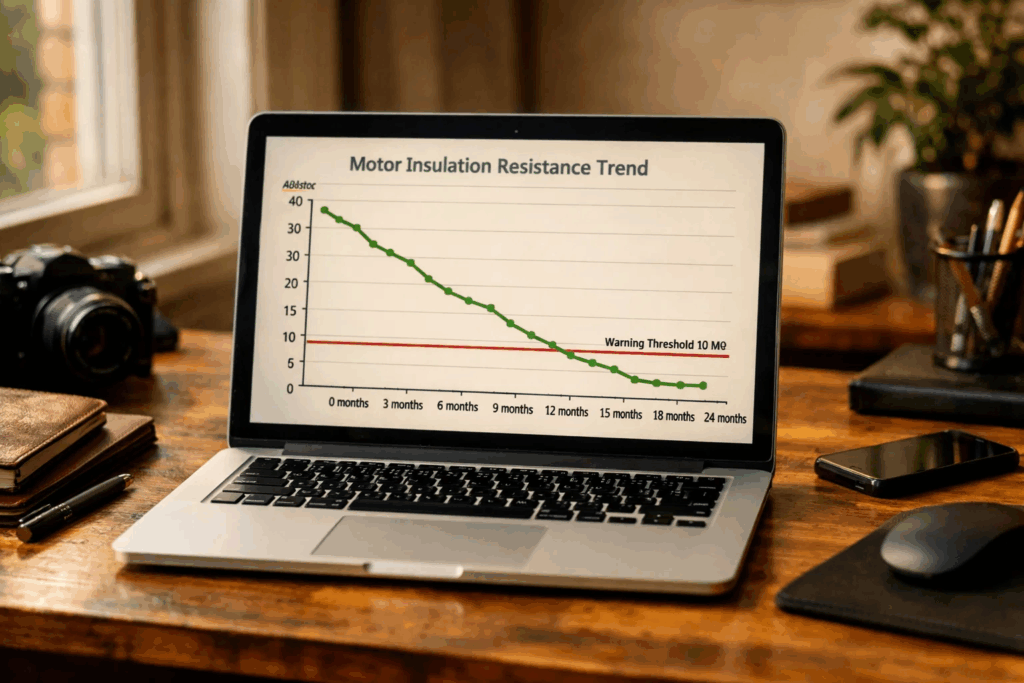
Trending is Everything:
A single IR value tells you where a motor is today. Trend data tells you where it will be in 6 months. Always record, store, and compare results over time.
Learn how to maintain accurate test records: How to Maintain and Calibrate Your Digital Surge Tester
See common electrical testing mistakes to avoid: Troubleshooting Common Electrical Testing Errors
Best Practice:
Follow a risk-based approach — test more frequently when condition or environment demands it, and less frequently when motors are proven stable and operating in benign conditions.
Having the right instrument makes your testing programme faster, safer, and more accurate.
For low-voltage motor testing (up to 6kV): VM5K/VM6K Digital Surge Tester
For medium-voltage motors (10–15kV): 10kV–15kV Digital Surge Tester with HiPot
For high-voltage motors and transformers: 25kV–40kV Digital Surge Tester
For the most demanding HV applications: 50kV Digital Surge Tester
For three-phase motor winding testing procedures: How to Check Windings on a 3-Phase Motor
For single-phase motor testing: How to Test Windings on a Single-Phase Motor
At a minimum, annual insulation resistance (Megger) and surge testing for general-purpose motors, per IEEE 43 and IEC 60034. Critical motors in harsh environments should be tested every 3–6 months. Standby motors should also be tested every 3–6 months due to moisture susceptibility during idle periods.
IEEE 43 recommends a minimum insulation resistance of 1 MΩ per kV of rated voltage plus 1 MΩ as a baseline. A motor rated at 400V should have a minimum IR of approximately 1.4 MΩ, though values well above 100 MΩ are typical for healthy windings.
The PI is the ratio of the 10-minute insulation resistance reading to the 1-minute reading. A PI of 2.0 or above is generally considered acceptable. Values below 2.0 indicate moisture contamination or significant insulation degradation. Values above 4.0 indicate excellent insulation condition.
Surge testing at the correct voltage level for the motor’s rating has minimal cumulative impact on insulation. However, hipot testing should be limited — repeated dielectric withstand tests at full voltage accelerate ground wall insulation ageing and should be performed only once per maintenance cycle.
More frequently. Standby motors are highly vulnerable to moisture ingress and surface contamination because they are not generating internal heat that normally keeps windings dry. Test standby motor insulation every 3–6 months regardless of how rarely they are operated.
Significantly. Motor insulation life roughly halves for every 10°C rise above its rated temperature class — known as the Arrhenius Rule. Motors running above their rated temperature class should be tested more frequently and monitored for insulation resistance trends.
variable-frequency drives generate high-frequency voltage spikes that are far more damaging to turn-to-turn insulation than sinusoidal supply voltage. Motors connected to variable-frequency drives should be surge tested at least annually, and insulation resistance tested every 6 months.
A single IR reading tells you the motor’s insulation condition at that moment. Trend analysis — comparing IR values taken at regular intervals over months or years — tells you whether insulation is stable, slowly degrading, or rapidly deteriorating. Trending is far more valuable for maintenance decision-making.
IEEE 43 recommends investigating any motor whose IR falls below 1 MΩ per kV of rated voltage. Many maintenance teams use 10 MΩ as an action threshold for further testing and monitoring, and 1 MΩ as the absolute minimum before the motor is removed from service.
Yes — always. A baseline surge and IR test before rewind documents the pre-repair condition. A full test after rewind (IR, PI, surge, and hipot) verifies the quality of the rewind work before the motor is returned to service.
There is no universal answer to how often you should test motor insulation — because no two motors operate in identical conditions. What is certain is this: testing too rarely is always more expensive than testing too often, because a single unplanned failure will cost more than years of scheduled testing.
Use the frameworks in this guide to build a tiered testing schedule tailored to your motors’ criticality and operating environment. Pair it with quality instrumentation, disciplined trend tracking, and you will extend motor life, reduce energy waste, and eliminate unplanned downtime.
Contact the Vivid Metrawatt team for expert advice on test instruments, testing protocols, and maintenance planning.
→ Get in Touch
See all available instruments: Digital Surge Tester Range
Browse all resources and guides: Vivid Metrawatt Resources