

An unplanned motor failure on a high-speed production line can cost between $6,000–$60,000 (or local currency equivalent) per incident when you add up lost output, emergency labour, expedited parts, and restarting procedures. Despite this, maintenance teams the world over still debate a fundamental question: should you test motors on a fixed calendar (preventive), or only when real-time condition data signals a problem (predictive)?
The answer is not simply one or the other — but understanding the trade-offs is the first step toward building a maintenance programme that genuinely protects both your equipment and your budget.
For a detailed overview of condition-based approaches, see our guide on Predictive Maintenance for Industrial Motors.
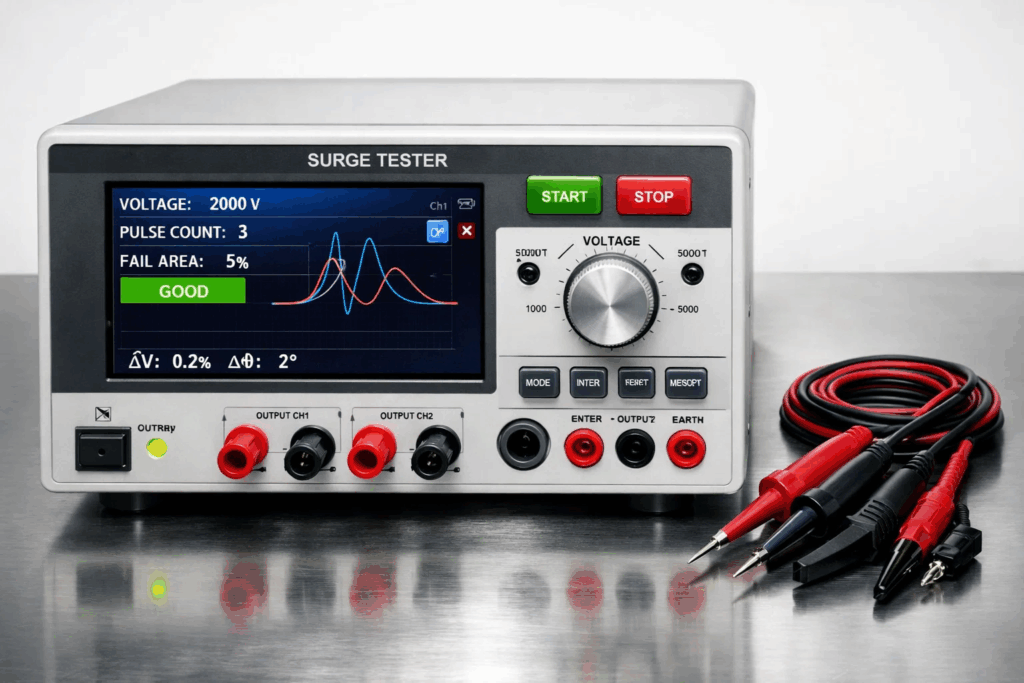
Preventive motor testing — sometimes called time-based maintenance — involves performing standardised electrical and mechanical checks on a fixed schedule, regardless of whether the motor shows any symptoms. Intervals are typically quarterly, semi-annual, or annual depending on duty cycle and criticality.
Typical Preventive Tests
Learn how IR testing works in our full Megger test guide: What Is a Megger Test and How to Perform It?
For turn-to-turn insulation checks, explore our page on the Digital Surge Tester, which combines surge, hipot, and IR modes in a single instrument.
Advantages of Preventive Testing
Limitations of Preventive Testing
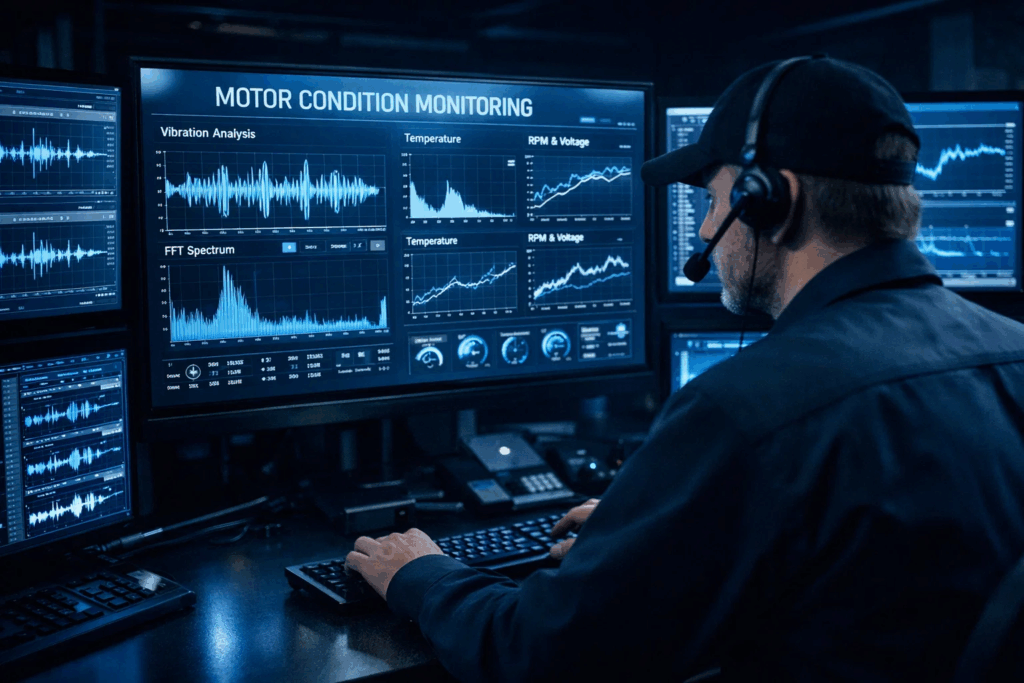
Predictive motor testing — also called condition-based maintenance (CBM) — uses real-time or trending data to determine when a motor actually needs attention. Tests are only performed when parameters cross defined thresholds, dramatically reducing unnecessary interventions.
Typical Predictive Technologies
Understand Motor Circuit Analysis in depth: What Is Motor Circuit Analysis?
See how electrical signature analysis complements predictive maintenance: Electrical Signature Analysis Explained
Advantages of Predictive Testing
Limitations of Predictive Testing
| Criterion | Preventive Testing | Predictive Testing |
| Cost (Upfront) | Low — uses existing test instruments | Moderate to High — monitoring hardware required |
| Cost (Long-term) | Higher — unnecessary tests accumulate | Lower — fewer unneeded interventions |
| Downtime | Scheduled downtime for every test cycle | Minimal — tests triggered by condition |
| Fault Detection Speed | Depends on interval (may miss fast faults) | Near real-time for monitored parameters |
| Best For | Critical motors, post-repair validation | Large fleets, continuous-process industries |
| Skill Requirement | Moderate — standard test procedures | Higher — data interpretation expertise needed |
| Compliance Support | Strong — aligns with IEEE/IEC standards | Emerging — standards still evolving |
Preventive Testing Works Best In:
See how surge testing applies to railways: Ultimate Guide to Surge Testing for Indian Railways
Predictive Testing Works Best In:

The most effective motor maintenance programmes use both approaches together. Predictive monitoring runs continuously, flagging motors whose condition is trending downward. When a threshold is crossed, the motor is pulled for a full suite of preventive offline tests — surge testing, Megger IR, and winding resistance — before being returned to service or sent for repair.
Pro Tip:
Use predictive data to intelligently schedule preventive tests. Rather than testing all 200 motors in your plant every six months, focus offline testing resources on the 15–20 motors that condition monitoring has flagged as at-risk. This single change typically reduces total testing labour by 40–60%.
Explore how automated systems support both strategies: Automated Motor Testing Systems
Whether you follow a preventive or predictive programme, the digital surge tester remains the most powerful offline diagnostic instrument available for motor windings. It is the only tool that can conclusively identify turn-to-turn insulation weaknesses — a failure mode that neither IR testing nor online monitoring can reliably detect.
Compare surge vs hipot to understand each tool’s role: Surge Tester vs Hipot Tester — Key Differences
Not sure which surge tester suits your application? Read: Choosing the Right Surge Tester for Your Needs
View Vivid Metrawatt’s full range of instruments on the Digital Surge Tester product page.
Ask yourself the following questions:
For NEMA vs IEC standards compliance guidance, read: NEMA vs IEC Motor Standards — Key Differences
Preventive motor testing follows a fixed schedule — motors are tested at set intervals regardless of their condition. Predictive motor testing is condition-driven — tests are only performed when real-time or trend data signals that a motor needs attention. Preventive is simpler to implement; predictive delivers higher long-term ROI for large fleets.
For large motor fleets in continuous-process industries, predictive maintenance typically saves more money over time by eliminating unnecessary interventions. For smaller fleets of critical motors or post-repair validation, preventive testing delivers more predictable and manageable costs.
Yes — and this hybrid approach is widely considered the most effective. Predictive monitoring flags at-risk motors continuously, and preventive offline tests (surge, Megger IR, winding resistance) are then applied selectively to those motors, significantly reducing wasted testing labour.
Industry standards such as IEEE 43 and IEC 60034 recommend annual testing as a minimum. Critical motors in harsh environments — high humidity, elevated temperatures, or VFD-driven applications — should be tested every 3–6 months.
A comprehensive preventive programme includes insulation resistance (Megger/IR) testing, polarisation index (PI) testing, surge (impulse) winding testing, hipot (dielectric withstand) testing, winding resistance measurement, and visual inspection.
Predictive motor testing is also called condition-based maintenance (CBM), condition monitoring, or reliability-centred maintenance (RCM). Technologies used include Motor Circuit Analysis (MCA), Electrical Signature Analysis (ESA), vibration analysis, thermography, and partial discharge monitoring.
Both. In preventive programmes, digital surge testers perform scheduled winding integrity checks. In predictive programmes, they confirm and characterise faults identified by online monitoring systems before a motor is returned to service or sent for repair.
Continuous-process industries — petrochemical plants, paper mills, food and beverage facilities, data centres, and wind energy operations — benefit most from predictive testing because unplanned downtime in these environments is extremely costly.
Fast-developing faults — such as turn-to-turn insulation failures caused by VFD voltage spikes or sudden moisture ingress — can occur between scheduled test intervals and go undetected until catastrophic winding failure.
Consider four factors: the size of your motor fleet, the cost of unplanned downtime, your team’s expertise in data interpretation, and the accessibility of your motors for offline testing. Large fleets with high downtime costs favour predictive; smaller critical fleets with compliance requirements favour preventive.
There is no universally superior strategy. Preventive motor testing delivers structured, compliance-backed assurance with lower upfront investment. Predictive testing delivers higher long-term ROI for large fleets and critical assets. The most cost-effective maintenance programmes intelligently blend both — using condition data to focus offline testing resources exactly where they are needed most.
Whatever your strategy, the quality of your test instruments determines the quality of your decisions. A precise, reliable digital surge tester is the cornerstone of any serious motor maintenance programme.
Explore Vivid Metrawatt’s range of digital surge testers — engineered for precision, built for industry.
→ View Digital Surge Testers
Have questions? Contact our technical team: Reach Us
Browse all motor testing resources: Vivid Metrawatt Blog