
Choosing the wrong kVA bearing heater is one of the most common — and most avoidable — procurement mistakes in industrial maintenance. Undersize, and your heating cycle is slow, uneven, and frustrating: the bearing reaches the outer surface temperature but the bore hasn’t expanded enough, the window for mounting closes faster than expected, and the job has to restart. Oversize, and you are paying for capacity your workshop never uses — and moving a 300 kg floor-mounted unit around a repair shop when a 5 kg portable model would have done the job. The right kVA is the one matched to your bearing weight. This guide provides the complete Vivid Metrawatt bearing heater size chart — from 3.5 kVA for small bearings to 40 kVA for components up to 700 kg — with the decision logic, confirmed specifications, and application context to make the right call before you enquire.
Table of Contents
A bearing induction heater works by inducing eddy currents inside the bearing steel through an alternating electromagnetic field. Those eddy currents flow against the steel’s electrical resistance and generate heat from within the material. The rate at which heat is generated — and therefore how quickly the bearing reaches its target temperature — is directly proportional to the power delivered by the generator: its kVA rating.
This means kVA determines two things simultaneously:
The practical rule: match the kVA to the heaviest bearing you regularly work with. If that bearing is 40 kg, the 6/8 kVA model is correct. If it is 400 kg, you need the 25/40 kVA model. Choosing one model up from your maximum regular requirement gives useful headroom without overspending on capacity you will never use.
Key principle: All four Vivid Metrawatt bearing heater models use the same microcontroller-based intelligent electronic controls and offer the same Temperature mode and Time mode operation. What changes between models is power output and physical capacity — the control interface and user experience are consistent across the range.
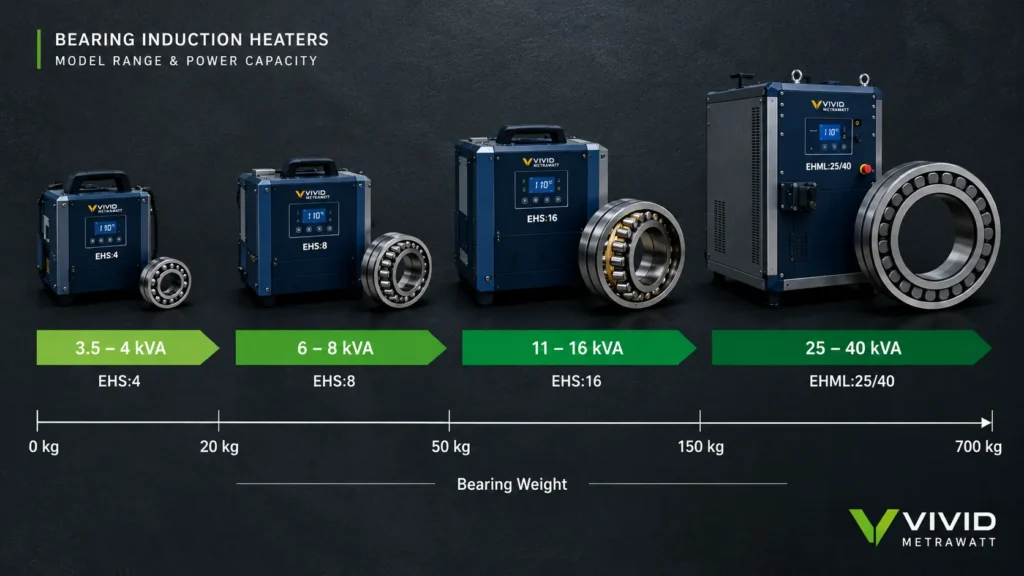
Use this chart as your primary selection reference. Find your bearing weight in the left column and read across to the confirmed Vivid Metrawatt model.
| Bearing Weight | kVA Rating | Model | Machine Weight | Yoke / Support Size | Best Suited To |
|---|---|---|---|---|---|
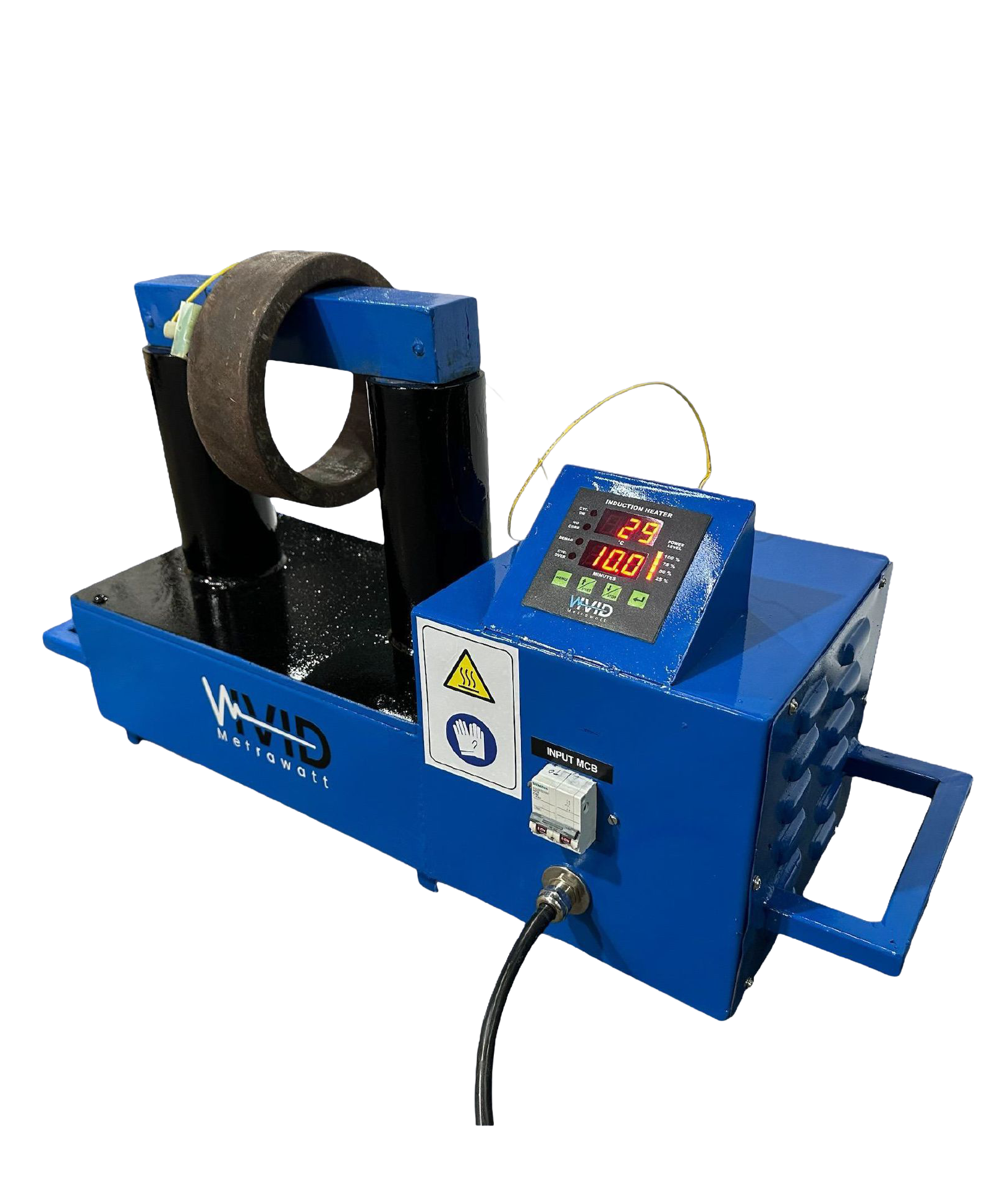
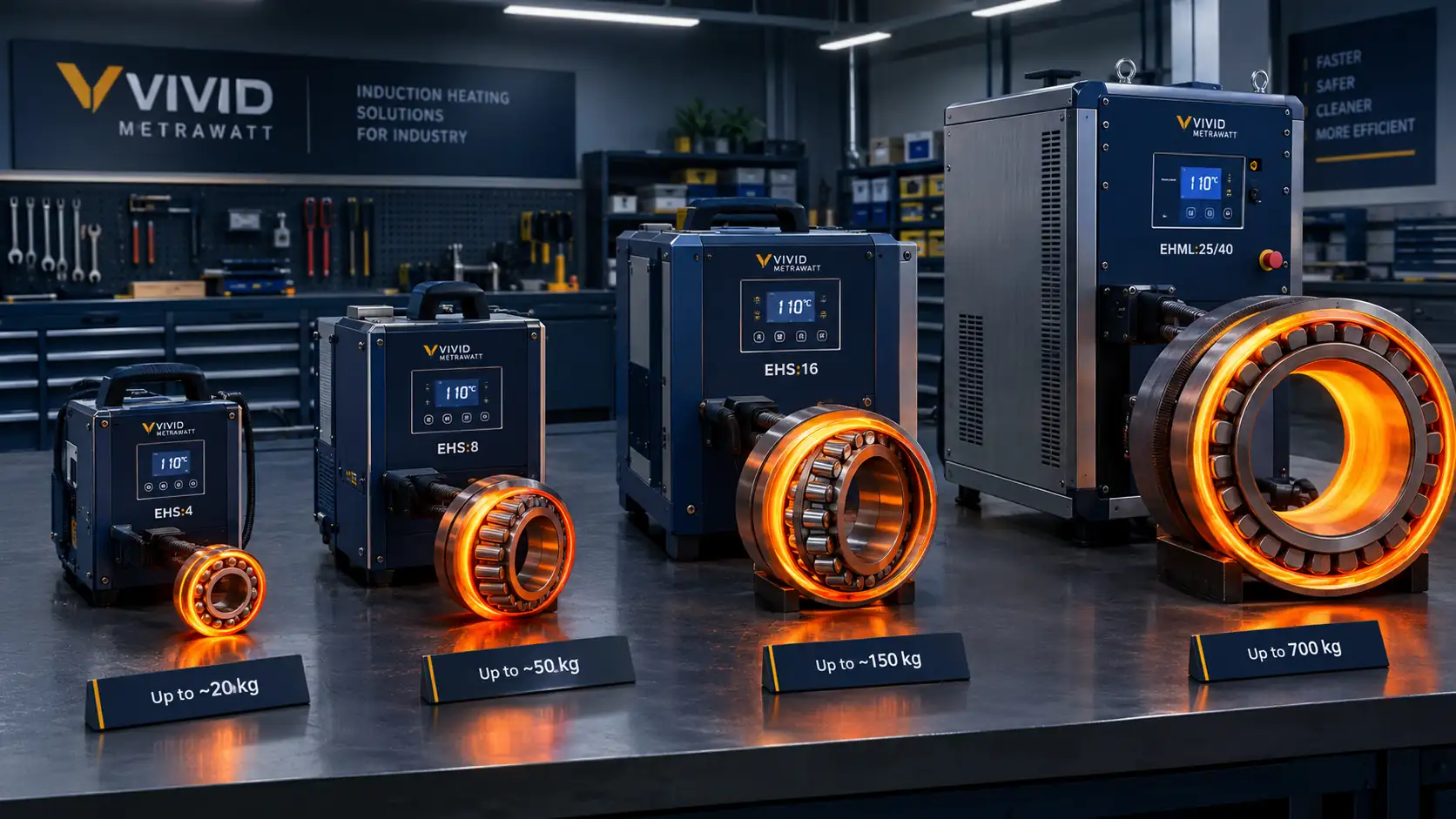
| Up to ~20 kg | 3.5 / 4.0 kVA | EHS/EHSU:4 | Lightweight & portable | Raiser Blocks 55×55×125 mm | Small bearings; field maintenance; multi-machine workshops; portable use |
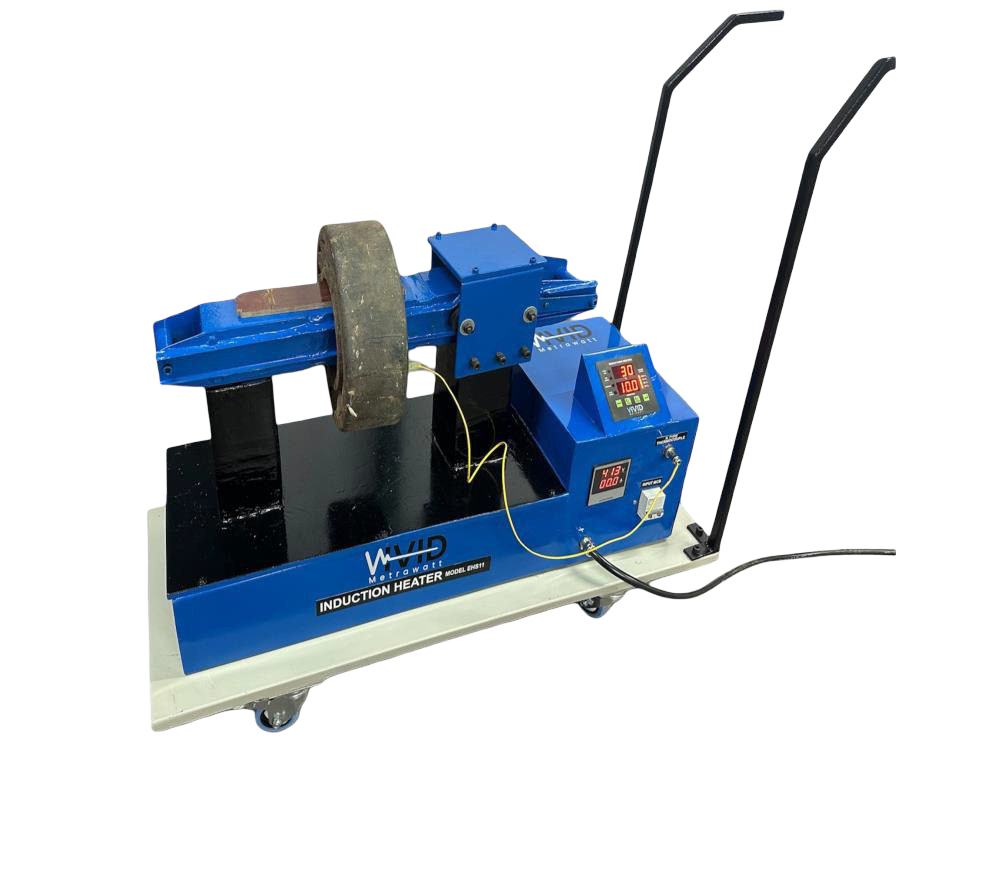
| 20 kg – 50 kg | 6 / 8 kVA | EHS/EHSU:8 | ~86 kg | Roll-sliding yoke 80×80×490 mm | General industrial workshop; pump, motor, gearbox bearing maintenance |
| 50 kg – 150 kg | 11 / 16 kVA | EHS/EHSU:16 | ~86 kg | Roll-sliding yoke 80×80×490 mm | Heavy equipment maintenance; steel plants; railways; power plant bearings |
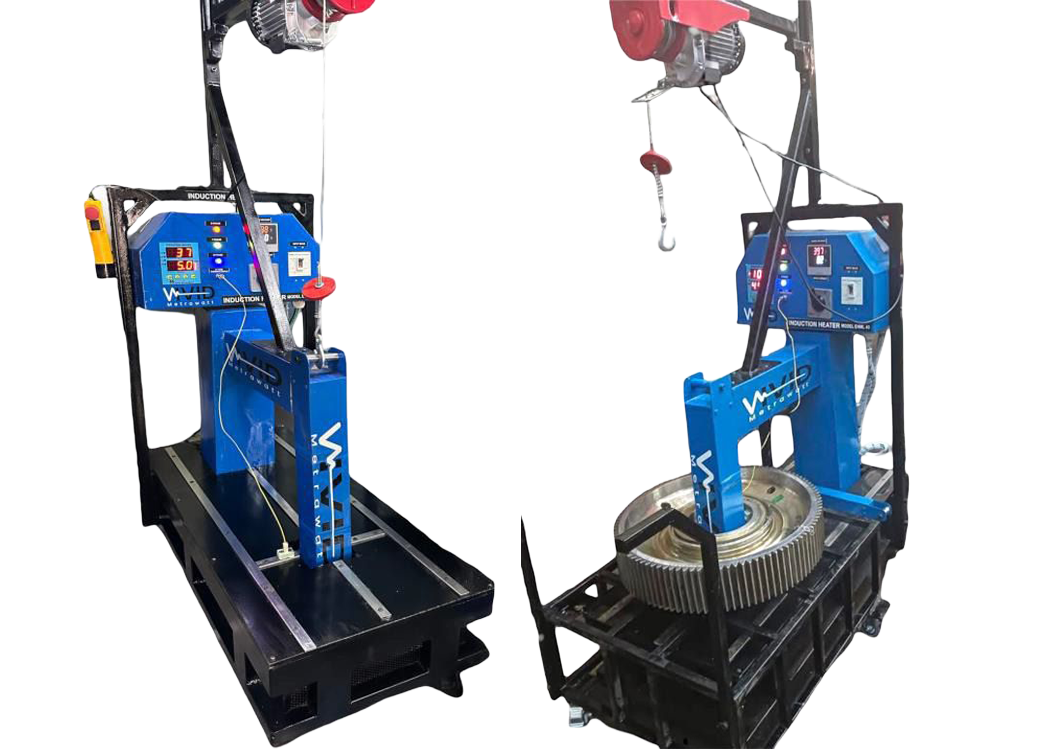
| 150 kg – 700 kg | 25 / 40 kVA | EHML:25/40 | ~300 kg | Roll-sliding yoke 105×105×590 mm | Mill roll shop; cement kilns; wind turbine main bearings; large mining bearings |
Selection tip from Vivid Metrawatt: Match the model to your largest regularly-used bearing. If you work with a wide range of bearing sizes, the EHML:25/40 gives the most flexibility — it covers the full spectrum from small to 700 kg. For applications above 700 kg or with non-standard requirements, contact the Vivid Metrawatt team for a custom solution.
Product page: EHS/EHSU:4 Induction Heater
The EHS/EHSU:4 is Vivid Metrawatt’s entry-level, portable bearing heater — designed specifically for small bearings and for maintenance environments where the technician moves between machines rather than working at a fixed bench. Its lightweight construction is the primary design priority: a maintenance engineer can carry it to the machine, heat the bearing on-site, mount it, and move to the next job without returning to a workshop.
The EHS/EHSU:4 (and all other models in the range) offers two confirmed operating modes:
Product page: EHS/EHSU:8 Induction Heater
The EHS/EHSU:8 is the general-purpose mid-range bearing heater for industrial workshops handling medium-weight bearings on pumps, motors, fans, compressors, and general mechanical equipment. Its 6/8 kVA power rating and ~86 kg machine weight make it a workshop-resident unit rather than a portable carry tool — it stays at the maintenance bench and the bearings come to it.
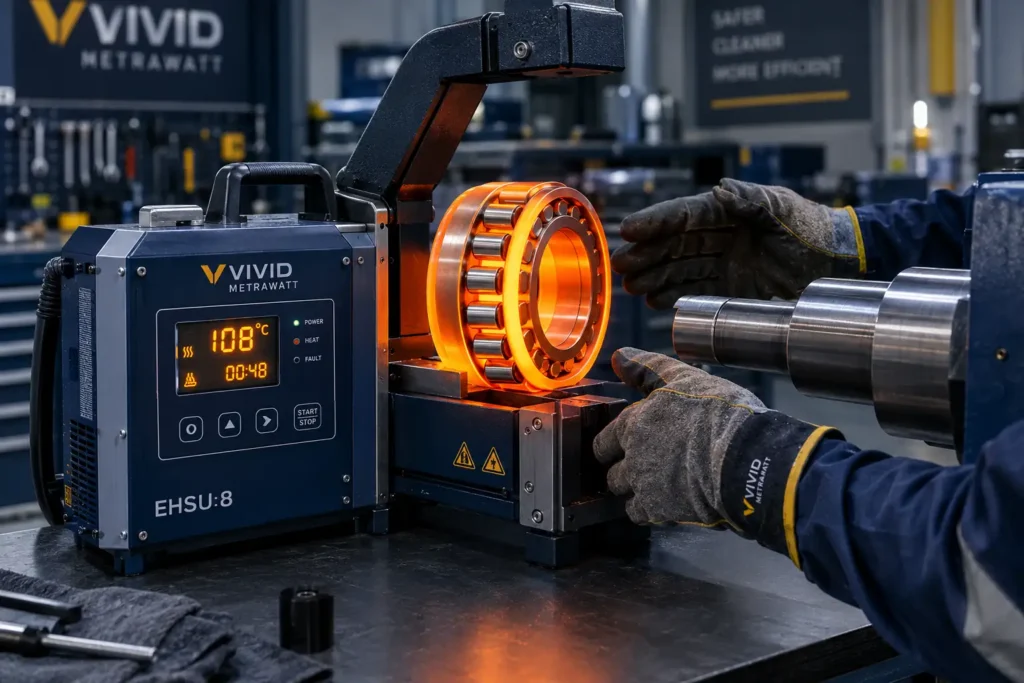
The EHS/EHSU:8 introduces the confirmed Roll-Sliding Arrangement — a yoke handling system designed to lift the yoke mechanically or roll it off the vertical supports automatically, without rubbing, damaging, or scraping the mating surfaces. This arrangement is available in manual or automated form. Its purpose is threefold:
Product page: EHS/EHSU:16 Induction Heater (16 kVA)
The EHS/EHSU:16 occupies the same physical frame as the EHS:8 — same ~86 kg machine weight, same 80×80×490 mm yoke — but delivers significantly higher power at 11/16 kVA. This higher power output means faster heating cycles on the same bearing weight, or the ability to heat heavier bearings (up to approximately 150 kg per the category page) that the 6/8 kVA model handles too slowly for efficient workshop throughput. It is the right choice for heavy equipment maintenance environments where large bearings are the norm and cycle time per bearing directly affects workshop output.
Both models share the same physical form factor (~86 kg, same yoke) and the same control interface. The decision is purely about power and capacity ceiling:
Product page: EHML:25/40 Induction Heater
The EHML:25/40 is a fundamentally different class of bearing heater from the EHS series. At ~300 kg machine weight and 25/40 kVA power output, it is a permanent floor installation designed for the heaviest bearing applications in any industry — mill roll bearings, kiln support bearings, main shaft bearings on large wind turbines, and large mining equipment drive bearings. It can heat a bearing of 700 kg to temperature as per requirement in customised time — confirmed on the product page. No other model in the Vivid Metrawatt bearing heater range approaches this capacity.
The EHML’s yoke is 105×105×590 mm — significantly larger than the EHS series’ 80×80×490 mm. This larger cross-section carries higher magnetic flux, delivering more energy to large-bore, heavy-mass bearings. The longer 590 mm span accommodates the larger bore diameters of bearings in the 150–700 kg weight range — typically large spherical roller bearings, tapered roller bearings, and cylindrical roller bearings used in steel mill, cement plant, and large rotating machinery applications.
The EHML:25/40 represents the top of the standard product range at 700 kg bearing capacity. For applications above this — extremely large industrial bearings in power plant turbines, the largest blast furnace and rolling mill equipment, or specialised applications where standard yoke geometry does not suit the component — Vivid Metrawatt offers custom induction heating solutions. Contact the team with the bearing’s weight, bore diameter, and application to discuss options.
Bearing weight is the primary selection variable, but four other factors can shift the decision — occasionally pushing you up to the next model, or confirming that the lighter model is adequate.
The bore diameter of the bearing determines whether it fits on the heater’s yoke. The EHS series yoke is 80×80×490 mm — this accommodates standard bore sizes up to the bearing sizes in the 50–150 kg range. The EHML’s 105×105×590 mm yoke handles the larger bores of heavy industrial bearings. If you have a bearing that is lighter than 150 kg but has an unusually large bore diameter, check the yoke span against the bore before ordering. The EHS:4 also confirms the availability of Raiser Blocks (55×55×125 mm) for heating bearings of larger diameter on the smaller unit.
If you are heating the same bearing size repeatedly in a production or high-volume maintenance context — multiple bearings per shift — cycle time matters as much as capacity. A higher kVA model heats the same bearing faster, reducing the time between cycles and improving throughput. If you heat one bearing per day, cycle time is not a constraint; if you heat twenty bearings per shift, upgrading from 8 kVA to 16 kVA can meaningfully improve productivity on the same component size.
The EHS:4 is explicitly described as lightweight and portable — confirmed for carrying to the machine. The EHS:8 and EHS:16 at ~86 kg are workshop-resident units that move on castors if at all. The EHML:25/40 at ~300 kg is a floor-mounted installation. If your application requires the heater to be transported between machines, locations, or floors, the EHS:4 is the only genuinely portable option in the bearing heater range. For larger bearings requiring portability, the MF Quick-Heater range (EHF-22/33/44 with flexible inductors) provides an alternative that covers heavier components in a mobile format.
The EHS/EHSU:16 confirms reprogrammable data storage up to 999 entries — the ability to store pre-validated heating programmes for recurring bearing types and recall them by number. For a production environment where 50 different bearing part numbers are regularly processed and each has a validated target temperature and hold time, this storage capacity is operationally significant. For a small repair shop that heats a small range of bearing types, the simpler controls of the EHS:4 or EHS:8 are entirely sufficient.
Decision summary: Lead with bearing weight. Then ask: what is the bore diameter? What is my cycle frequency? Do I need portability? Do I need programme storage? If any of these factors push you toward the next model up, choose the next model. If they all align with your primary weight band, the chart selection is confirmed.
| Industry | Typical Bearing Weight | Primary Model | Application |
|---|---|---|---|
| Automotive manufacturing & service | 1–20 kg | EHS:4 | Wheel hub bearings, gearbox bearings, alternator bearings |
| General industrial MRO | 5–50 kg | EHS:4 / EHS:8 | Motor bearings, pump bearings, fan bearings, conveyor bearings |
| HVAC & pump industry | 5–50 kg | EHS:8 | Pump impeller bearings, chiller motor bearings, cooling tower fan bearings |
| Indian Railways | 20–150 kg | EHS:8 / EHS:16 | Axle box bearings, traction motor bearings, wheelset bearings |
| Power generation | 50–300 kg | EHS:16 / EHML:25/40 | Turbine shaft bearings, generator end-shield bearings, boiler fan bearings |
| Wind energy | 50–700 kg | EHS:16 / EHML:25/40 | Main rotor shaft bearings, yaw drive bearings, pitch bearing replacement |
| Steel plant / roll shop | 100–700 kg | EHML:25/40 | Rolling mill neck bearings, pinion stand bearings, backup roll bearings |
| Cement industry | 100–700 kg | EHML:25/40 | Kiln support roller bearings, ball mill trunnion bearings, crusher bearings |
| Mining | 50–700 kg | EHS:16 / EHML:25/40 | Conveyor drive bearings, crusher shaft bearings, mill drive bearings |
| Paper & pulp mills | 20–200 kg | EHS:8 / EHS:16 / EHML:25/40 | Dryer cylinder bearings, press roll bearings, headbox pump bearings |
| Motor repair shops | 1–50 kg | EHS:4 / EHS:8 | Drive end and non-drive end bearing replacement across all motor frame sizes |
For specific railway bearing heating applications and the equipment recommendation for railway maintenance workshops, see our dedicated guide on induction heating solutions for railway applications. For the automotive sector, see our guide on induction heater for the automotive industry.
The most common sizing error: the maintenance manager specifies the cheapest model that will “probably” handle the largest bearing in the facility, without checking the confirmed capacity of that model against the actual bearing weight. The result is a unit that runs at or beyond its capacity ceiling on the largest bearings — producing slow, uneven heating, frustrated technicians, and an instrument that runs hot continuously. The fix is straightforward: list every bearing type in your regular inventory, identify the heaviest, and match that weight to the chart above.
A 6/8 kVA model can technically heat a 48 kg bearing to temperature — but it will take longer than a 16 kVA model on the same component. In a workshop that heats two or three bearings per week, the difference is irrelevant. In a workshop heating ten bearings per shift, the additional cycle time per bearing accumulates into significant lost productivity over a year. Always factor in volume as well as weight when selecting the model — high-volume applications benefit from the step up in power even when the absolute weight capacity is not being pushed.
The EHML:25/40’s 300 kg machine weight and floor-mounted installation make it entirely unsuitable for workshops that primarily heat small bearings and value mobility. Its power output at 25–40 kVA is also mismatched to small bearings — the heating cycle on a 5 kg bearing in a 40 kVA unit is very fast, potentially too fast for precise temperature control at low absolute temperatures. The right model is always the one calibrated to the actual component weight range, not the one with the highest headline specification.
Practical recommendation: If you genuinely work across a very wide bearing weight range — from 5 kg fan motor bearings to 400 kg mill bearings in the same facility — consider having two models: an EHS:4 for the small work and field use, and an EHML:25/40 for the heavy work in the mill bay. The cost of the right tool for each application is always lower than the cost of the wrong tool used on both.
For the complete step-by-step bearing fitting and removal procedure including pre-operation checklist, see our guide on induction heating for bearing fitting and removal. For shrink fitting applications beyond standard bearing inner rings, see our guide on induction heating for shrink fitting.
Start with your bearing weight. Use the master size chart in Section 2 — find your heaviest regularly-used bearing weight and read across to the recommended model. Then check the four secondary factors in Section 7: bore diameter, cycle frequency, portability requirement, and programme storage need. If any of these factors suggest the next model up, choose it. If they all align with your primary weight band, the chart selection is confirmed. When in doubt, contact Vivid Metrawatt with your bearing part number or weight and bore diameter — the team will confirm the right model.
Yes — provided your heaviest bearing falls within the confirmed capacity of your selected model. All Vivid Metrawatt bearing heaters work on any ferrous bearing type (deep groove ball, cylindrical roller, spherical roller, tapered roller, thrust bearing) and on other shrink-fit components including gear hubs, coupling bores, and sleeves. The model selection is driven by component weight and bore diameter, not by bearing type.
Confirmed on the EHS/EHSU:8 and EHS/EHSU:16 product pages: 6–7 minutes to reach 100°C. This applies to both the 6/8 kVA and 11/16 kVA models on this bearing weight range. The higher kVA of the EHS:16 provides faster cycles on heavier bearings above 50 kg, and enables the capacity ceiling to extend to approximately 150 kg.
The EHML:25/40 can heat a bearing of up to 700 kg — confirmed on the product page. For requirements above 700 kg, Vivid Metrawatt offers custom solutions. Contact the team with the bearing’s weight, bore diameter, material, target temperature, and required heating time to discuss options.
Both modes are confirmed on all Vivid Metrawatt bearing heater models. Temperature mode sets a target temperature — the unit heats to that temperature and automatically cuts off. This is the recommended mode for all bearing mounting work, as it prevents exceeding the 125°C metallurgical limit for standard bearing steel. Time mode sets a heating duration — the unit heats for that time and stops. This is useful for applications where a time-based procedure has been validated, or where accurate temperature measurement is not possible. For standard bearing mounting, always use Temperature mode.
Yes — automatic demagnetisation after heating is a confirmed feature across the Vivid Metrawatt bearing heater range. This is a critical safety function: residual magnetism in a bearing after induction heating would attract ferrous particles (metal dust, wear debris) into the bearing during operation, causing accelerated wear of raceways and rolling elements. The automatic demagnetisation cycle removes this residual magnetism before the bearing is mounted.
Yes — confirmed on the EHS/EHSU:16 product page which explicitly lists mounting of bearings, gears, couplings, and sleeves as confirmed applications. Any component that fits on the heater’s yoke and is made of a compatible ferromagnetic material (iron, steel, stainless steel) can be heated. For irregularly shaped or very large components that do not suit the yoke-based geometry of the EHS/EHML bearing heater range, the MF Quick-Heater range (EHF-22/33/44 with flexible inductors) is the more appropriate product — the flexible inductor wraps around any shape or size of component.
Yes — provided your bearing sizes are below approximately 20 kg. The EHS:4 is explicitly confirmed as the right starting point for small bearings, light-duty maintenance, and anyone new to induction heating. Its microcontroller controls and feather touch keyboard make it straightforward to operate. If you later find that your bearing sizes grow beyond its capacity, you can step up to the EHS:8 or EHS:16 — the control interface is consistent across the range, so the transition is seamless.
Find Your Bearing Heater — Matched to Your Bearing Weight
3.5 kVA to 40 kVA. Up to 700 kg bearing capacity. Microprocessor-controlled temperature and time modes. Automatic demagnetisation. Roll-sliding yoke safety system. Trusted by 500+ industries across 30+ countries. 30+ years manufacturing. CE certified. Custom solutions available for non-standard applications.
→ EHS/EHSU:4 (3.5/4 kVA) — Small bearings up to ~20 kg | Portable
→ EHS/EHSU:8 (6/8 kVA) — 40–50 kg to 100°C in 6–7 min | Workshop
→ EHS/EHSU:16 (11/16 kVA) — Up to ~150 kg | Heavy-duty workshop
→ EHML:25/40 (25/40 kVA) — Up to 700 kg | Heavy industrial
→ View the Complete Bearing Induction Heater Range
→ Contact Vivid Metrawatt — Tell Us Your Bearing Weight and We’ll Confirm the Right Model
Explore Bearing Induction Heaters by Country
→ Bearing Induction Heater Manufacturer & Supplier in Vietnam
→ Bearing Induction Heater Manufacturer & Supplier in South Africa
→ Bearing Induction Heater Manufacturer & Supplier in UAE
→ Bearing Induction Heater Manufacturer & Supplier in USA
→ Bearing Induction Heater Manufacturer & Supplier in Singapore