
Manufacturing facilities struggle daily with detecting insulation faults in motors and transformers before failures occur. Manual testing creates bottlenecks, while inconsistent quality standards put product reliability at risk. When your production line demands testing 500+ motors daily, manual surge testing consumes 3-5 minutes per unit. One misread waveform or incorrectly set parameter allows defective products to reach customers—resulting in warranty claims, brand damage, and safety hazards.
Choosing between manual and automatic surge testing transforms your quality control process. This guide examines both approaches, helping you align technology with production volume, operational requirements, and quality standards. Understanding the fundamental principles of surge testing provides the foundation for making this critical decision.
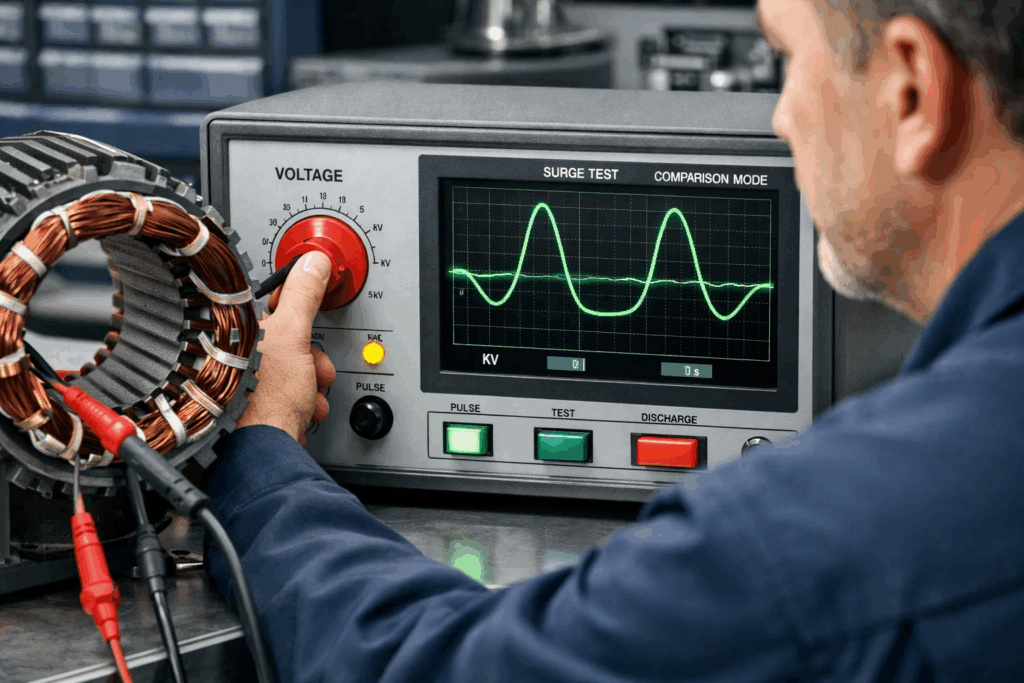
Manual surge testing represents the traditional approach to insulation fault detection in electrical windings. This method relies on skilled operators who manually control every aspect of the testing process, from parameter configuration to result interpretation.
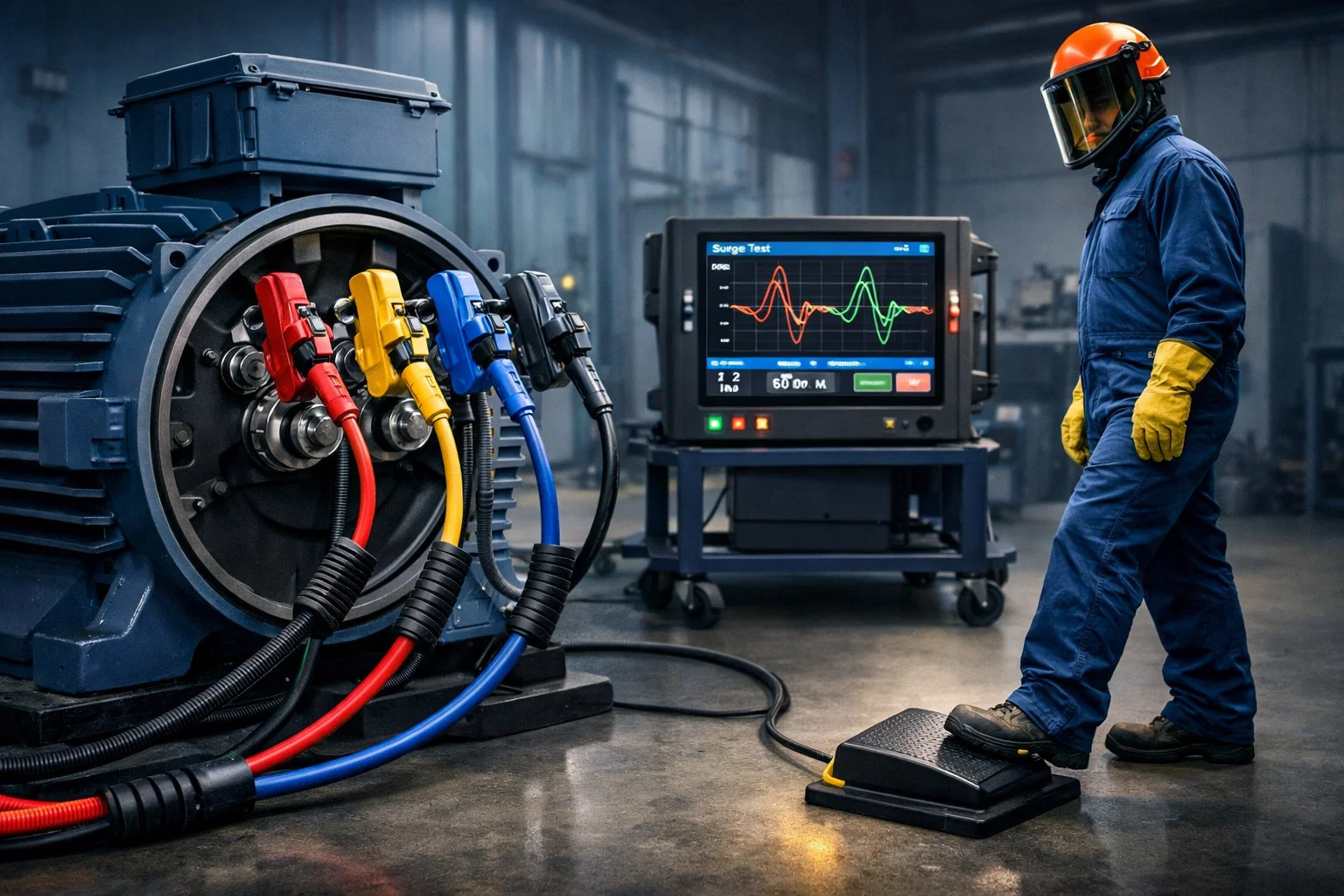
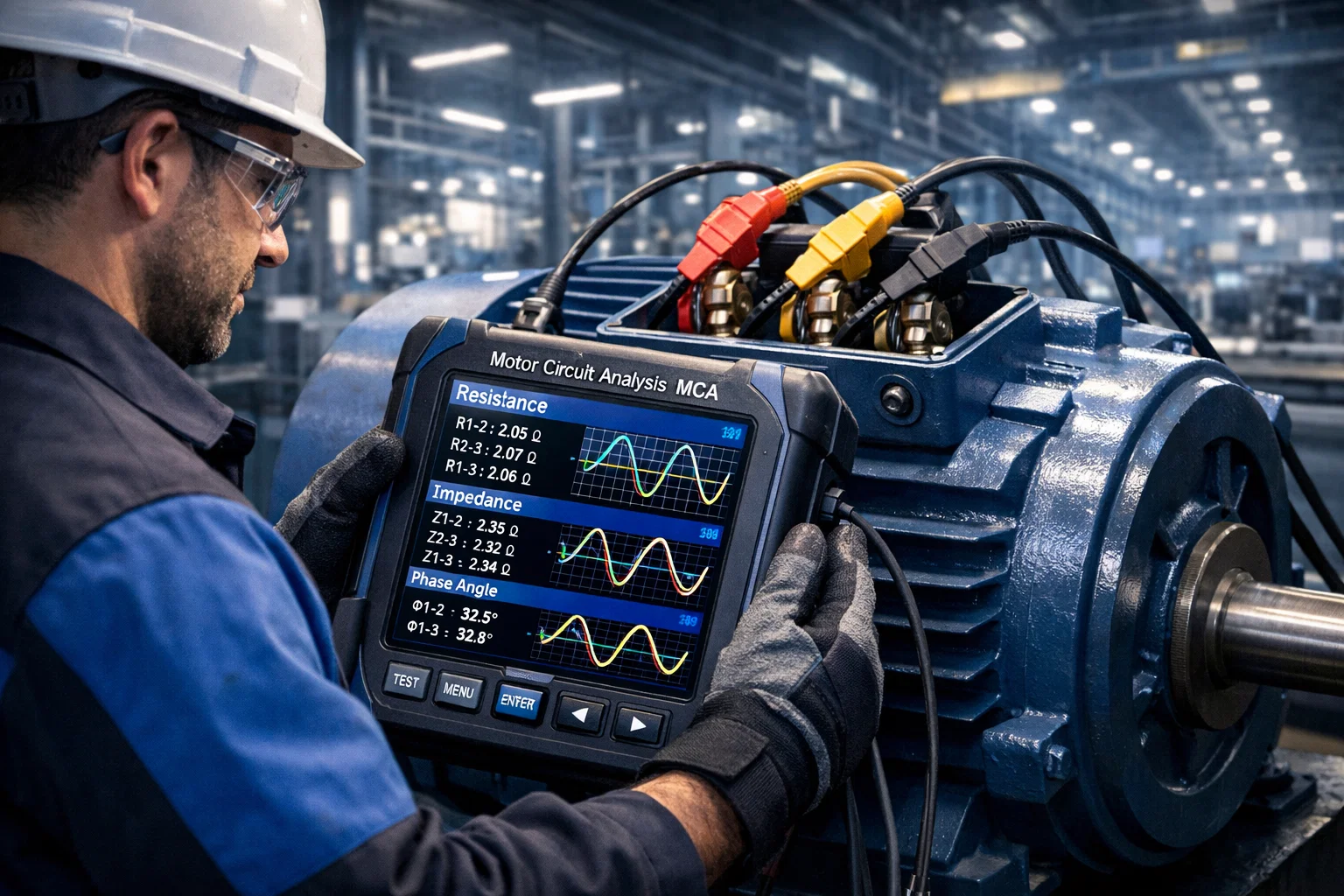
In a manual surge testing setup, operators connect test leads to the device under test (DUT), configure voltage levels and pulse frequencies, then initiate the high-voltage impulse. The surge tester generates an impulse that stresses the insulation system, revealing weaknesses that might not appear during normal operation. Operators examine waveforms on the screen, comparing them against known good patterns or previous test results.
Manual testing offers several inherent advantages:
The test sequence typically involves seven steps: connecting the probe assembly, selecting appropriate test voltage, initiating the surge impulse, observing waveform patterns, comparing results against acceptance criteria, documenting findings, and disconnecting test equipment. This process requires focused attention and proper technique to ensure accurate, repeatable results.
However, manual testing presents significant challenges. The process depends heavily on operator skill level, attention span, and consistency. Human factors such as fatigue, distraction, or varying interpretation standards lead to inconsistent results. For comprehensive insights into various surge testing applications across industries, understanding these operational dynamics becomes essential for optimizing quality control processes.
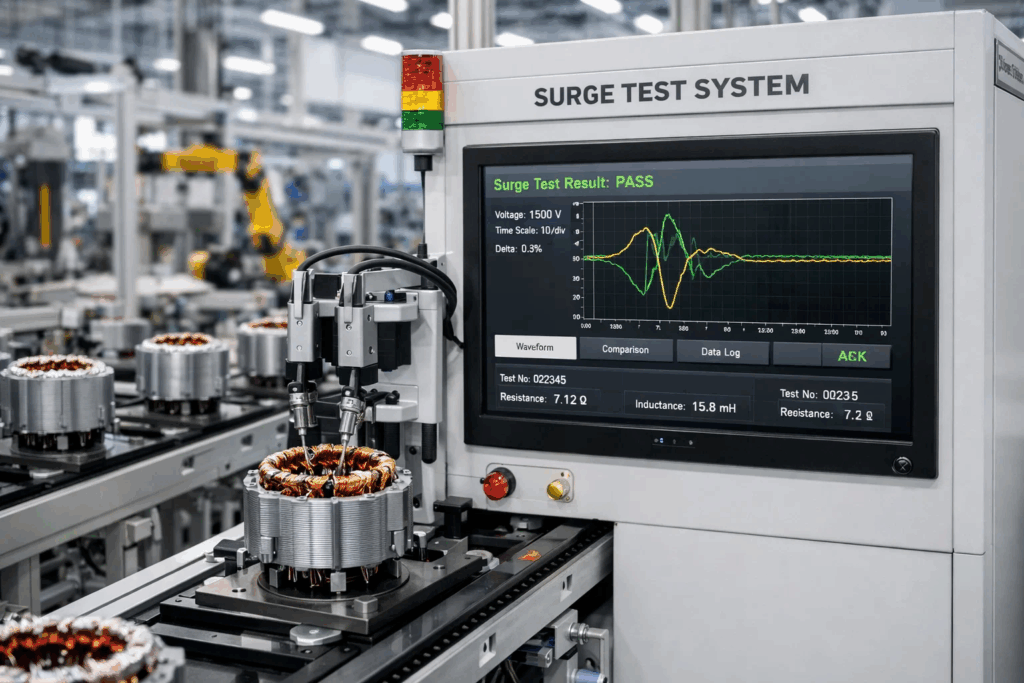
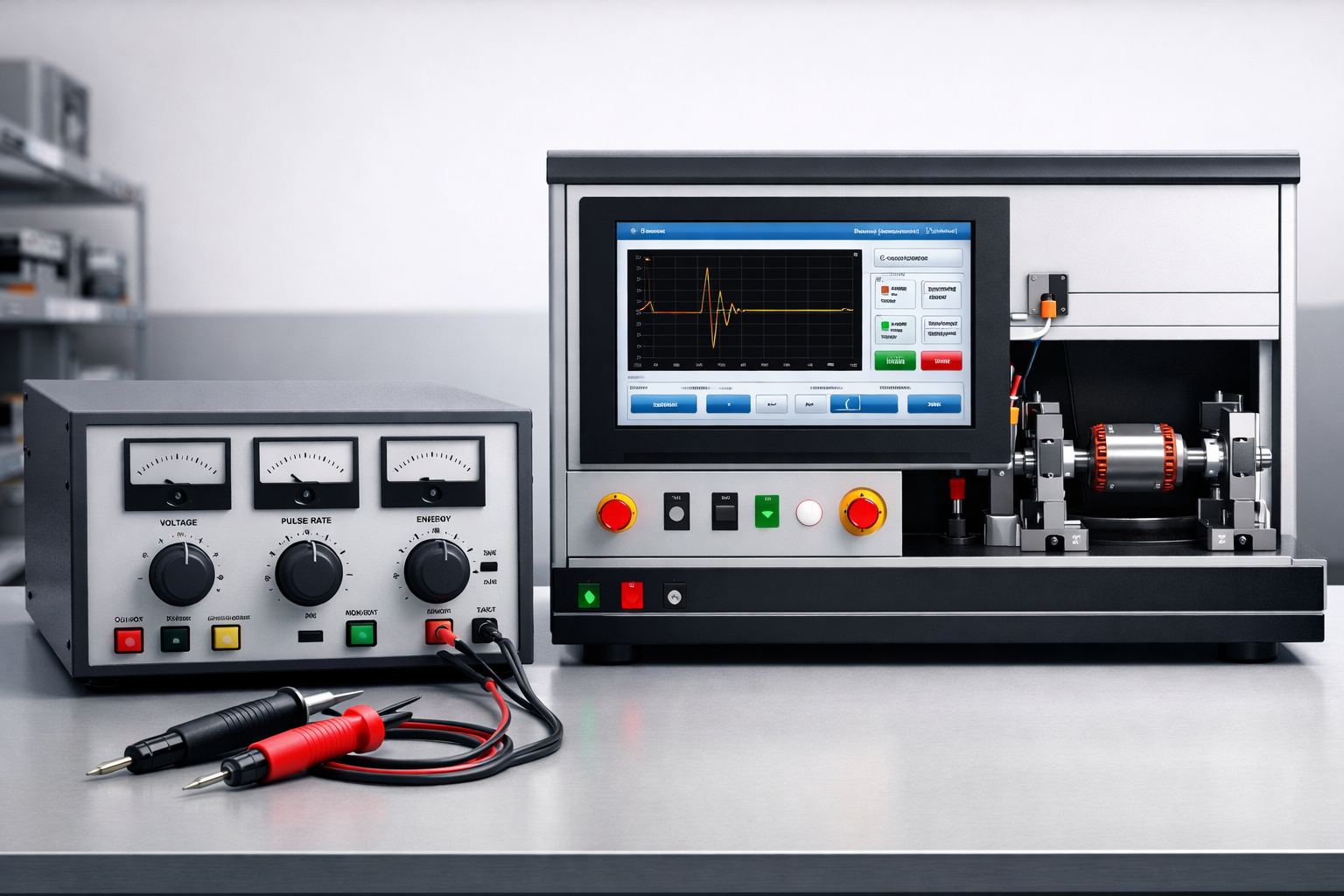
Automatic surge testing revolutionizes quality control by integrating surge test equipment with production line systems, enabling hands-free, consistent testing operations. These sophisticated systems incorporate robotics, automated handling mechanisms, and intelligent software managing the entire testing cycle without human intervention.
In automated environments, products move through testing stations via conveyor systems or robotic handlers. Systems automatically position test probes, execute predefined test sequences, capture and analyze waveform data, make pass/fail decisions based on programmed criteria, and log results to centralized databases—all within seconds.
Modern automated motor testing systems incorporate advanced features transforming the testing landscape:
Key technological capabilities include:
The transformation from manual to automatic testing represents more than equipment upgrades—it signifies a fundamental shift in quality assurance approaches. Automatic systems eliminate variability inherent in human-dependent processes while dramatically increasing testing capacity. The consistency achieved through automation ensures every tested unit receives identical evaluation criteria, regardless of shift, operator, or time of day.
Advanced waveform analysis capabilities enable these systems to detect subtle fault patterns with exceptional precision, providing quality assurance levels impossible to achieve consistently with manual methods.
Understanding performance differences requires examining multiple dimensions beyond simple throughput metrics. The comparison encompasses accuracy, consistency, data management, and operational flexibility.
| Performance Factor | Manual Surge Testing | Automatic Surge Testing |
|---|---|---|
| Testing Speed | 3-5 minutes per unit | 15-45 seconds per unit |
| Daily Throughput | 12-15 units/hour | 80-240 units/hour |
| Test Consistency | 15-30% variability | 99.5%+ repeatability |
| Data Documentation | Manual entry required | 100% automatic capture |
| Operator Dependency | High skill requirement | Minimal supervision needed |
| Multi-shift Consistency | Variable across shifts | Identical 24/7 performance |
| Setup Time | 2-3 minutes per unit | 5-15 seconds per unit |
| Error Rate | 3-8% false readings | <0.5% system errors |
Testing Speed and Throughput:
Manual surge testing typically requires 3-5 minutes per motor when performed correctly, including connection setup, test execution, waveform interpretation, and documentation. Experienced operators working efficiently might test 12-15 motors per hour, though this rate decreases throughout shifts due to fatigue factors.
Automatic systems complete identical testing sequences in 15-45 seconds per unit, depending on test complexity and handling system design. This represents a 5-10x throughput improvement compared to manual methods. More importantly, automatic systems maintain consistent speed throughout continuous operation, whereas manual testing rates inevitably decline during extended shifts.
Accuracy and Reliability Metrics:
Manual testing accuracy depends primarily on operator expertise and attention to detail. Skilled technicians with years of experience identify subtle waveform anomalies indicating developing insulation problems. However, research studies indicate manual testing consistency varies by 15-30% between operators, even with standardized procedures and training.
Automatic surge testing systems eliminate human variability through algorithmic consistency. Once programmed and validated, these systems apply identical criteria to every test. Advanced detection algorithms enable exceptional precision, typically achieving 99.5%+ test-to-test repeatability in identical conditions. This consistency proves critical for industries requiring stringent quality standards.
Data Management and Traceability:
Manual testing creates documentation challenges. Operators must record test results manually or input data into computer systems, introducing potential transcription errors and incomplete record-keeping. Under production pressure, documentation shortcuts often occur, compromising traceability and analysis capabilities.
Automatic systems capture every data point from every test automatically. Complete waveform data, test parameters, environmental conditions, and pass/fail results are stored in databases with full traceability to specific units, operators, and timestamps. This comprehensive data enables statistical process control, trend analysis, and rapid root-cause investigation when quality issues arise.
For facilities requiring detailed quality documentation and continuous improvement initiatives, exploring benefits of using surge testers with automated data collection becomes essential.
Determining the optimal transition point from manual to automatic surge testing requires careful analysis of production volumes, product mix complexity, and quality requirements. While no universal threshold exists, several factors help identify when automation becomes economically and operationally justified.
Low-Volume Operations (1-50 units/day):
For facilities producing fewer than 50 units daily, manual surge testing typically provides adequate capacity without excessive resource requirements. One skilled operator comfortably tests this volume while maintaining quality attention. This level allows for:
Medium-Volume Operations (50-200 units/day):
This range represents the automation decision zone. Facilities in this category should conduct detailed analysis considering:
Many facilities in this range implement hybrid approaches—automating high-volume standard products while maintaining manual capabilities for custom or low-volume items. This balanced approach provides maximum operational flexibility.
High-Volume Operations (200+ units/day):
Operations exceeding 200 units daily almost universally benefit from automatic surge testing. At this scale:
Beyond raw volume, consider these additional automation triggers:
For electric vehicle motor testing applications where quality standards are exceptionally stringent and production volumes are high, automatic systems have become the industry standard regardless of other considerations.
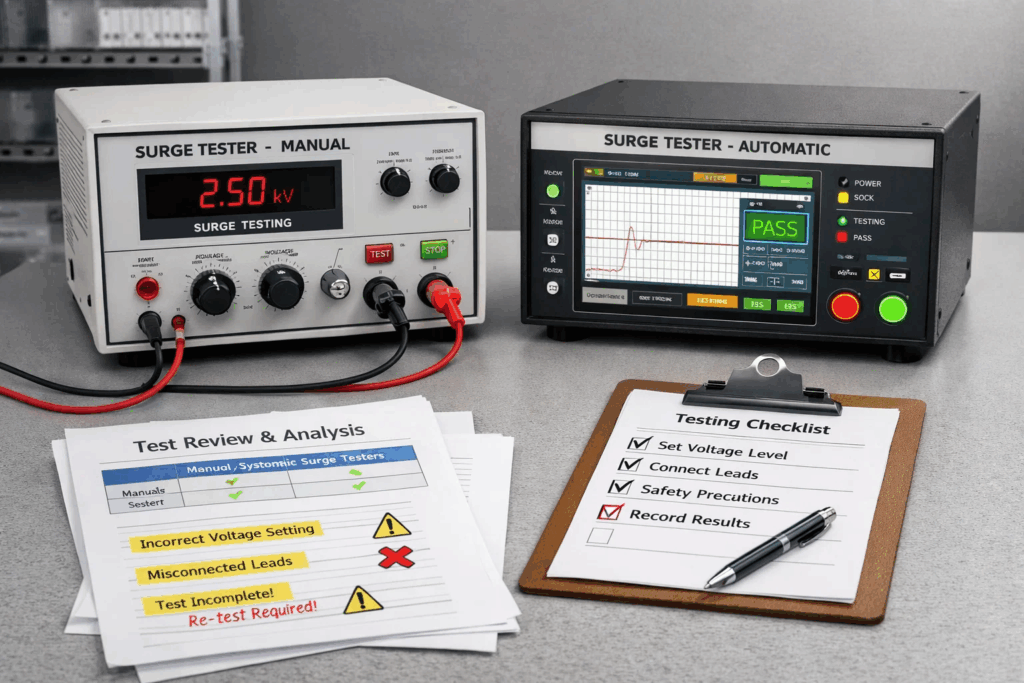
Organizations frequently make costly mistakes when evaluating surge testing systems. Understanding these common pitfalls helps ensure informed decision-making aligning with long-term business objectives.
Mistake #1: Focusing Solely on Initial Investment
Many facilities select manual systems based purely on lower upfront requirements without conducting comprehensive total cost of ownership analysis. This shortsighted approach ignores ongoing operational expenses, quality costs associated with inconsistency, and opportunity costs from limited capacity.
Solution: Calculate multi-year total cost of ownership including equipment, labor, maintenance, training, quality costs, and capacity constraints. This comprehensive view often reveals automatic systems deliver superior economics despite higher initial investments. Consider not just current needs, but projected requirements three to five years forward.
Mistake #2: Underestimating Integration Complexity
Automatic surge testing systems require careful integration with existing production systems, quality databases, and workflow processes. Organizations frequently underestimate engineering time, software development, and validation testing required for successful implementation. Understanding how to properly maintain and calibrate testing systems becomes crucial for long-term success.
Solution: Allocate sufficient resources for integration, validation, and startup support. Engage system integrators or equipment suppliers early in planning processes to identify potential challenges and develop realistic implementation timelines. Budget both time and resources for comprehensive system validation before full production deployment.
Mistake #3: Neglecting Operator Training and Change Management
Transitioning from manual to automatic testing represents significant operational changes. Insufficient attention to operator training, resistance management, and process documentation leads to delayed adoption and suboptimal system utilization. Operators accustomed to manual control may initially resist automated systems or fail to utilize advanced features effectively.
Solution: Develop comprehensive training programs covering both technical operation and troubleshooting scenarios. Involve operators early in system selection and implementation to build ownership and address concerns proactively. Create clear standard operating procedures leveraging automation capabilities while maintaining operator engagement.
Mistake #4: Ignoring Future Scalability Requirements
Organizations often select systems based on current production volumes without considering growth trajectories or product diversification plans. This results in premature system obsolescence and expensive upgrades or replacements within just a few years of initial implementation.
Solution: Evaluate systems based on projected multi-year volume requirements and product mix expansion plans. Build in excess capacity to accommodate growth without immediate reinvestment needs. Select modular systems allowing incremental expansion rather than complete replacement when capacity increases are needed.
Mistake #5: Overlooking Support and Service Considerations
Equipment longevity and productivity depend heavily on supplier support capabilities, spare parts availability, and service response times. Organizations sometimes select systems based on features alone, discovering too late that inadequate support creates costly downtime. Understanding common troubleshooting scenarios helps appreciate the value of strong vendor support.
Solution: Evaluate supplier credentials including service network coverage, response time guarantees, spare parts inventory, and technical support availability. Request customer references and investigate actual service experiences before committing. Consider long-term partnership potential, not just initial transaction.
Mistake #6: Failing to Consider Testing Method Complementarity
Some organizations assume they must choose exclusively between manual and automatic systems. This binary thinking overlooks hybrid approaches leveraging strengths of both methods for different product lines or testing requirements.
Solution: Analyze your product portfolio segmentation. High-volume standardized products justify automation, while low-volume custom products benefit from manual testing flexibility. Implement hybrid approaches maximizing overall facility efficiency. Understanding the difference between testing methodologies helps optimize testing strategy.
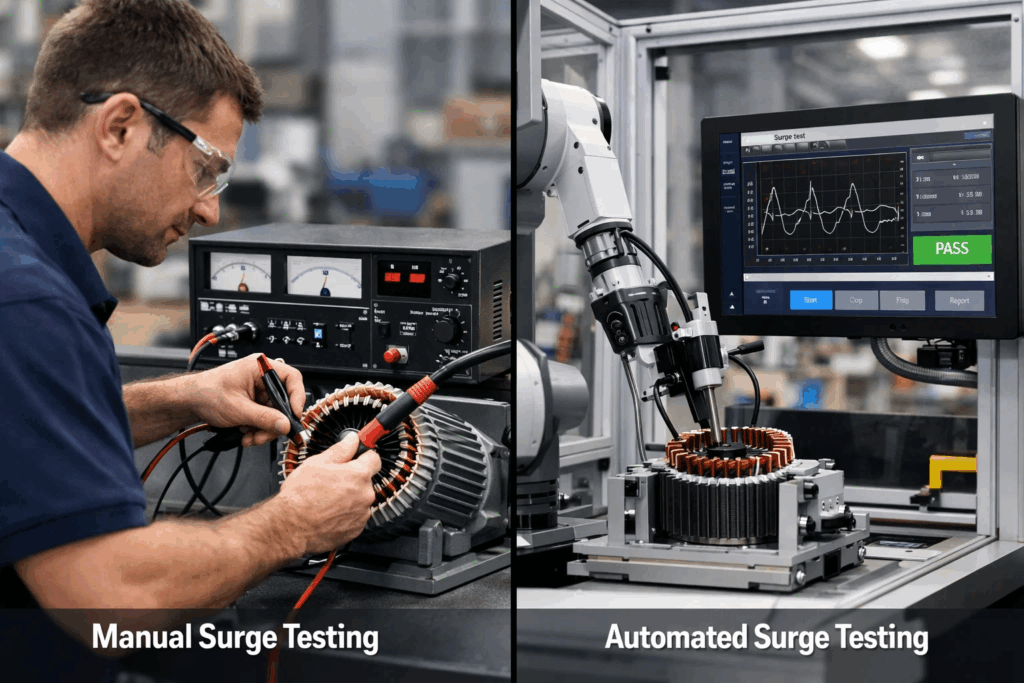
Different industries face unique testing requirements, production characteristics, and economic constraints influencing optimal surge testing approach. Understanding industry-specific considerations helps align technology choices with operational realities.
Industries Favoring Manual Surge Testing:
Aerospace and Defense: Custom motor and transformer designs require flexible testing approaches accommodating unique specifications. Low-to-medium production volumes and high-value products justify manual testing overhead. Engineers often need detailed waveform analysis and troubleshooting benefiting from hands-on operator expertise.
Research and Development Facilities: Academic institutions and corporate R&D labs working on next-generation motor designs require maximum testing flexibility. Frequent parameter changes and experimental configurations make manual systems more practical than automated approaches.
Custom Industrial Equipment Manufacturers: Companies producing specialized motors, generators, or transformers for unique applications typically work with small batch sizes and varying specifications. Manual testing provides adaptability these operations require.
Repair and Rewind Shops: Motor service centers testing repaired or rewound equipment deal with unpredictable conditions and varying product types. Manual testing allows technicians to apply their expertise in assessing whether repairs successfully restored insulation integrity. Understanding how to test motor windings becomes essential in repair scenarios.
Industries Favoring Automatic Surge Testing:
Automotive and Electric Vehicle Manufacturing: High-volume production with standardized motor designs makes automation essential. Quality consistency requirements and production speed demands justify investment in sophisticated automatic testing systems. Modern EV manufacturers routinely test thousands of drive motors daily.
HVAC Equipment Production: Compressor motors, fan motors, and pump motors produced in high volumes benefit significantly from automated testing. Consistent product designs and quality requirements align perfectly with automation capabilities. For specific applications, exploring best surge testers for HVAC motor testing provides targeted guidance.
Home Appliance Manufacturing: Washing machine motors, dryer motors, refrigerator compressors, and similar components produced in massive volumes require automated testing. Speed, consistency, and data management capabilities justify automation investment.
Power Tool Manufacturing: Cordless drill motors, saw motors, and similar high-volume products benefit from automatic testing. Consistent quality standards and competitive pressure for reliability make automation valuable.
Industrial Motor Manufacturing: Facilities producing standard frame motors in high volumes achieve optimal efficiency with automatic testing. Integration with production lines and quality management systems streamlines operations.
Armature and Rotor Production: Specialized facilities producing armatures for various motor manufacturers benefit from digital armature surge testing automation. High daily volumes and consistent products justify sophisticated automated systems.
Making the right decision requires systematic evaluation of multiple factors beyond simple production volume considerations. Use this decision framework to guide your selection process.
Step 1: Assess Your Current and Future Production Requirements
Begin by analyzing your actual testing needs:
Step 2: Define Your Quality and Documentation Requirements
Consider quality standards and compliance needs:
Step 3: Evaluate Your Operational Constraints
Examine practical operational factors:
Step 4: Calculate Total Cost of Ownership
Develop comprehensive financial analysis:
Step 5: Consider Hybrid Implementation Approaches
Evaluate mixed strategy options:
Step 6: Engage Stakeholders Throughout Decision Process
Involve key personnel in evaluation:
Understanding distinctions like surge tester vs hipot tester helps refine overall testing strategy ensuring all insulation integrity requirements are addressed comprehensively.
Manual surge testers require operators to control every aspect of testing including setup, execution, and result interpretation. Automatic surge testers integrate with production lines, performing tests without human intervention using robotic handling, automated waveform analysis, and self-contained data management. The primary difference lies in operator dependency, testing speed, and result consistency.
Automatic surge testing typically becomes economically justified at production volumes exceeding 100-200 units daily, though specific thresholds vary by industry and product complexity. Facilities in the 50-200 unit daily range should conduct detailed ROI analysis. Beyond 200 units daily, automation almost universally delivers superior economics and quality consistency compared to manual methods.
Manual surge testing can achieve high accuracy when performed by skilled, experienced operators under ideal conditions. However, consistency varies 15-30% between different operators due to human factors like fatigue, interpretation differences, and attention variations. Automatic systems maintain 99.5%+ repeatability by eliminating human variability, delivering superior consistency over extended periods.
The most critical mistakes include focusing solely on initial investment without analyzing total cost of ownership, underestimating integration complexity and implementation timelines, neglecting operator training and change management, ignoring future scalability requirements, and overlooking supplier support capabilities. Organizations should conduct comprehensive multi-year analysis rather than making decisions based purely on upfront expenditure.
Modern automatic surge testing systems feature user-friendly interfaces requiring minimal programming expertise for daily operation. Initial system setup and test program development may require technical support from equipment suppliers or system integrators. Once configured, operators need basic computer skills for system monitoring and simple adjustments. Comprehensive training programs typically enable effective operation within days.
Yes, hybrid approaches combining manual and automatic surge testing provide optimal flexibility for many facilities. High-volume standardized products justify automated testing, while low-volume custom products benefit from manual testing adaptability. This strategy maximizes overall facility efficiency by leveraging strengths of each approach for appropriate applications.
Choosing between manual and automatic surge testing represents a strategic decision impacting quality, efficiency, and competitiveness for years to come. Manual systems offer flexibility and lower initial investment ideal for low-volume, high-variety operations, while automatic systems deliver consistency, throughput, and data management capabilities essential for high-volume production.
The surge testing landscape continues evolving with advances in artificial intelligence, machine learning, and Industry 4.0 integration. Whichever approach you select today, ensure it provides upgrade paths and scalability for future requirements. Your decision should align with strategic business objectives while delivering measurable improvements in quality assurance and operational efficiency.
Ready to optimize your surge testing operations? Evaluate your specific requirements using the decision framework provided, engage equipment suppliers for demonstrations and proposals, and make the investment that positions your facility for long-term success.
Explore how Vivid Metrawatt Global’s manual and automatic surge testers support diverse production environments—from low-volume, high-precision testing to fully automated high-throughput manufacturing lines. Understanding the performance differences between manual and automatic surge testing systems helps manufacturers align testing speed, accuracy, and data management capabilities with operational goals, ensuring consistent insulation fault detection and long-term motor reliability.