
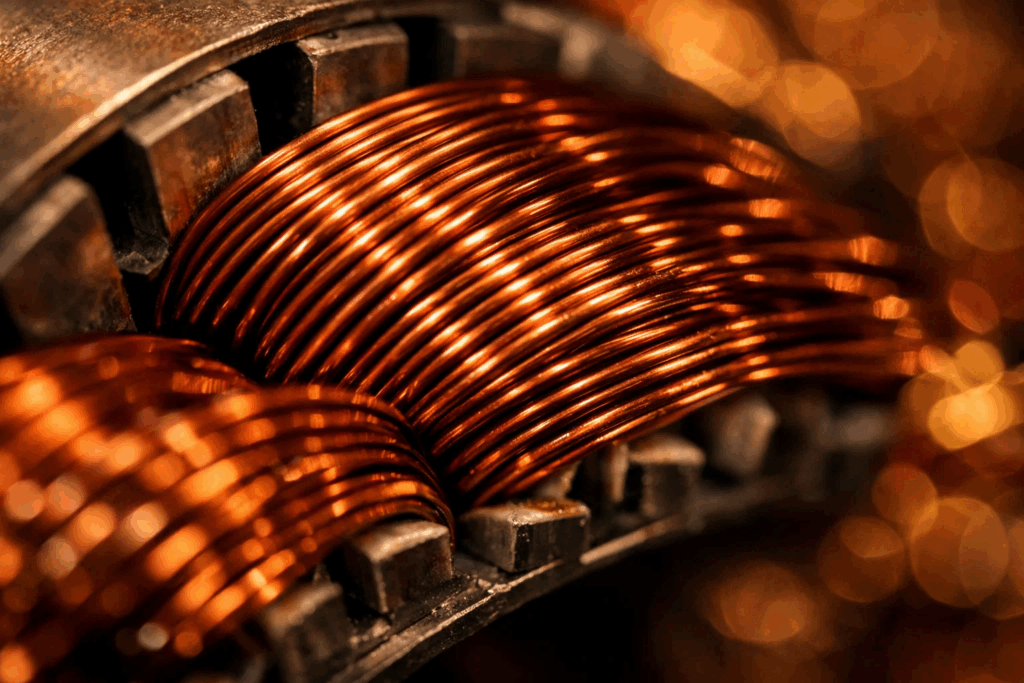
The most dangerous winding faults are the ones you cannot see coming. A motor can pass a standard Megger insulation resistance test in the morning and fail catastrophically by afternoon — because the fault is not between the winding and ground, but between individual turns within the same coil.
Turn-to-turn insulation failures account for a significant proportion of motor winding failures, yet they are essentially invisible to the most commonly used diagnostic tools. The impulse winding tester — also known as a surge winding tester or impulse surge tester — exists specifically to find these faults.
Understand the signs of motor winding failure: Motor Winding Failure Signs You Should Not Ignore
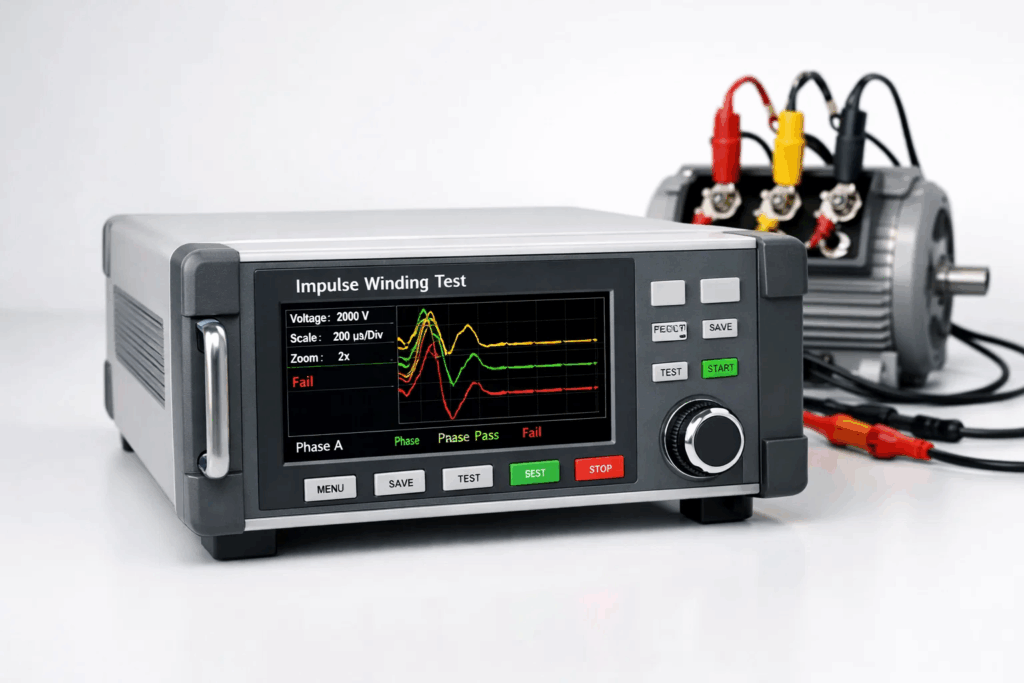
An impulse winding tester is a precision electrical diagnostic instrument that applies a rapid, high-voltage impulse (surge) to a motor or transformer winding and captures the resulting oscillating waveform on a digital display. By comparing the waveforms between phases (or between a known-good reference and the winding under test), the instrument reveals any internal insulation weaknesses that would cause asymmetry in the response.
The terms “impulse winding tester”, “surge tester”, and “digital surge tester” are often used interchangeably, though strictly speaking, the impulse winding tester is the broader category and the digital surge tester is the modern, microprocessor-controlled implementation of the same principle.
For a comprehensive foundation: What Is a Surge Tester? — A Complete Introduction
Explore the difference between impulse and surge voltage testing: Impulse vs Surge Voltage Testing — Key Differences
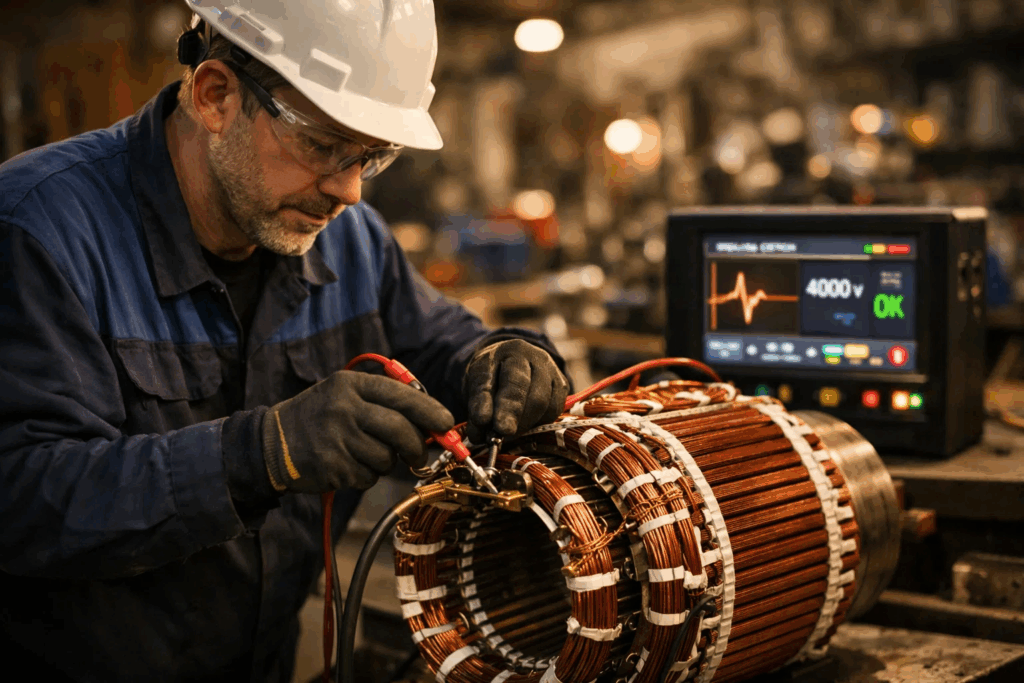
The operating principle draws on the behaviour of resonant LC circuits. Each winding behaves as an inductor, and the tester introduces a known capacitance. When the impulse voltage is applied, the circuit oscillates at a frequency determined by the winding’s inductance — which is a direct function of its physical integrity.
Step-by-Step Test Process
In a healthy three-phase motor, all three phases have identical winding geometry and inductance. Any internal fault — a shorted turn, degraded turn-to-turn insulation, or coil-to-coil leakage — alters the inductance of that phase, producing a visibly different waveform.
Deep-dive into waveform interpretation: Waveform Analysis in Surge Testing
Understand Error Area Ratio (EAR) analysis: What Is Error Area Ratio in Surge Testing?
| Feature | Impulse Winding Tester | Megger (IR Test) | Hipot Test |
| What It Detects | Turn-to-turn & coil-to-coil shorts | Ground insulation degradation | Insulation breakdown to ground |
| Voltage Type | High-voltage impulse (DC pulse) | DC (500V–5000V) | AC or DC sustained high voltage |
| Test Duration | Seconds per winding | 1–10 minutes | 1 minute (dielectric withstand) |
| Best Use Case | Winding integrity verification | Moisture / contamination detection | Post-rewind quality assurance |
See the full comparison: Difference Between Megger and Surge Test for Windings
Surge tester vs hipot tester — detailed breakdown: Surge Tester vs Hipot Tester
It is important to note what an impulse winding tester does NOT detect: ground insulation condition (use a Megger for this) and sustained breakdown voltage (use a hipot tester). All three instruments play complementary roles in a complete motor testing protocol.
Understanding how surges cause insulation failures: Surge Tester and Insulation Failures
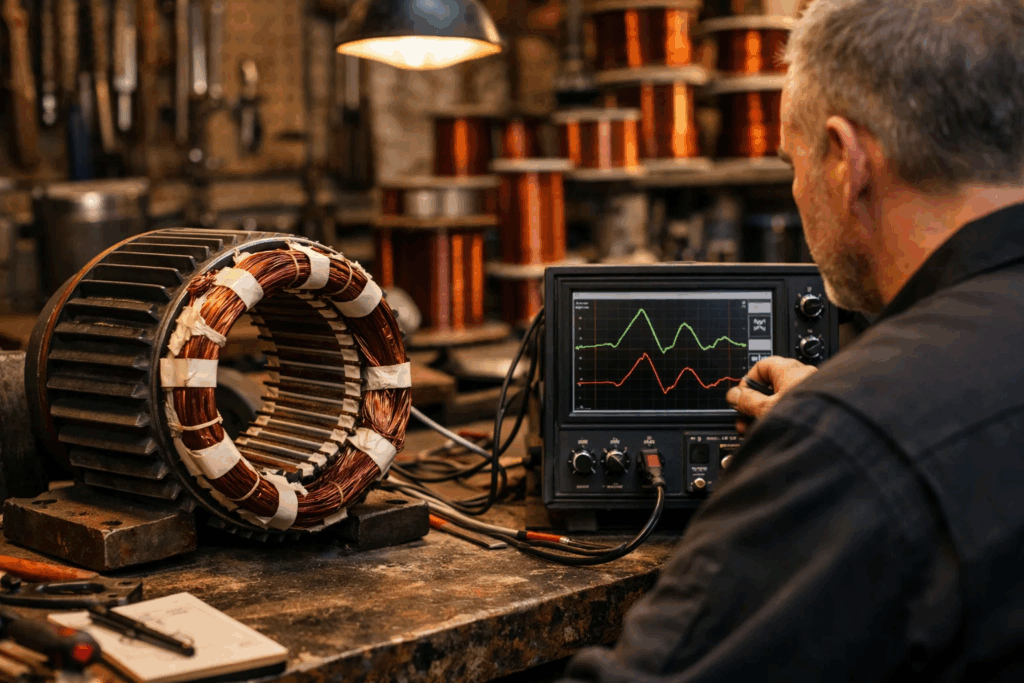
After Every Motor Rewind or Repair
This is the most critical application. A newly rewound motor must be surge tested before it leaves the repair shop. A missed shorted turn will cause premature failure in service — often within weeks.
As Part of Scheduled Preventive Maintenance
Annual or semi-annual surge testing of in-service motors reveals developing inter-turn insulation weaknesses before they propagate into catastrophic winding failure.
Before and After Variable-Frequency Drive (VFD) Installation
VFDs generate high-frequency voltage spikes that are far more stressful on inter-turn insulation than sinusoidal voltage. Surge test any motor before connecting it to a VFD, and test more frequently thereafter.
For OEM End-of-Line Production Testing
Every motor that leaves a manufacturing facility should pass a surge test. This ensures zero-defect delivery and protects warranty obligations.
For Incoming Inspection of Repaired Motors
When a repaired motor is received from a third-party repair workshop, surge test it before installation to independently verify the quality of the rewind work.
See how surge testing enhances motor reliability: Surge Testing Enhances Motor Reliability and Efficiency
Applications of digital surge testers across industries: Applications of the Digital Surge Tester
Manual vs automatic surge testers — which is right for you? Manual vs Automatic Surge Tester Comparison
Using a footswitch for safe, hands-free operation: How to Use a Footswitch for Hands-Free Surge Testing
What is an LCD-based surge tester? LCD-Based Surge Tester — Features and Benefits
Healthy Winding
All three phase waveforms overlay perfectly. The oscillation is smooth and symmetrical. EAR value is below the threshold (typically <3% for a healthy winding).
Turn-to-Turn Fault
One phase waveform shifts — it oscillates at a slightly different frequency because the shorted turns reduce the effective inductance of that phase. The EAR value will exceed the fault threshold.
Open Circuit
The affected phase produces no oscillating waveform, or a severely distorted one. This is immediately obvious on any digital display.
Degraded Insulation (Pre-Fault)
Waveforms are very slightly mismatched — EAR is elevated but below the hard fault threshold. This is the most valuable finding: the motor is still safe to operate but should be scheduled for rewinding at the next available opportunity.
EV motor testing guide: Electric Vehicle Motor Testing — A Complete Guide
Best surge tester for HVAC motor testing: Best Surge Tester for HVAC Motor Applications
Generator surge testing: What Is a Generator Surge Tester?
How surge generators work: How Surge Generators Work
An impulse winding tester — also called a surge winding tester or digital surge tester — is a precision electrical instrument that applies a high-voltage impulse to a motor or transformer winding and analyses the resulting oscillating waveform to detect internal insulation faults, particularly turn-to-turn shorts.
A Megger (insulation resistance tester) applies a sustained DC voltage to measure the resistance between the winding conductor and the motor frame (ground insulation). An impulse winding tester fires a rapid high-voltage pulse to stress and evaluate the insulation between individual turns within the winding (turn-to-turn insulation). They test different insulation systems and should both be used in a complete testing programme.
No — it excels at detecting turn-to-turn shorts, coil-to-coil shorts, phase-to-phase shorts, open circuits, incorrect turn counts, and degraded inter-turn insulation. It does not test ground wall insulation condition (use a Megger) or dielectric withstand strength (use a hipot tester).
IEEE 522 recommends a surge voltage of 2 × rated voltage + 1000V for new or rewound motors. For in-service motors, a reduced voltage of 1.5–1.75 × rated voltage is used to avoid stressing already-aged insulation. Always refer to the standard and OEM specification for your specific application.
The tester applies an identical impulse to each winding phase. In a healthy motor, all phase waveforms are identical because each phase has the same inductance. A shorted turn reduces the inductance of that phase, causing its waveform to oscillate at a different frequency — producing visible asymmetry that the tester detects and displays.
EAR is a quantitative metric that calculates the percentage difference in area between two compared waveforms. A low EAR (typically below 3%) indicates a healthy winding. An EAR above the fault threshold indicates a winding defect. EAR provides an objective, numerical pass/fail criterion rather than relying solely on visual waveform interpretation.
You must use an impulse winding tester after every motor rewind or repair (pre-service acceptance), as part of scheduled preventive maintenance, before and after VFD installation, for OEM end-of-line production testing, and for incoming inspection of motors received from repair workshops.
Yes — when performed at the correct voltage level for the motor’s rating. Impulse testing at the recommended IEEE 522 voltages poses no meaningful risk to a healthy winding. The test is far more likely to reveal a pre-existing weakness than to create one.
Yes. Single-phase motors can be tested by comparing the main winding against the start winding, or against a stored reference waveform of a known-good motor of the same type. A reference comparison method is used when phase-to-phase comparison is not possible.
A manual surge tester requires the operator to set voltage levels, initiate each test, and interpret waveforms visually. An automatic surge tester runs a programmed test sequence, applies preset voltages, compares waveforms automatically, and delivers a clear pass/fail result — faster, more consistent, and suitable for high-volume production testing.
Key selection factors are: maximum test voltage (must cover your motor’s rated voltage class), waveform comparison method (phase-to-phase or reference), EAR measurement capability, integrated hipot function, data logging and PC connectivity, and whether manual or automatic operation suits your workflow.
An impulse winding tester is not optional for any serious motor maintenance or repair operation — it is essential. It is the only instrument that reliably detects turn-to-turn insulation faults: the hidden failures that other tests miss and that cause the majority of in-service winding failures.
Whether you operate a motor repair workshop, manage a large industrial fleet, or manufacture motors, adding impulse winding testing to your quality and maintenance protocols will pay for itself many times over in prevented failures, reduced repair costs, and extended motor life.
Vivid Metrawatt offers a complete range of digital surge and impulse winding testers for every application and voltage class.
Explore the Range
Contact our technical experts: Customer Support