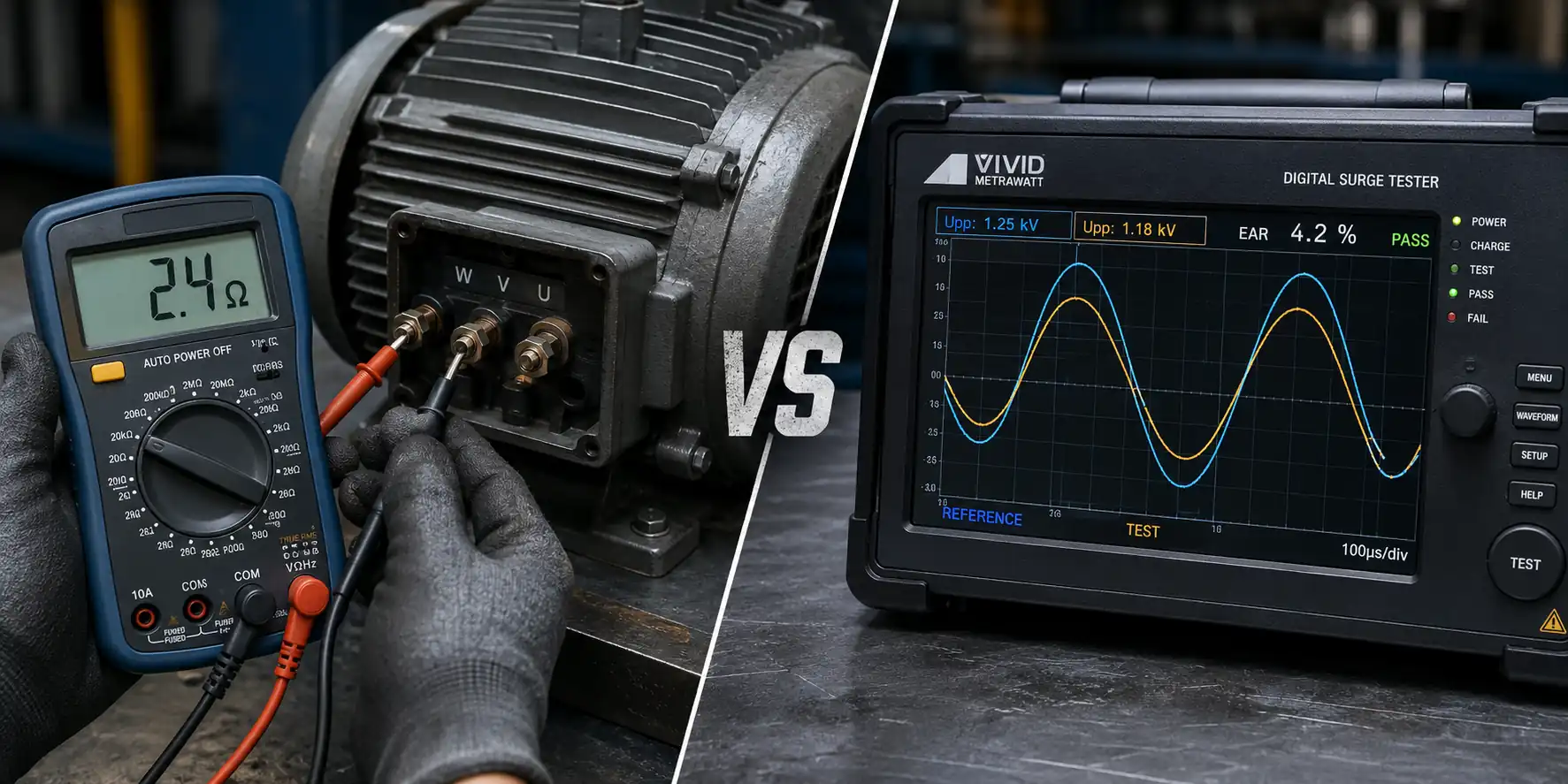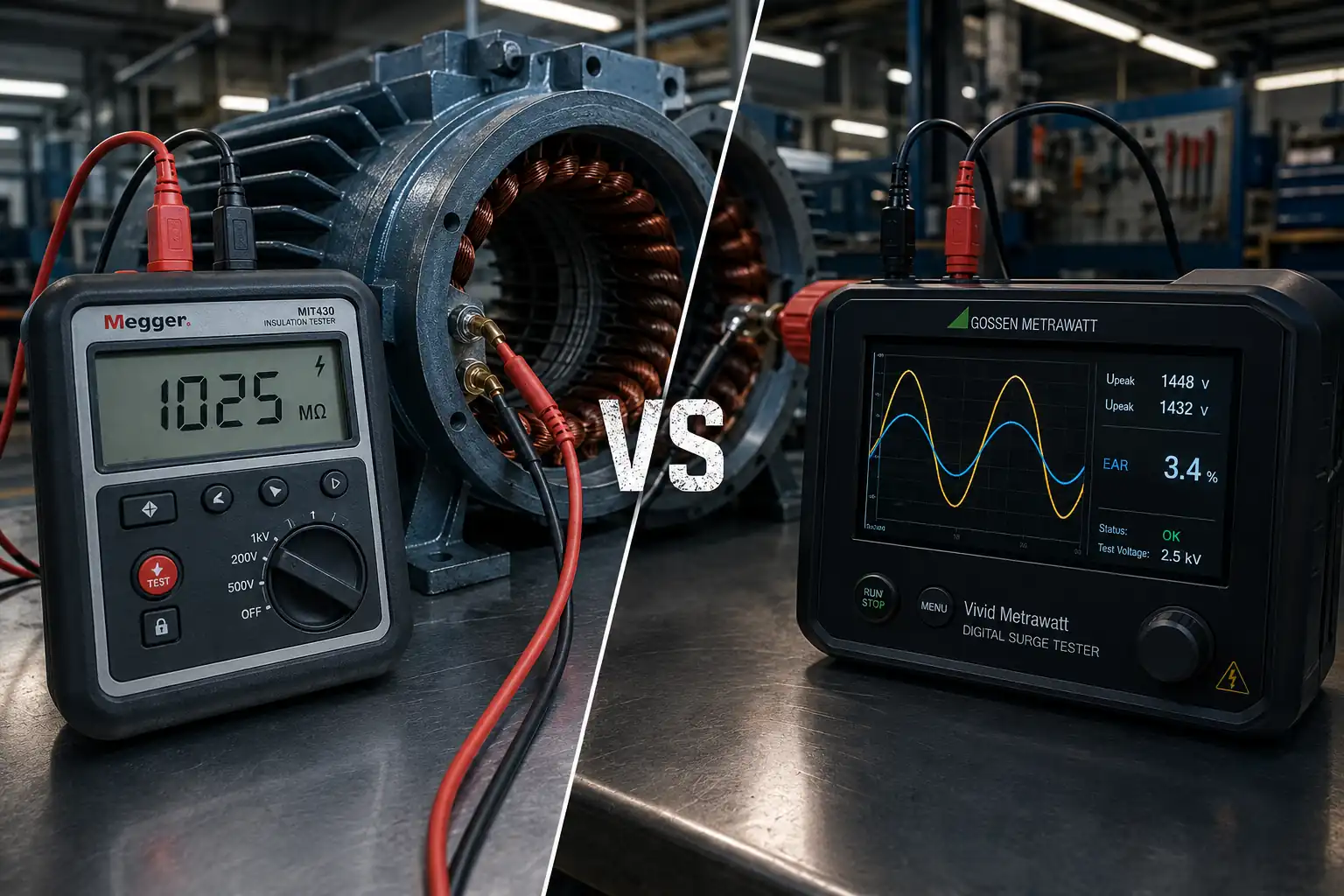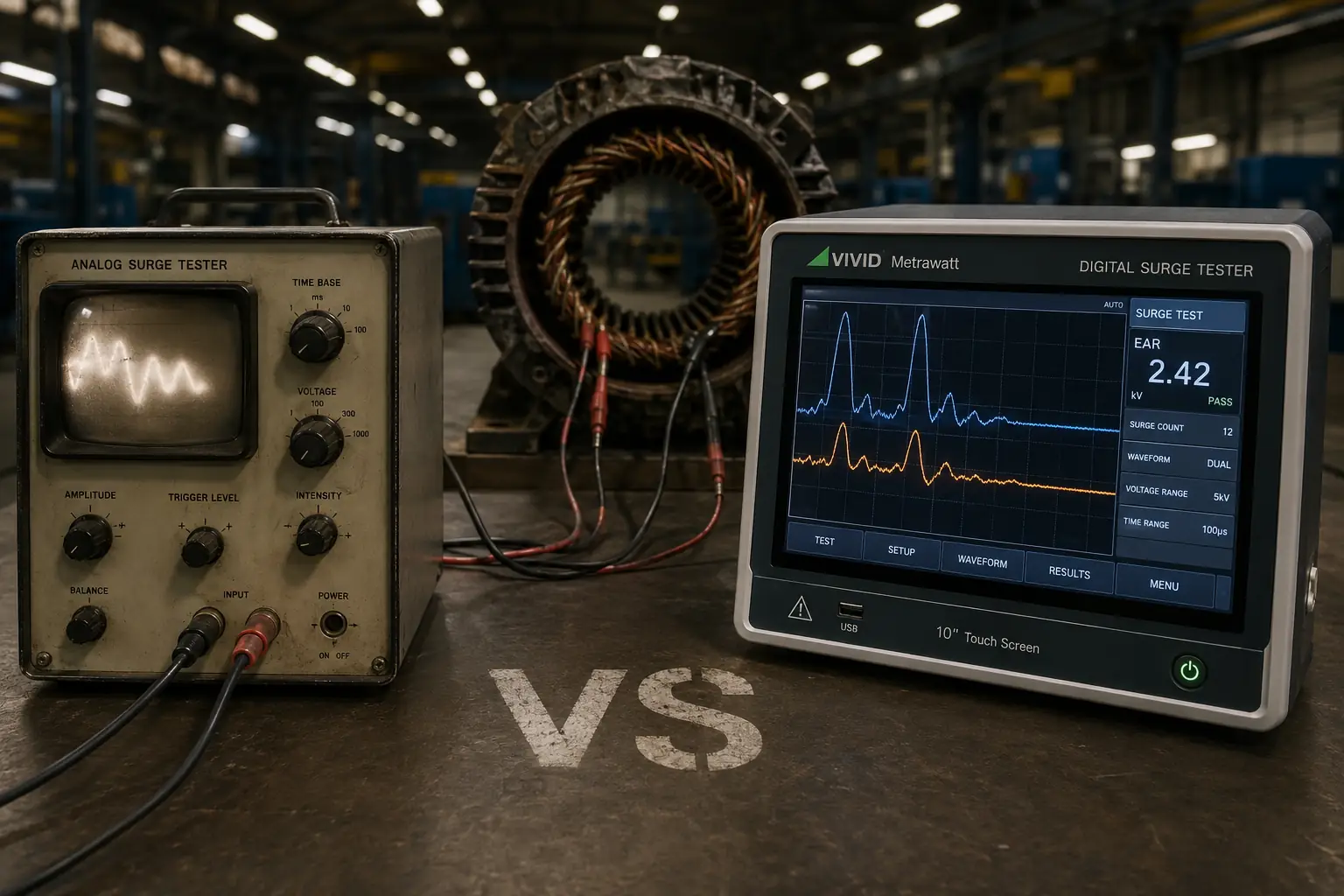

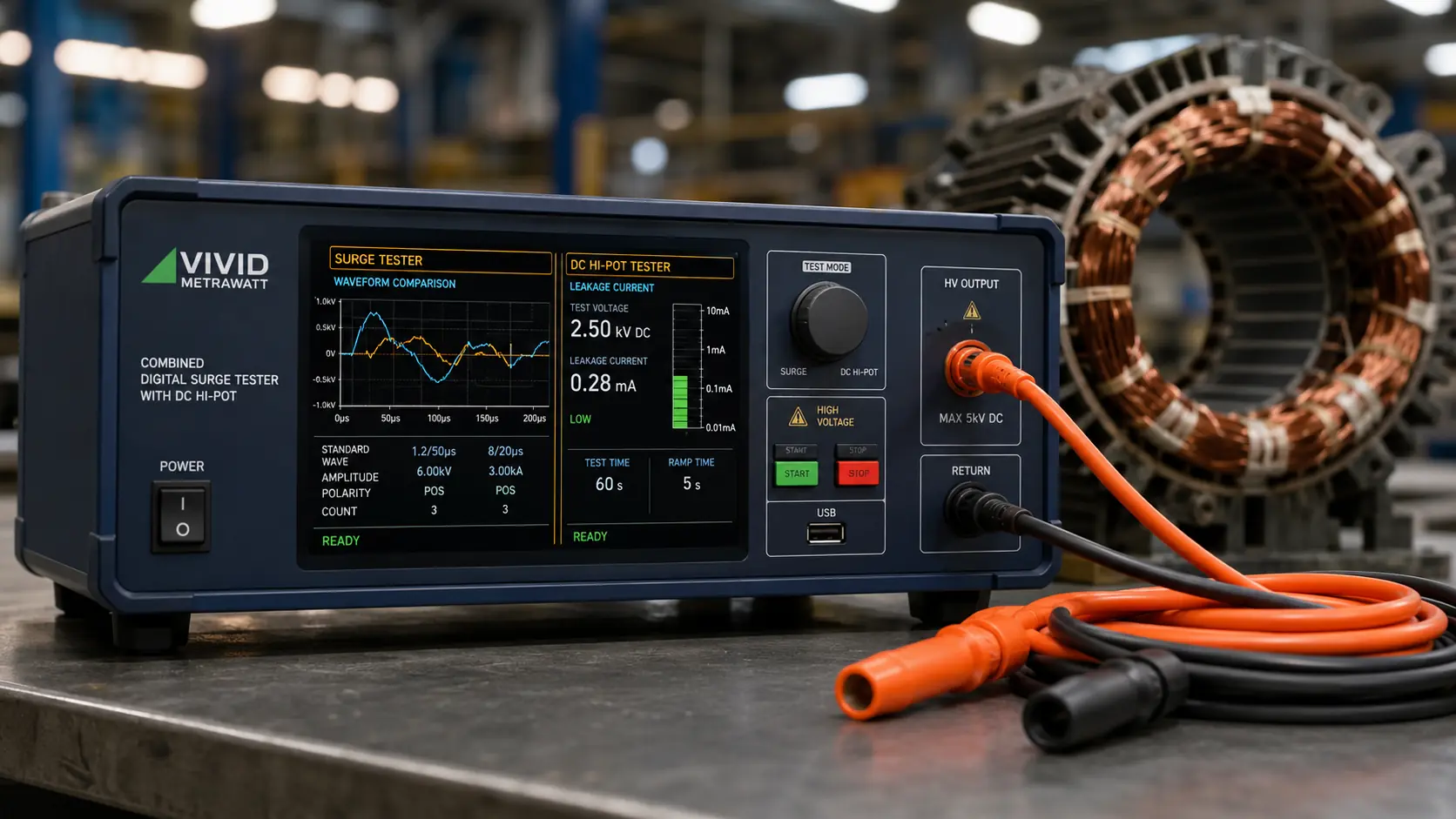
Both tests apply high voltage to electrical windings. Both are used in motor and transformer insulation qualification. And both are routinely confused with each other — with engineers sometimes assuming one covers what the other does. The surge test and the Hi-Pot test measure fundamentally different aspects of insulation integrity — and specifying the wrong one, or only one when both are required, creates gaps in your quality assurance programme that will eventually show up as field failures. This guide explains the precise difference, when each test is required, and what the combined Vivid Metrawatt instruments deliver that neither test alone can.
Table of Contents
These two tests are often grouped together because they both involve applying high voltage to windings — but the similarity ends there. They target entirely different insulation structures, use different waveforms of applied voltage, and reveal different categories of fault.
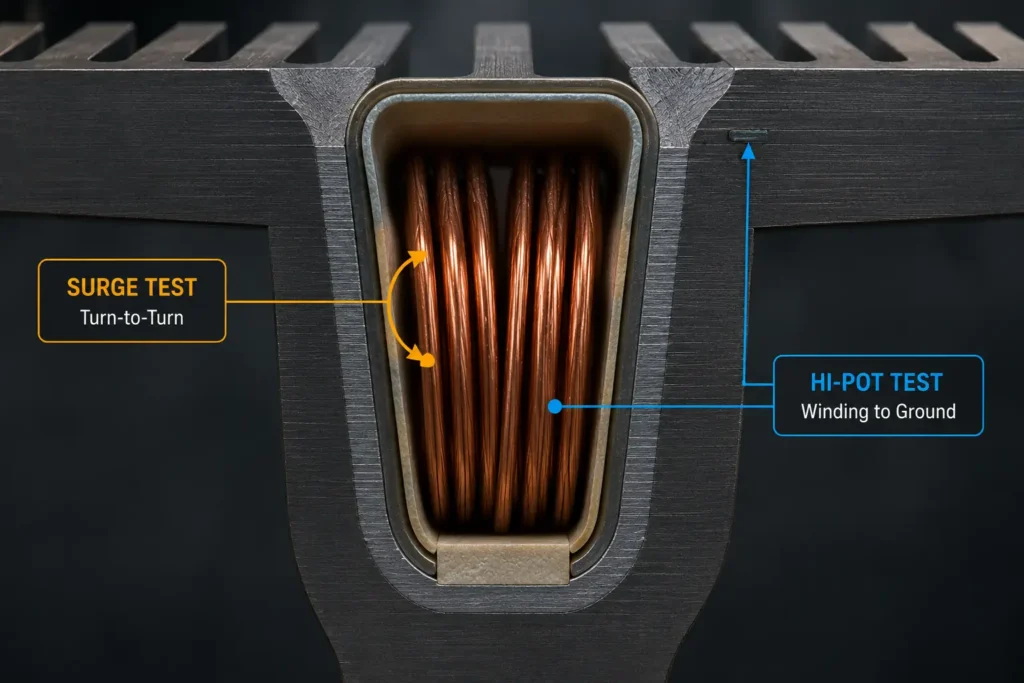
The surge test applies a fast-rising, short-duration high-voltage impulse across the winding phases. It stresses the insulation between adjacent wire turns inside the winding coil — the turn-to-turn insulation. The test evaluates this insulation by comparing the resulting waveform against a reference or matched phase. Any deviation in the waveform indicates a fault within the coil itself.
The Hi-Pot test (High Potential test, also called dielectric withstand test) applies a sustained high voltage between the winding conductors and the earthed motor frame. It stresses the ground wall insulation — the main insulation barrier that prevents the winding from making electrical contact with the motor’s casing. The test evaluates this by monitoring leakage current. If the insulation breaks down, current flows to ground and the test trips.
The defining distinction: The surge test looks inside the winding — between its turns. The Hi-Pot test looks outside the winding — between the winding and ground. A healthy winding must pass both. Passing one gives no information about the other.
The surge test — also called the impulse winding test — works by applying a high-voltage impulse to the winding and analysing the waveform that results. When the impulse is applied to a three-phase stator, the instrument compares the waveforms produced by each phase. In a healthy, balanced winding, the waveforms from each phase are identical — they superimpose on each other with precision on the display.
When there is a turn-to-turn insulation fault — two wire turns in contact with each other — the affected coil behaves differently under the impulse. Its resonant frequency changes, its waveform shifts or collapses, and the comparison between phases produces a visible and measurable divergence. This divergence is quantified as the Error Area Ratio (EAR) — a percentage value that the instrument calculates automatically.
What the surge test reliably detects:
What the surge test does not reliably detect:
For a full technical explanation of how surge waveforms are generated, compared, and interpreted, see our guide on waveform analysis in surge testing.
The Hi-Pot test applies a sustained voltage — significantly higher than the winding’s rated operating voltage — between the winding conductors and the motor’s earthed frame. The purpose is not to measure resistance (that is the Megger’s function) but to stress the ground wall insulation under a defined overvoltage and confirm that it does not break down.
The test monitors the leakage current that flows through the insulation during the voltage application. A healthy insulation system allows only a tiny, stable leakage current. If the insulation has a weakness — a pinhole, a contaminated zone, a crack in the ground wall — the leakage current increases, and the test trips on the current limit threshold. The winding fails.
The voltage level applied in a Hi-Pot test is defined by the applicable standard — typically IEC 60034-1 or the relevant product standard — and is usually set at 2× the rated operating voltage plus 1000V for a routine production test, or higher for type testing.
What the Hi-Pot test reliably detects:
What the Hi-Pot test does not detect:
Important distinction: The Hi-Pot test is a withstand test — it confirms the insulation survives a defined overvoltage, not that it is in excellent condition. A winding can pass a Hi-Pot test with insulation that is already significantly degraded, as long as the degradation has not yet reached a breakdown point. It does not replace long-term insulation resistance trending.
| Parameter | Surge Test (Impulse Winding Test) | Hi-Pot Test (Dielectric Withstand Test) |
|---|---|---|
| What insulation it tests | Turn-to-turn and coil-to-coil — inside the winding | Ground wall insulation — winding to earthed frame |
| Voltage waveform | Fast-rising impulse — oscillating, millisecond duration | Sustained DC or AC voltage — seconds to minutes duration |
| Measurement output | Waveform comparison + EAR % — pass/fail on fault detection | Leakage current (µA / mA) — pass/fail on current threshold |
| Detects turn-to-turn shorts? | ✅ Yes — primary purpose | ❌ No — no path to ground, no leakage current change |
| Detects ground insulation breakdown? | ⚠️ Indirectly — not its primary function | ✅ Yes — primary purpose |
| Detects winding imbalance / wrong connections? | ✅ Yes — asymmetric waveform reveals imbalance | ❌ No |
| Test voltage range (Vivid Metrawatt) | 1KV to 50KV peak impulse | DC Hi-Pot integrated into combined models (5KV to 40KV) |
| Test duration | Seconds per phase | 30 seconds to 1 minute per application (DC); 1 minute (AC) |
| Applicable standard | IEEE 522, IEC 60034-15 | IEC 60034-1, IEEE 95 (DC Hi-Pot) |
| Can it replace the other? | ❌ No | ❌ No |
The Hi-Pot test itself has two variants — AC and DC — and the choice matters for certain applications. Vivid Metrawatt’s combined surge tester instruments incorporate DC Hi-Pot. Here is why DC Hi-Pot is the relevant variant for motor and generator winding testing:
| Feature | DC Hi-Pot | AC Hi-Pot |
|---|---|---|
| Effect on capacitive windings | Low charging current — stable, precise leakage current measurement | High capacitive charging current — can mask small leakage currents |
| Stress on insulation | Lower mechanical stress on insulation | Higher mechanical stress — closer to actual AC operating stress |
| Preferred for | Motor and generator winding qualification, field testing, combined instruments | Finished product safety compliance (IEC 60335, IEC 62368 etc.) |
| Equipment safety | Safer for large windings — stored energy is lower | Higher stored energy at test voltage — greater risk if breakdown occurs |
For a full breakdown of both Hi-Pot test types, their voltage levels, and application differences, see our dedicated guide on AC Hi-Pot vs DC Hi-Pot testing.
Use the digital surge tester as your primary test instrument at these points in the motor’s life cycle:
For more on the full range of surge testing applications across industries, visit our guide on applications of the digital surge tester.
The Hi-Pot test (DC withstand test) is the correct test at these specific points:
Important sequence note: The Hi-Pot test must always be preceded by a Megger insulation resistance test. Applying Hi-Pot voltage to a winding with severely degraded or wet ground insulation risks an uncontrolled dielectric breakdown — potentially damaging the winding further and creating a safety hazard. The Megger result confirms the winding is in a condition suitable for Hi-Pot testing before the overvoltage is applied.
The complete insulation qualification test sequence — for a rewound stator, a new OEM motor, or a motor returned for acceptance testing — requires both the surge test and the Hi-Pot test, because they confirm different and non-overlapping aspects of insulation integrity.
The correct sequence is:
Running the surge test before the Hi-Pot test is the correct sequence for a critical reason: if a turn-to-turn fault is present, the Hi-Pot test voltage may cause the fault to progress into a phase-to-ground breakdown, damaging the winding further and producing a misleading test result. By identifying the turn-to-turn fault first with the surge test, you avoid applying Hi-Pot voltage to a winding that already has an internal fault.
For more on the relationship between these tests and how the waveform-based surge test complements the current-based Hi-Pot test, see our detailed article on what Hi-Pot means in a digital surge tester.
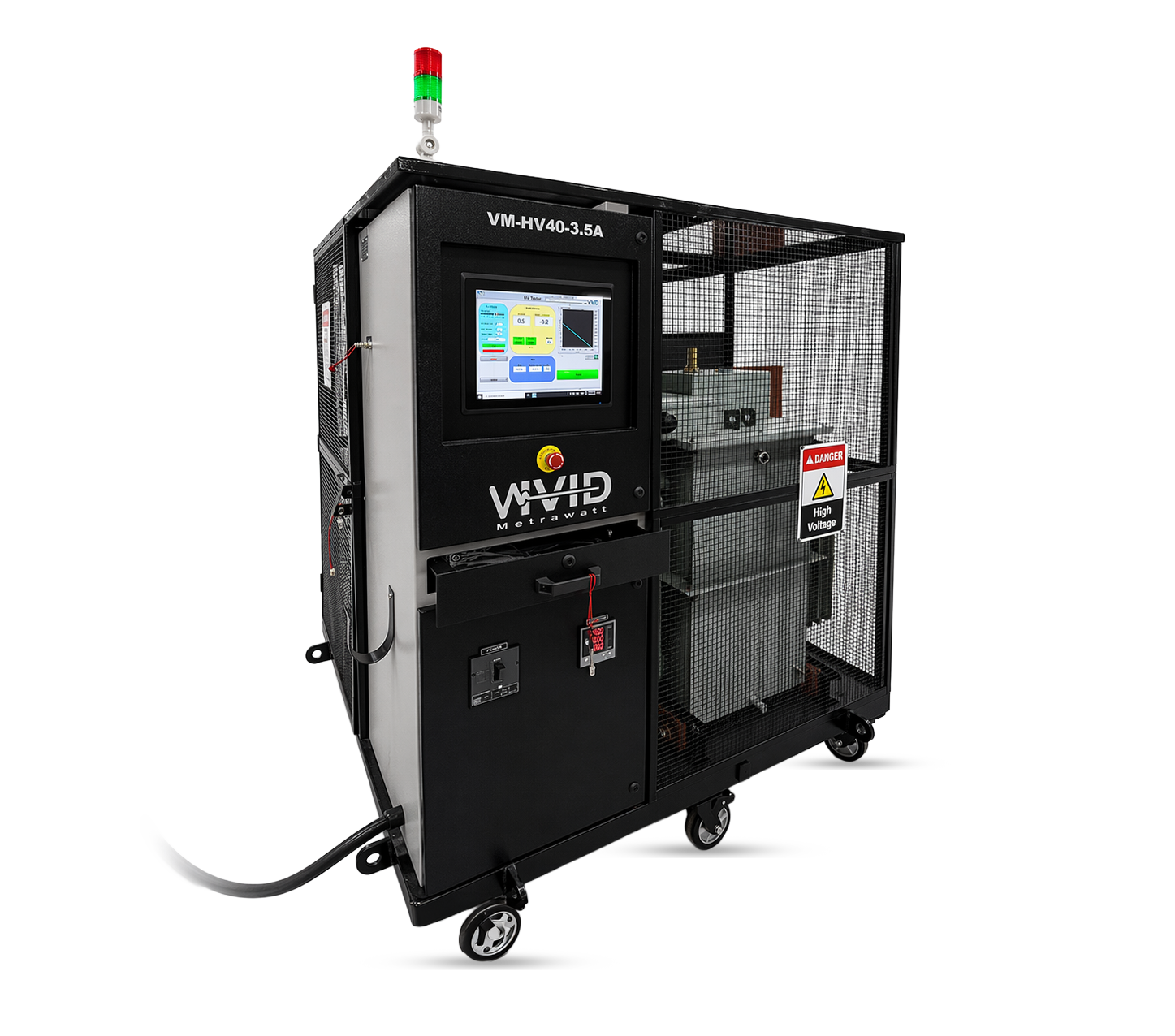
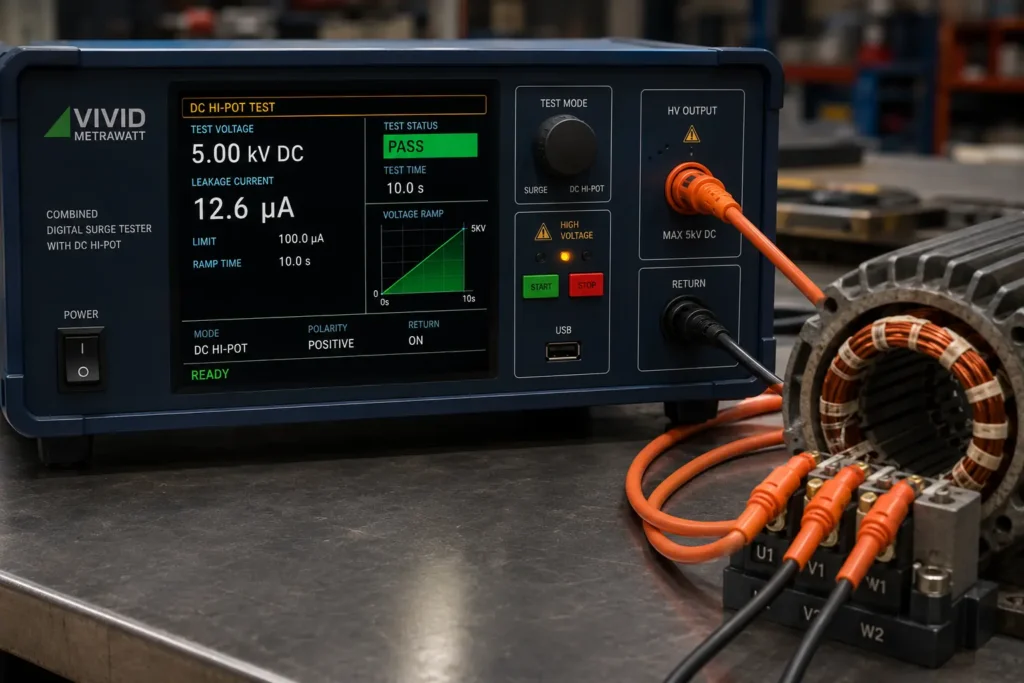
Vivid Metrawatt manufactures a range of digital surge testers with integrated DC Hi-Pot test function — a single instrument that performs both the surge waveform test and the DC withstand test in a single connected setup. This eliminates the need for two separate instruments, two sets of test connections, and two separate calibration records on the test certificate.
Available combined models by KV class:
| Model | Winding Voltage Class | Ideal Application |
|---|---|---|
| 5KV / 6KV Surge Tester with DC Hi-Pot | Up to 2.4 KV AC | Industrial stator and HVAC motor qualification; OEM production QC |
| 10KV / 12KV / 15KV Surge Tester with Hi-Pot | Up to 6.6 KV AC | Utility and process industry motor qualification; generator winding testing |
| 25KV / 30KV / 40KV Surge Tester with DC Hi-Pot | Up to 15 KV AC | Railway traction, power generation, heavy industry acceptance testing |
All Vivid Metrawatt digital surge testers are CE certified and compliant with IEEE and IEC specifications. For specifications and enquiries on any model, contact the Vivid Metrawatt team directly.
For the full product range, visit the Vivid Metrawatt Digital Surge Tester page.
A surge test applies a fast-rising impulse voltage to detect turn-to-turn insulation faults inside the winding coil, using waveform comparison. A Hi-Pot test applies a sustained high DC or AC voltage to test the ground wall insulation — the insulation barrier between the winding and the motor’s earthed frame — using leakage current monitoring. They test entirely different insulation structures and neither can substitute for the other.
No. A turn-to-turn short exists entirely within the winding coil — two adjacent wire turns in contact with each other. This fault has no electrical path to the earthed motor frame. Because the Hi-Pot test works by monitoring current flowing to ground, a turn-to-turn fault produces no change in the Hi-Pot leakage current and will not be detected. Only the surge test — which stresses the turn-to-turn insulation directly — will reveal it.
Always perform the surge test before the Hi-Pot test. If a turn-to-turn fault is present and Hi-Pot voltage is applied first, the sustained overvoltage may cause the fault to propagate through the slot insulation to ground — producing a Hi-Pot failure that is actually a downstream consequence of an undetected turn-to-turn fault, and potentially damaging the winding further. Identifying the turn-to-turn fault first with the surge test protects the integrity of the Hi-Pot result.
Yes. Several models in the Vivid Metrawatt range integrate DC Hi-Pot testing alongside the surge test function in a single instrument. These combined instruments — available at 5KV/6KV, 10KV/12KV/15KV, and 25KV/30KV/40KV — allow both tests to be completed without reconnecting or changing instruments, reducing test time and the risk of connection errors.
Per IEC 60034-1, the routine DC Hi-Pot test voltage for a 415V motor is typically 2× rated voltage + 1000V = approximately 1830V DC applied between winding and frame. This is a guideline; the applicable voltage depends on the specific product standard, the motor’s voltage class, whether it is a routine test or type test, and any customer specification requirements. Always refer to the applicable standard for the exact test voltage.
A Hi-Pot test conducted at the voltage levels specified in the applicable standard (routine test levels) is intended to be non-destructive to healthy windings. However, it is a more aggressive stress test than a Megger — it applies a significantly higher voltage for a sustained duration. A winding with marginal or already-degraded ground insulation may not survive the Hi-Pot test; this is by design — the test is intended to find weak insulation before the motor is put into service, rather than finding it through an in-service failure.
Both test ground insulation — from winding to frame — but with different purposes. The Megger test measures insulation resistance in megohms: is the insulation healthy and dry? The Hi-Pot test applies a withstand voltage: can the insulation survive a defined overvoltage without breaking down? The Megger gives you a diagnostic value that can be trended over time; the Hi-Pot gives you a binary pass/fail on withstand capability. Both are required in a comprehensive testing programme.
Get Both Tests Done — in One Instrument
Vivid Metrawatt’s combined surge tester and DC Hi-Pot instruments let you complete the full winding insulation qualification sequence in a single connected setup — with no instrument change, no re-connection, and a single test record. CE certified. IEEE and IEC compliant. Trusted by Indian Railways and industrial facilities across more than 30 countries.
→ View 5KV / 6KV Surge Tester with DC Hi-Pot
→ View 10KV / 12KV / 15KV Surge Tester with Hi-Pot