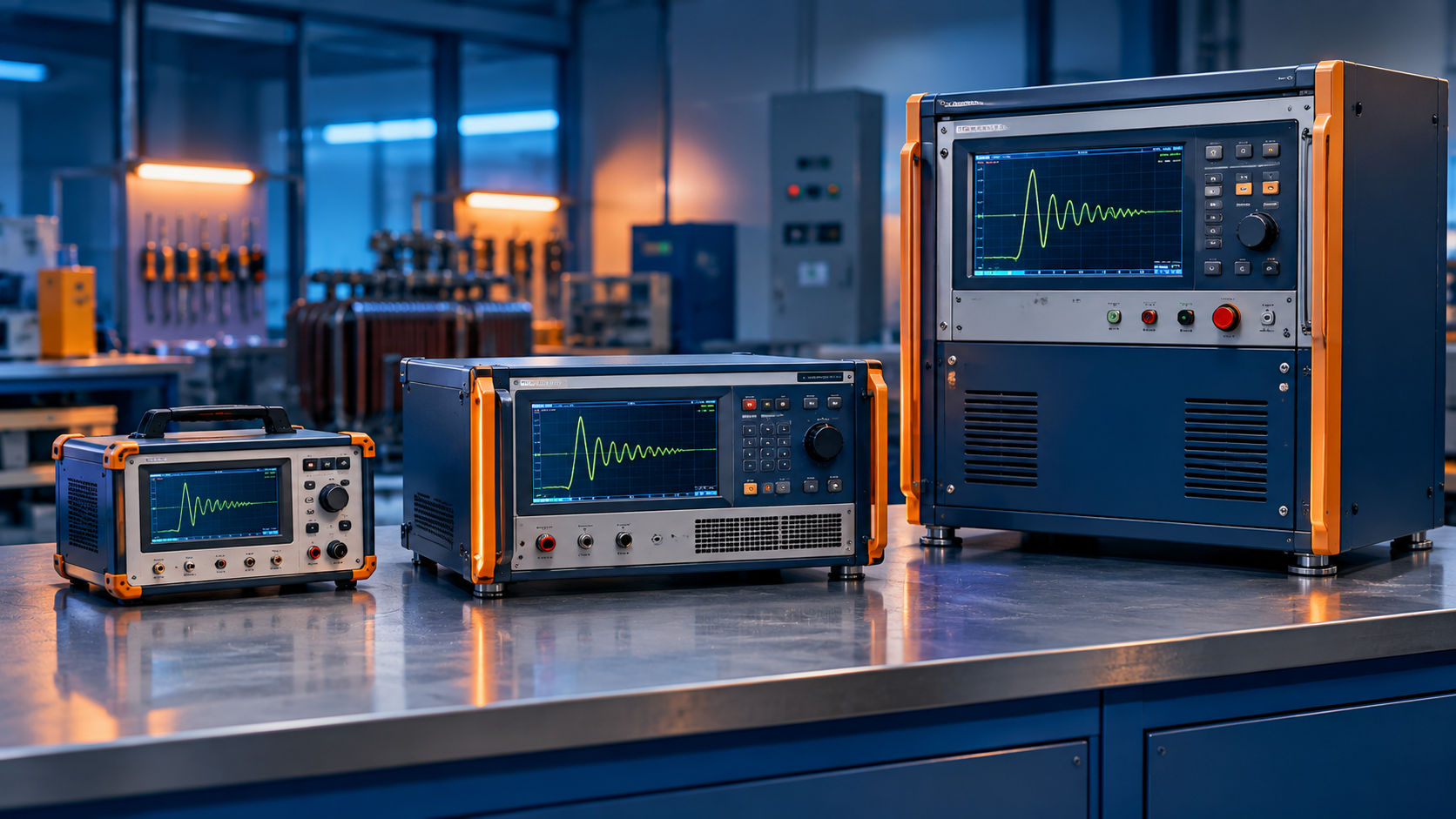

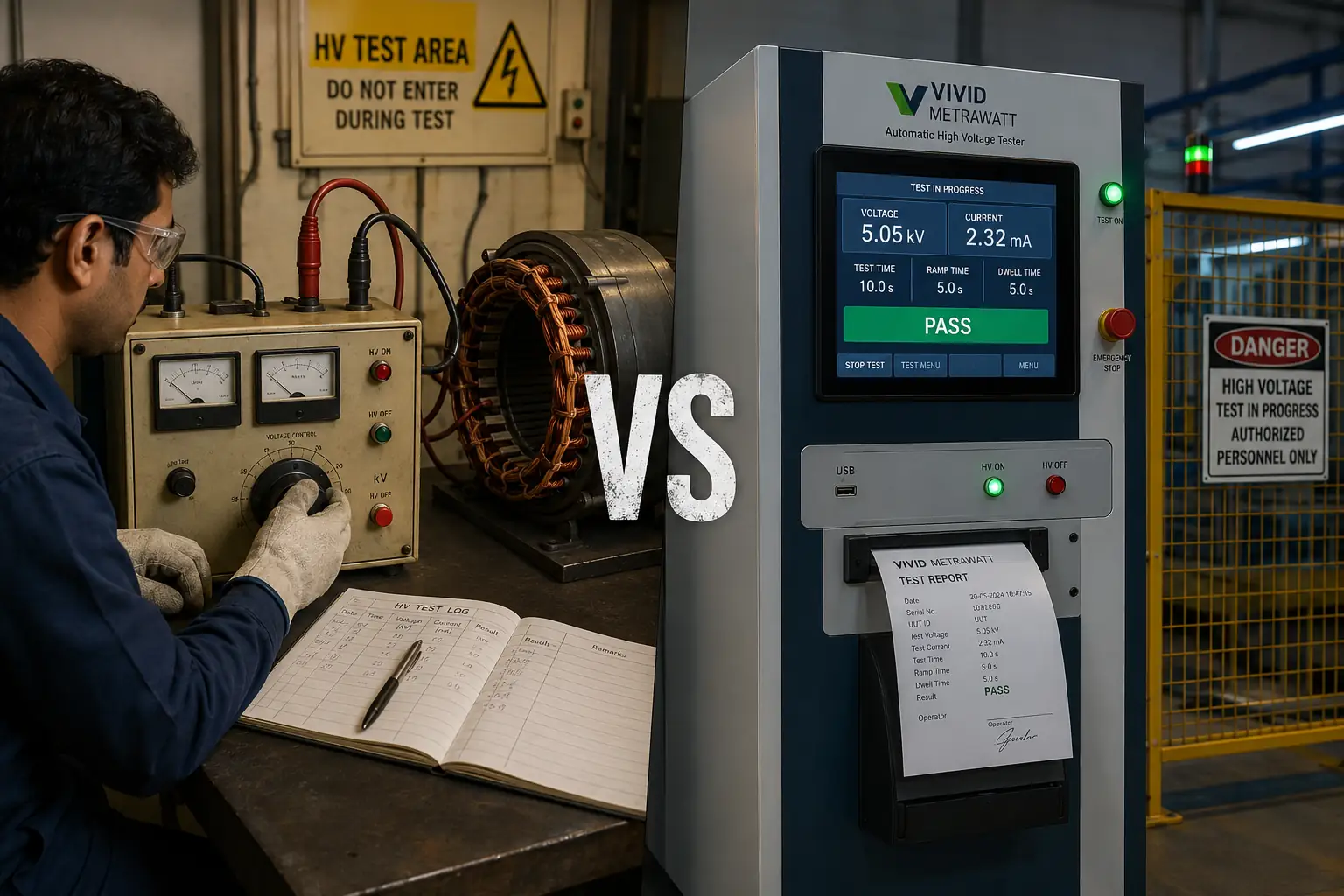
A single undetected insulation failure in a production motor, transformer, or cable assembly can result in a warranty claim, a safety incident, or a field failure that costs far more than any testing programme would ever have. Yet many facilities still rely on manual high-voltage testing — where test voltage is set by hand, leakage current is read off a panel meter, and the pass/fail decision is recorded in a paper logbook. Automatic high voltage testers replace every one of those manual steps with a controlled, documented, repeatable system. This complete buyer’s guide covers what an automatic HV tester does, which applications and kV ratings are relevant to your industry, and what to look for in each model — based entirely on the confirmed VM-HV Series from Vivid Metrawatt.
Table of Contents
An automatic high voltage tester is a fully computerized electrical test instrument that applies a precisely controlled high voltage — between 15kV and 40kV depending on the model — to electrical equipment under test, monitors the resulting leakage current in real time, and automatically determines a pass or fail result against a pre-defined acceptance threshold. The entire test sequence — voltage ramp, hold, measurement, evaluation, and recording — is controlled by the instrument’s software and HMI, with no manual intervention required from the operator once the test is initiated.
This makes the automatic HV tester fundamentally different from manual high-voltage test equipment, where the operator controls the voltage dial, reads the current from an analogue panel meter, makes a subjective pass/fail judgement, and records the result manually. The automatic system removes every source of operator-dependent variability from the test result.
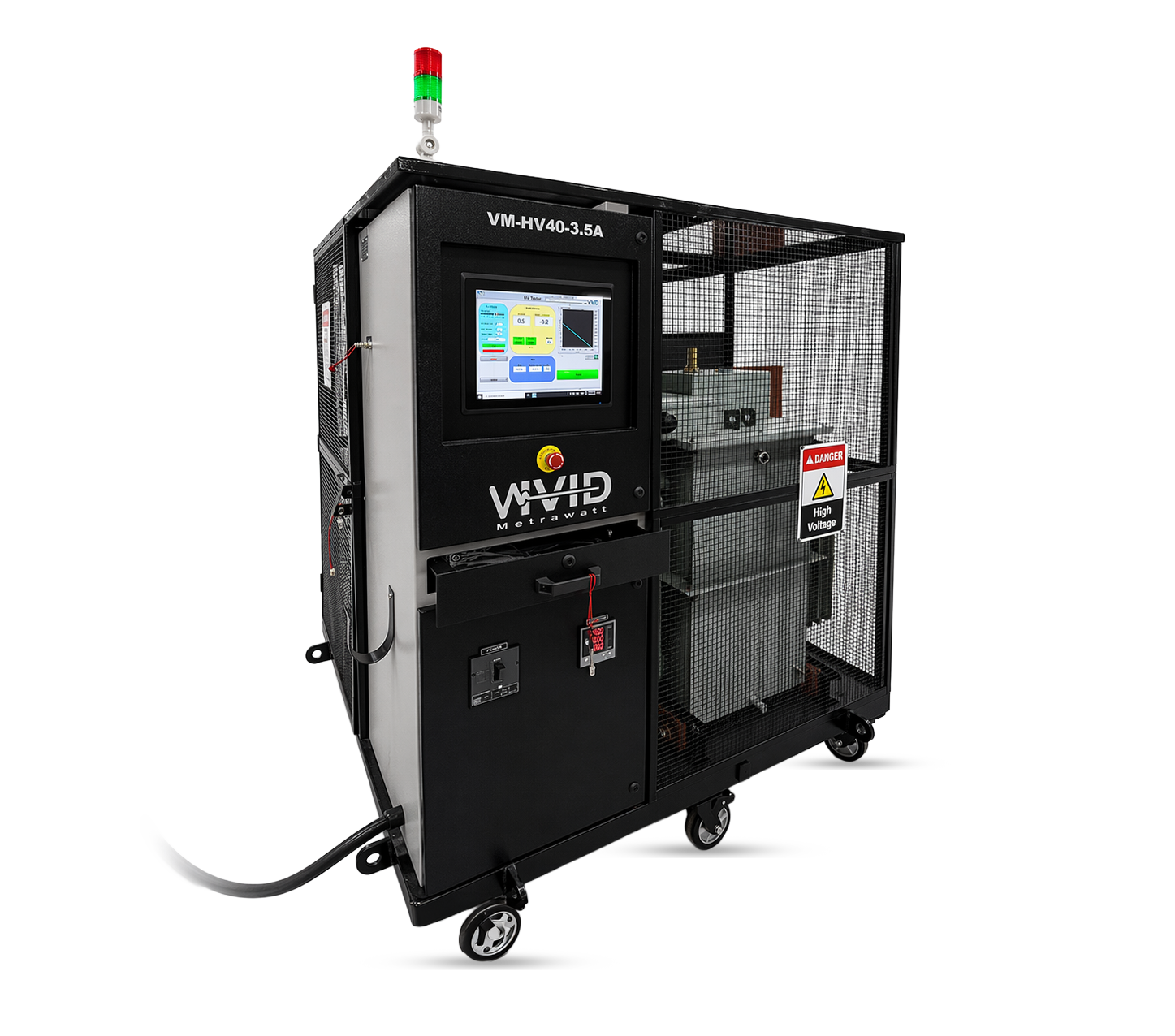
The Vivid Metrawatt VM-HV Series — available in 15kV, 20kV, 30kV, and 40kV models — is a fully computerized testing solution with HMI-based operation, real-time monitoring, integrated data logging, automatic report generation, and a safety barricading system with interlocks. Every model in the series is compliant with IEEE and IEC standards, CE certified, and manufactured to the same industrial quality standard that has supplied 30+ countries over nearly 30 years.
Key distinction: The term “high voltage tester” covers a wide range of instruments — from simple manual hipot testers to fully computerized production systems. This guide covers the computerized automatic category: instruments where the test sequence, data recording, and pass/fail determination are all handled by the instrument’s software — not the operator.
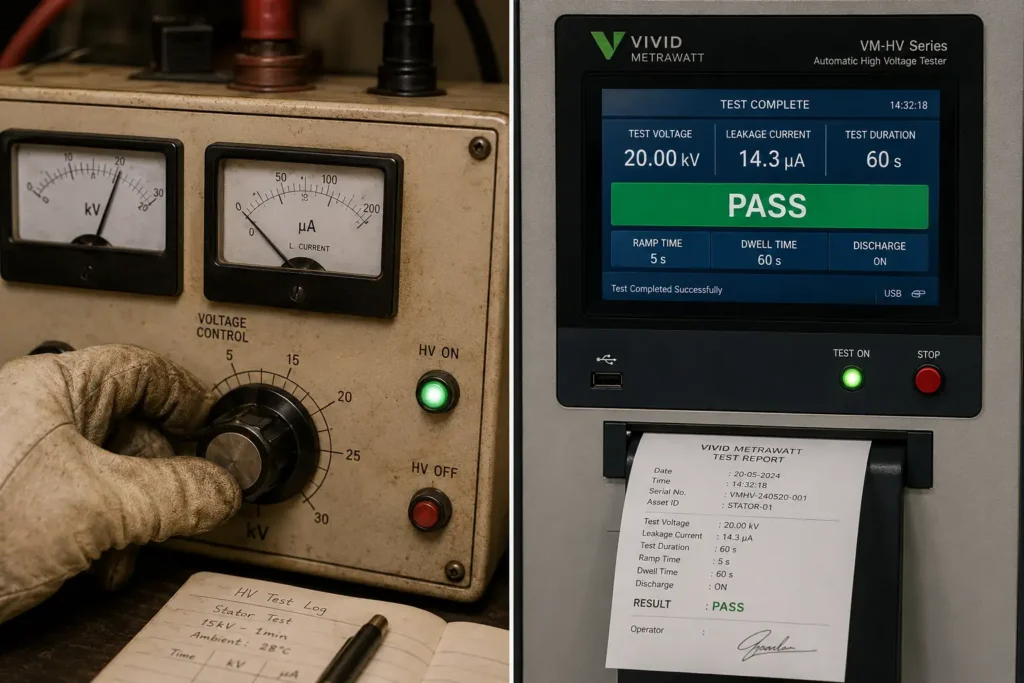
The automatic high voltage test — also called a dielectric withstand test or HiPot test — applies a sustained high voltage between the equipment’s winding conductors and its earthed metal frame, and monitors the resulting leakage current. The test verifies that the ground wall insulation can withstand a defined overvoltage level without breaking down. For a technical explanation, see our guide on what is a high voltage test.
In the VM-HV Series, the test sequence works as follows:
The VM-HV Series is confirmed for the following test applications — verified from all four individual product pages:
Testing of stators, coils, and winding assemblies for insulation integrity. After rewinding or manufacturing, every stator must pass an HV withstand test to confirm that the ground wall insulation can withstand the rated dielectric stress without breakdown — as required by IEC 60034-1.
Verification of transformer insulation and dielectric withstand capability. Both distribution transformers and power transformers require HV withstand testing at the coil and assembly level before commissioning.
Quality and insulation testing of electrical cables and wiring systems. Cable manufacturers use HV testing to verify insulation integrity before despatch — confirming that insulation voids, pinholes, or contamination are absent in the finished cable.
Routine production line testing and quality assurance for manufactured electrical components. The automatic operation of the VM-HV Series — no operator intervention required after test initiation — makes it directly compatible with production line workflows where every unit must be tested, documented, and cleared before the next stage.
The VM-HV Series is confirmed for laboratory, research, and development environments — including insulation material testing, prototype evaluation, and standards compliance verification.
The kV rating of an automatic HV tester must be matched to the operating voltage class of the equipment being tested and the test voltage required by the applicable standard. Each model in the VM-HV Series includes sub-models designated -1A through -5A, denoting different current output capacities for different test load requirements.
The VM-HV15 (Automatic High Voltage Tester – 15kV) is engineered for accurate insulation and dielectric strength testing of motors, stators, coils, transformers, and cables where the required test voltage falls within 15kV. This covers equipment with operating voltages up to approximately 6.6kV, where the standard test voltage formula (2× rated voltage + 1000V per IEC 60034-1) remains within 15kV.
The VM-HV20 (Automatic High Voltage Tester – 20kV) is a high-performance testing system for precise evaluation of electrical insulation and product reliability. It provides stable high-voltage output up to 20kV with accurate monitoring and automated testing capabilities — suited to medium-voltage motor stators, transformer coils, and cable assemblies in the upper medium-voltage class.
The VM-HV30 (Automatic High Voltage Tester – 30kV) is a robust and intelligent testing platform for medium to high-voltage electrical testing. At 30kV it covers large traction motors, high-voltage generator coils, and distribution-class transformer windings. It is suitable for production lines, quality assurance facilities, and laboratories handling high-voltage electrical products.
The VM-HV40 (Automatic High Voltage Tester – 40kV) is the highest-capacity model, developed for advanced high-voltage testing applications requiring exceptional accuracy and safety. It covers the most demanding requirements — large transformers, high-voltage motors, specialist cables, and insulation systems for critical applications such as aerospace, defence, and power utilities.
Sub-model selection: The -1A through -5A sub-model suffix within each kV rating denotes current output capacity — directly affecting suitability for high-capacitance loads such as large windings or long cables. Specifying the correct sub-model is as important as the kV level. Vivid Metrawatt’s engineering team can advise based on your specific test load parameters.
| Model | Max Output Voltage | Sub-Models | Primary Positioning | Typical Application |
|---|---|---|---|---|
| VM-HV15 | 15kV | VM-HV15-1A to VM-HV15-5A | Reliable dielectric testing; entry-level HV | Motors, stators, coils, transformers, cables (up to ~6.6kV operating voltage class) |
| VM-HV20 | 20kV | VM-HV20-1A to VM-HV20-5A | High-performance; demanding industrial applications | Medium-voltage motors, transformer coils, cable assemblies |
| VM-HV30 | 30kV | VM-HV30-1A to VM-HV30-5A | Robust platform; medium-to-high voltage | Traction motors, HV generator coils, distribution transformers, production QA labs |
| VM-HV40 | 40kV | VM-HV40-1A to VM-HV40-5A | Highest capacity; critical electrical environments | Large transformers, HV motors, specialist cables, aerospace, defence, power utilities |
All four models share the same complete feature set — computerized control, HMI-based operation, real-time voltage and current monitoring, data logging, automatic report generation, safety barricading with interlocks, and heavy-duty industrial construction. The differentiation is the maximum output voltage and the current output sub-model range. For the full product listing, visit the Vivid Metrawatt Automatic High Voltage Tester page.
![Automatic High Voltage Tester: Buyers Guide [2026]](https://vividmetrawattglobal.com/wp-content/uploads/2026/08/a_wide_well_lit_industrial_workshop_scene_with_a-1024x683.webp)
All features above are confirmed as standard across the full VM-HV Series. For detail on how the HV withstand test compares to other insulation test types, see our guide on AC HiPot vs DC HiPot testing.
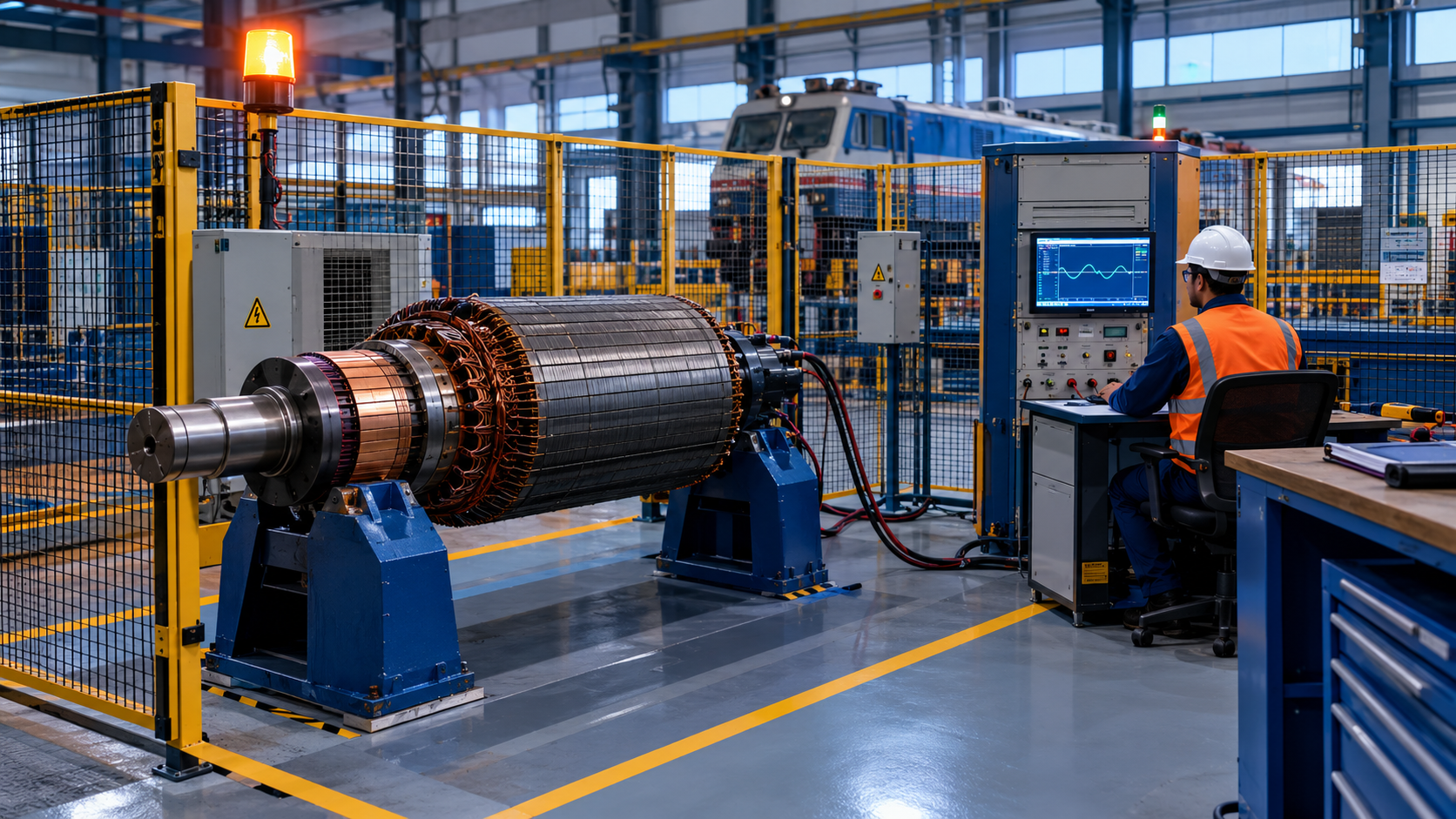
High voltage testing carries inherent operator safety risks that make the safety architecture of the test system as important as its measurement capability. The VM-HV Series addresses safety at two levels: the interlock system and the barricading system — both confirmed as standard across all four models.
The integrated safety barricading system creates a physical safety perimeter around the high-voltage test zone. The barricade is interlocked — the HV output cannot be energised unless the barricade is fully closed, and the HV output is immediately disconnected if the barricade is opened during a test.
The interlock protection system provides a second safety layer. Multiple interlocks — covering the barricade, the HV output connection, and the instrument’s safety circuits — must all confirm a safe state before the high-voltage test sequence can begin. Any interlock fault is detected before the test starts, not during it.
Safety note: Even with a fully interlocked automatic HV tester, formal safe working procedures, operator HV safety training, and lockout/tagout protocols remain required. The instrument’s safety systems supplement — they do not replace — proper safety management practices.
The following industries are confirmed from VM-HV Series product pages and Vivid Metrawatt’s confirmed client and industry base:
When specifying electrical test equipment for motor and winding qualification, a common question is the relationship between the automatic HV tester and the digital surge tester. They perform different tests on different insulation structures.
The automatic HV tester performs the dielectric withstand test — sustained high voltage between winding and ground to verify ground wall insulation withstand. It answers: can this insulation barrier survive a defined overvoltage?
The digital surge tester performs the impulse winding test — fast-rising impulse and waveform comparison between phases to detect turn-to-turn faults. It answers: is the turn-to-turn insulation inside this winding intact?
A complete winding qualification programme requires both. For the relationship between these two tests and the correct testing sequence, see our guide on surge tester vs HiPot tester. Vivid Metrawatt supplies both families — VM-HV Series for HV withstand and the digital surge tester range (1kV to 50kV) for impulse winding testing. For applications requiring both tests in one instrument, see the 5kV/6kV Digital Surge Tester with DC Hi-Pot and the 10kV/12kV/15kV Digital Surge Tester with Hi-Pot.
A fully computerized instrument that applies a precisely controlled high voltage to electrical equipment, monitors leakage current in real time, automatically determines pass or fail, and records and reports test data without manual operator intervention. The Vivid Metrawatt VM-HV Series is available in 15kV, 20kV, 30kV, and 40kV models.
15kV (VM-HV15-1A to VM-HV15-5A), 20kV (VM-HV20-1A to VM-HV20-5A), 30kV (VM-HV30-1A to VM-HV30-5A), and 40kV (VM-HV40-1A to VM-HV40-5A). The -1A to -5A suffix denotes different current output capacities within each voltage rating. Custom configurations are available.
Confirmed: motor and generator manufacturing, transformer manufacturing, cable and wire assembly, Indian Railways and traction, automotive including EV, aerospace, HVAC and pumps, wind energy, power generation, and R&D laboratories.
Yes — standard across all VM-HV Series models. The instrument generates a structured test report instantly after each test including pass/fail result, measured leakage current, actual test voltage, test duration, date/time stamp, and equipment identification.
All models include an integrated safety barricading system with interlocks. The HV output cannot be energised unless all interlocks confirm a safe state. Any interlock opening during a test immediately shuts down HV output. Controlled voltage ramp-up is also standard.
Yes. Test voltage is fully programmable within the instrument’s rated maximum. Parameters — voltage level, ramp rate, hold duration, and leakage current threshold — are set in software and saved as named test programmes for recall on subsequent sessions.
Confirmed from product pages: stators, coils and winding assemblies; transformers; electrical cables and wiring systems; production line QC testing; and laboratory and R&D applications.
Match the model to the operating voltage class of your equipment and the test voltage in the applicable standard (typically IEC 60034-1 for rotating machines). General guide: up to ~6.6kV operating → VM-HV15; up to ~9.5kV → VM-HV20; up to ~14.5kV → VM-HV30; above that → VM-HV40. For precise sub-model selection, contact Vivid Metrawatt’s technical team.
Automatic HV testers eliminate operator-dependent variability from every aspect of the test: voltage setting, current reading, pass/fail judgement, and data recording. They deliver higher throughput, complete traceability, automatic documentation, and a certified interlock safety system — none of which are available on manual instruments.
Specify the Right Automatic HV Tester for Your Application
The VM-HV Series covers every major high-voltage testing requirement from 15kV to 40kV — full computerized control, real-time monitoring, automatic data logging, instant report generation, and a certified safety interlock system. CE certified, IEEE and IEC compliant, manufactured by Vivid Metrawatt — supplying 30+ countries for nearly 30 years.
→ View Automatic High Voltage Tester – 15kV
→ View Automatic High Voltage Tester – 20kV
→ View Automatic High Voltage Tester – 30kV
→ View Automatic High Voltage Tester – 40kV
→ Contact Vivid Metrawatt for Technical Specification Advice

![Surge Testing for Wind Turbine Generators: Complete Guide [2026]](https://vividmetrawattglobal.com/wp-content/uploads/2026/09/a_wide_cinematic_industrial_outdoor_scene_at_an_o.webp)