
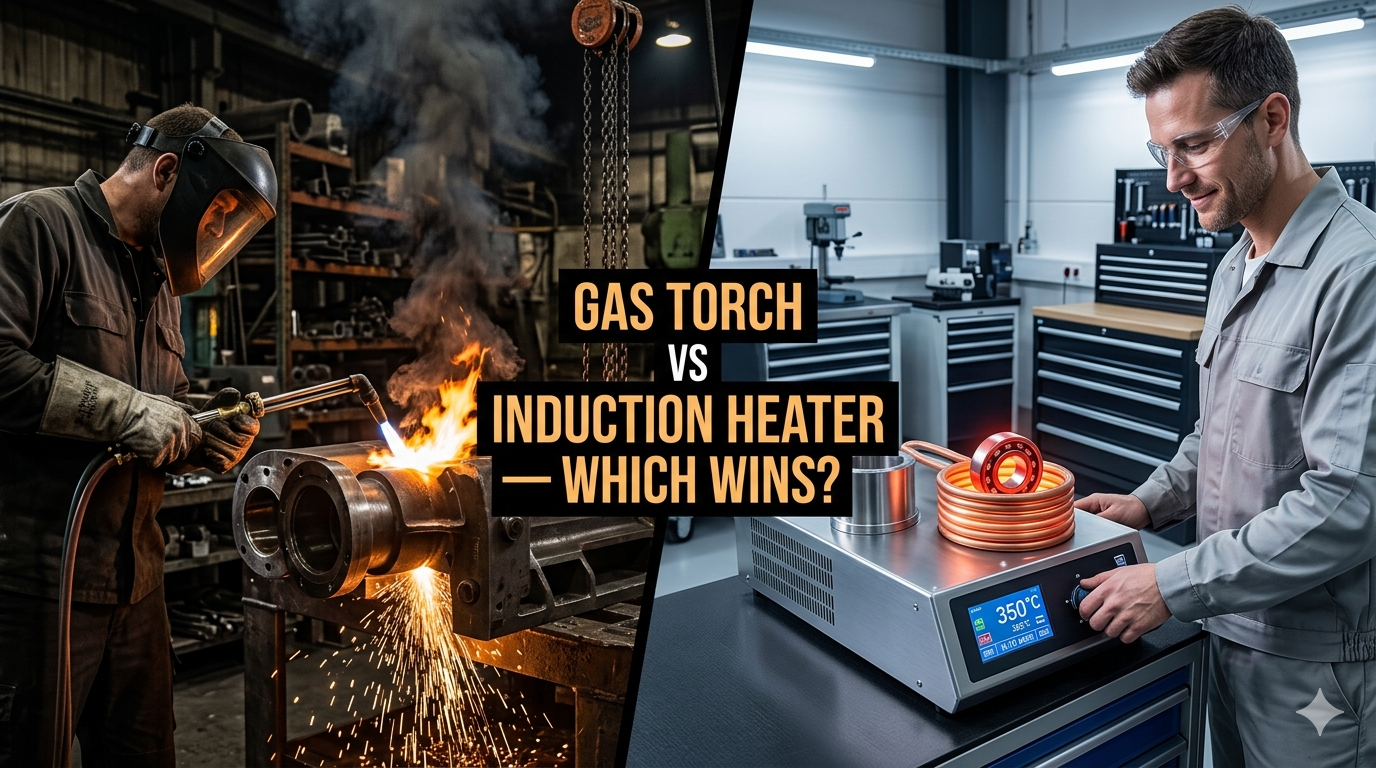
Gas torches have been the workhorse of industrial heating for decades. They are familiar, widely available, and inexpensive to purchase. But familiarity is not the same as optimality — and in modern industrial environments, the gas torch is increasingly being outpaced by induction heating on almost every measurable metric.
This comprehensive comparison covers safety, temperature control, energy efficiency, operational cost, and real-world suitability — so you can make a fully informed decision for your facility.
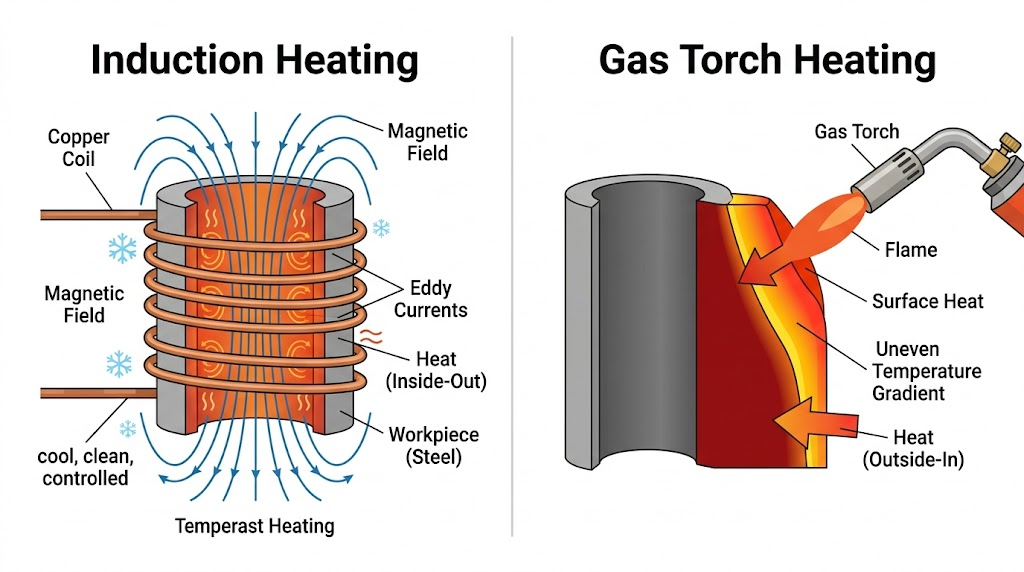
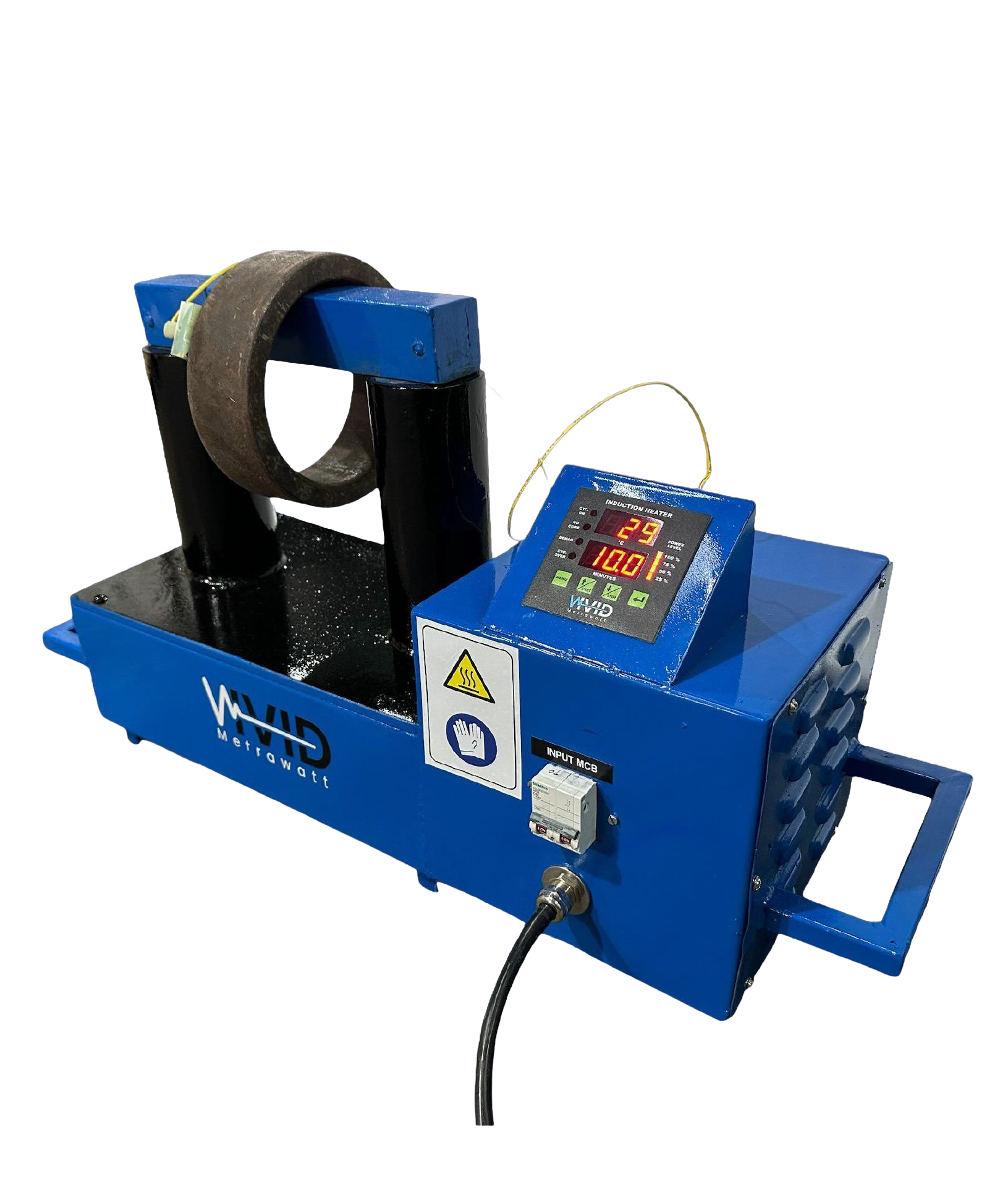
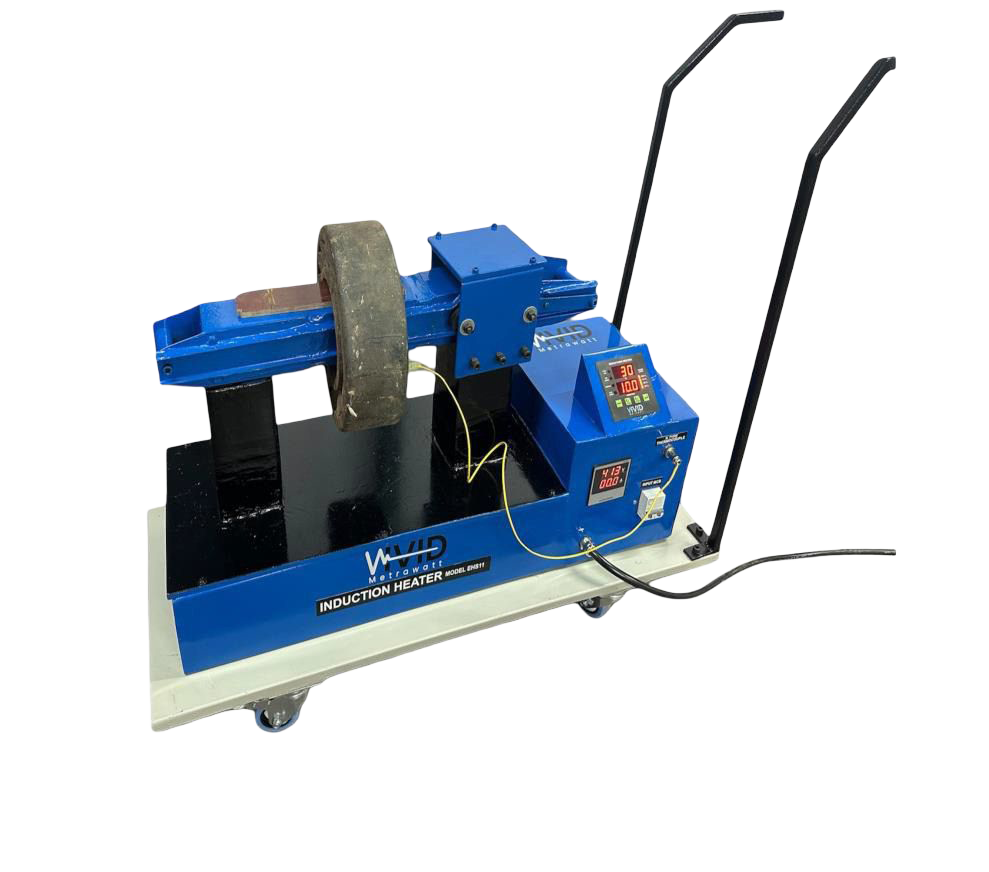
Induction heaters generate a high-frequency alternating magnetic field through a copper coil. When a conductive workpiece is placed inside or near the coil, eddy currents are induced directly inside the metal, generating heat from within. There is no open flame, no combustion, and no direct contact between the coil and the component.
A gas torch burns a fuel-oxidiser mixture — typically LPG, acetylene, or propane — to produce an open flame. Heat is transferred to the workpiece primarily by convection and radiation from the flame surface. The process is manually controlled and inherently less precise.
📖 For a detailed look at induction heating technology, explore the Vivid Metrawatt Induction Heater product page and our full induction heater range.
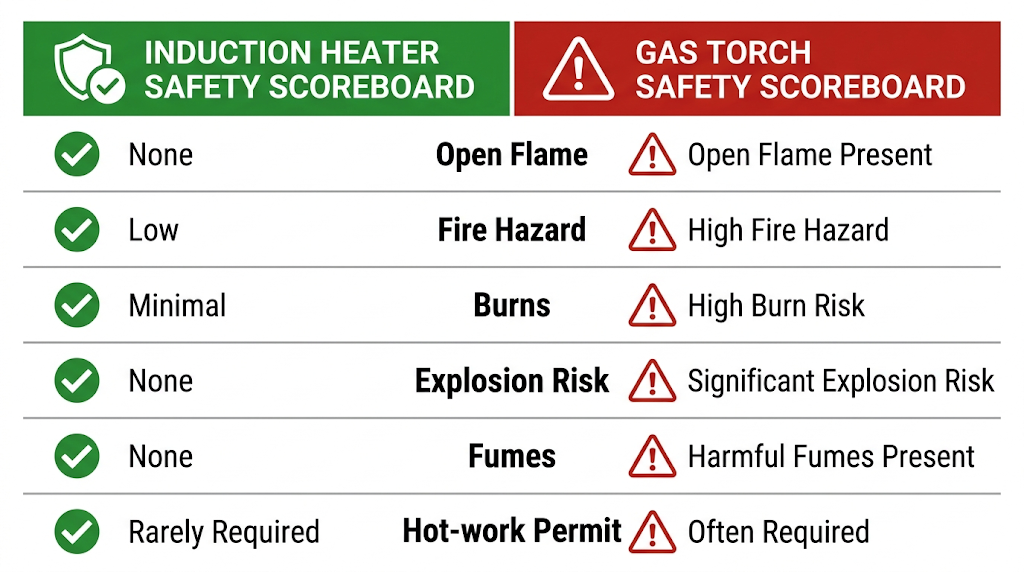
Safety is often the single most compelling reason to switch from gas torches to induction heaters.
| Safety Factor | Induction Heater | Gas Torch |
|---|---|---|
| Open Flame | None | Yes — constant risk |
| Fire Hazard | Minimal | High — especially near lubricants, seals |
| Burns to Operators | Low (coil is cool to touch) | High — radiant heat, flame contact |
| Explosion Risk | None | Present — gas leaks, cylinder handling |
| Fume / Smoke Generation | None | Yes — combustion byproducts |
| Hot-work Permit Required | Typically not required | Yes — in most facilities |
In facilities handling lubricants, hydraulic oils, solvents, or flammable materials, an open gas flame is a serious HSE liability. Induction heaters eliminate that risk entirely. Many large manufacturing plants have banned gas torches outright in enclosed maintenance bays precisely for this reason.
📖 Explore common induction heater mistakes that compromise safety — even the best technology requires correct operating practice.
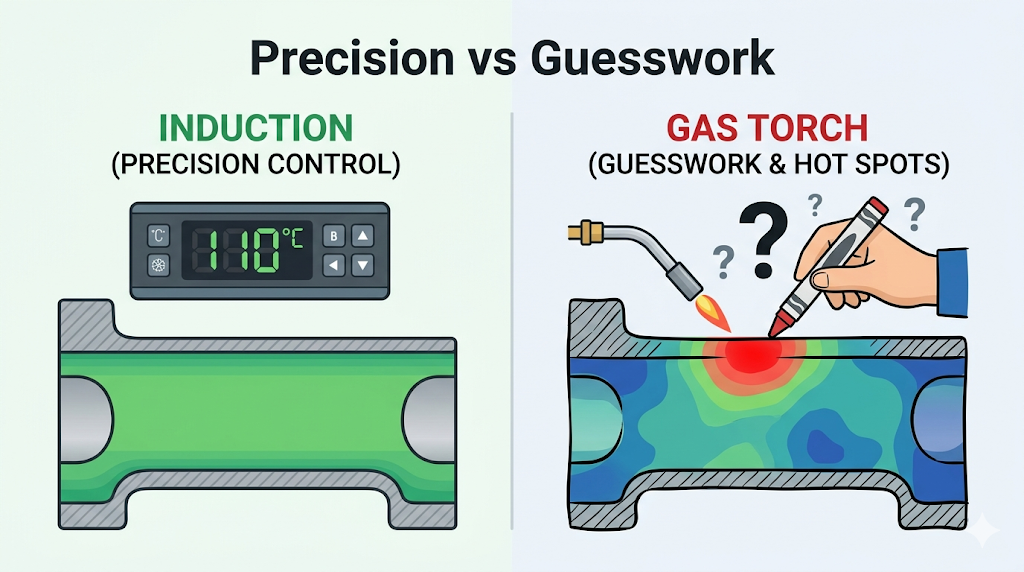
This is where the performance gap between induction and gas becomes most apparent.
🔧 Our 22 kW induction heater features a precision temperature controller with programmable set points, making it ideal for high-tolerance bearing and gear installations.
Gas torch heating is notoriously wasteful — the majority of combustion energy is lost to the surrounding environment through radiation and convective air currents. Induction heating delivers energy directly inside the workpiece, where it is needed.
| Efficiency Metric | Induction Heater | Gas Torch |
|---|---|---|
| Energy transfer efficiency | 85–95% | 30–50% |
| Heat losses to environment | Minimal | Very high |
| Fuel/energy cost per job | Lower | Higher (gas consumption) |
| Setup time | 2–3 minutes | 5–10 minutes |
| Operator training required | Minimal — digital interface | Significant |
Over a one-year period, a facility performing 15 bearing heating operations per week will typically recover the cost of a premium induction heater within 12–18 months purely through gas cost savings — before accounting for reduced hot-work permit administration, fire watch costs, or insurance implications.
📄 Download full product specifications from the Vivid Metrawatt resources section to compare energy ratings across our induction heater models.
Induction heaters heat components faster than gas torches for equivalent component sizes. The energy is deposited directly and uniformly, rather than working from the outside in.
Gas torch heating generates CO₂, CO, and nitrogen oxide emissions. In enclosed spaces, this requires forced ventilation and regular air quality monitoring. Induction heaters produce zero combustion emissions. They also contribute to ESG targets by reducing on-site fossil fuel consumption — a growing requirement for publicly listed industrial companies.
Many facilities are finding that switching to induction heating supports ISO 14001 environmental management compliance and simplifies ATEX zone risk assessments.
📖 Read more on our about page for our commitment to responsible industrial solutions.
| Criterion | Induction Heater | Gas Torch |
|---|---|---|
| Open flame | No | Yes |
| Temperature control | Digital, precise (±2°C) | Manual, variable |
| Energy efficiency | 85–95% | 30–50% |
| Heating speed | Fast (3–5 min per cycle) | Slower (10–20 min) |
| Operator safety | High | Moderate to low |
| Hot-work permit | Not required (most sites) | Required |
| Emissions | Zero | CO₂, CO, NOx |
| Initial cost | Higher | Lower |
| Running cost (annual) | Lower | Higher |
| Demagnetisation | Automatic | Not available |
| Best for | Precision fits, production lines | Rough heating, outdoor welding prep |
In the vast majority of planned industrial maintenance operations, induction heating is the superior choice — not by a narrow margin, but decisively.
📞 Contact our specialists via the Vivid Metrawatt contact page to discuss the right solution for your specific application.
Key Takeaways
- The comparison is framed as decisively resolved, not marginal. Across every metric in this piece (safety, precision, speed, efficiency, emissions, long-term cost), induction is positioned as superior — gas is framed as retaining only a narrow niche.
- Safety is presented as the strongest differentiator. No open flame, no explosion risk, no fume generation, and typically no hot-work permit — this matters most in facilities with lubricants, solvents, or enclosed maintenance bays where gas represents a genuine HSE liability.
- Gas retains legitimate use cases, not just theoretical ones. Large outdoor structural steel preheating before welding, emergency field repairs without portable power access, and very large/irregular geometries where coils can’t be positioned are named as scenarios where gas remains practical.
- The efficiency gap directly drives the cost case. Because gas loses the majority of combustion energy to the environment (only 30–50% efficient) versus induction’s 85–95%, the fuel-cost savings compound quickly — this is the mechanical reason behind the 12–18 month payback claim, not just a marketing number.
- Automatic cut-off removes the single biggest gas-torch failure mode. Manual, operator-skill-dependent heating with no automatic cut-off is identified as the direct cause of localised overheating and metallurgical damage — a risk induction’s automatic cutoff structurally eliminates.
- ESG/compliance angle is increasingly a procurement driver. Zero emissions and easier ATEX/ISO 14001 alignment are framed as relevant to publicly listed industrial companies specifically — worth noting if your audience includes compliance-driven buyers vs. pure cost-driven ones.
- This is vendor content — read the ROI/efficiency figures as illustrative, not independently audited. The 85–95% vs 30–50% efficiency figures and 12–18 month payback are presented without citation to an external source or methodology.
Yes, categorically. Induction heaters produce no open flame, no combustion gases, and no radiant burn risk to operators. They are the preferred heating method in any enclosed industrial environment.
For planned maintenance tasks — bearing fitting, gear mounting, coupling removal — yes, completely. For large-scale structural preheating in open environments, gas may still be used as a supplementary method.
A quality industrial induction heater costs more upfront than a gas torch set. However, the reduction in gas costs, safety administration, maintenance downtime, and component damage means the ROI is typically achieved within 12–24 months.
The learning curve is minimal. Modern induction heaters feature intuitive digital interfaces. Most operators are fully proficient within a single training session.
The induction heater vs gas torch debate is essentially resolved in most modern industrial settings. Induction heating wins on safety, precision, speed, energy efficiency, environmental impact, and long-term operational cost. Gas torches retain a niche role in specific outdoor and structural applications, but for the organised maintenance workshop, they are an outdated choice.
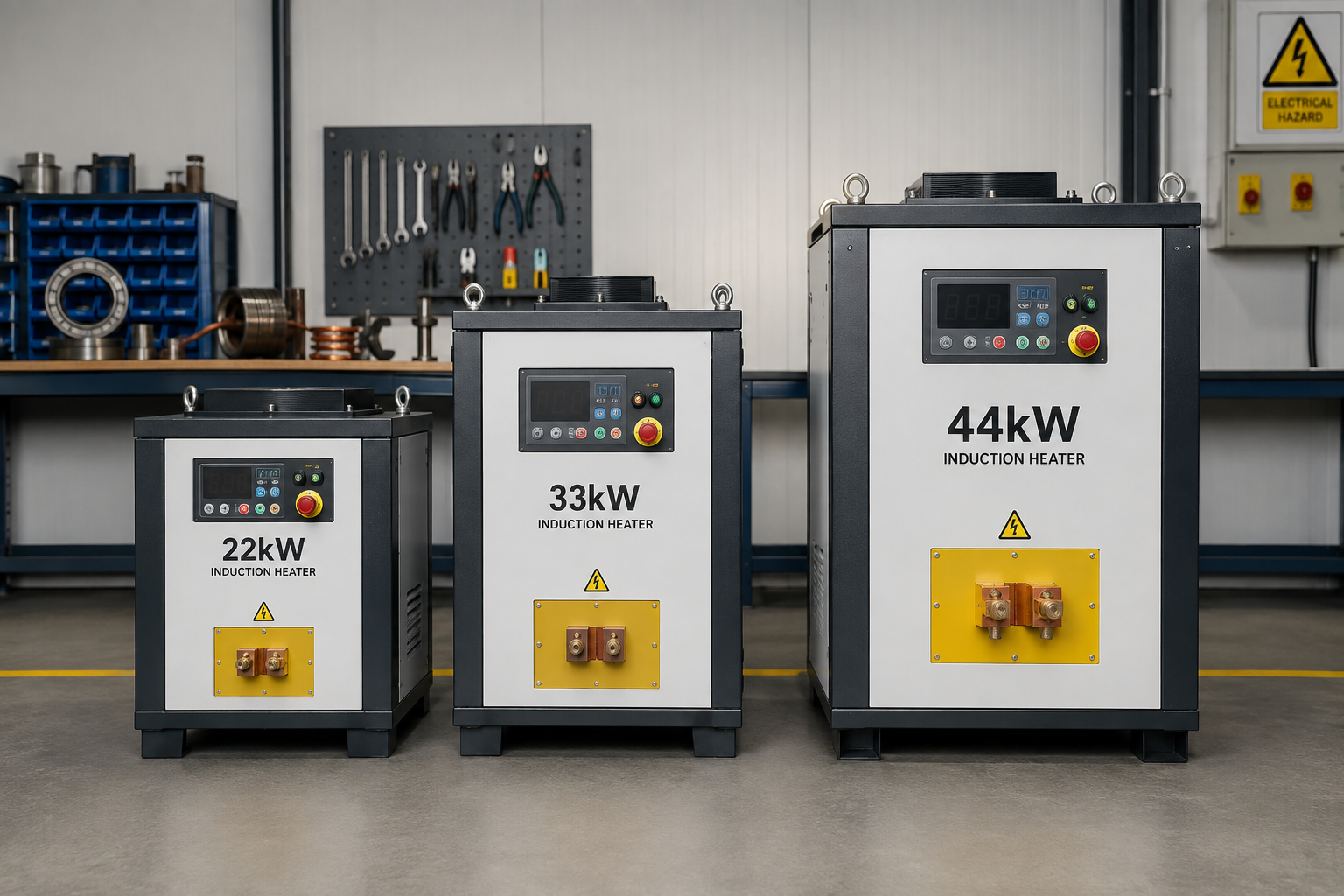
Vivid Metrawatt’s range of industrial induction heaters — from 10 kW to 44 kW — offers a solution for every scale of operation, backed by full technical support and proven global deployments.
✅ Zero flame. Zero fume. Zero compromise on precision.
✅ Models from 10 kW to 44 kW — suitable for every industrial application
✅ Free ROI analysis available on request