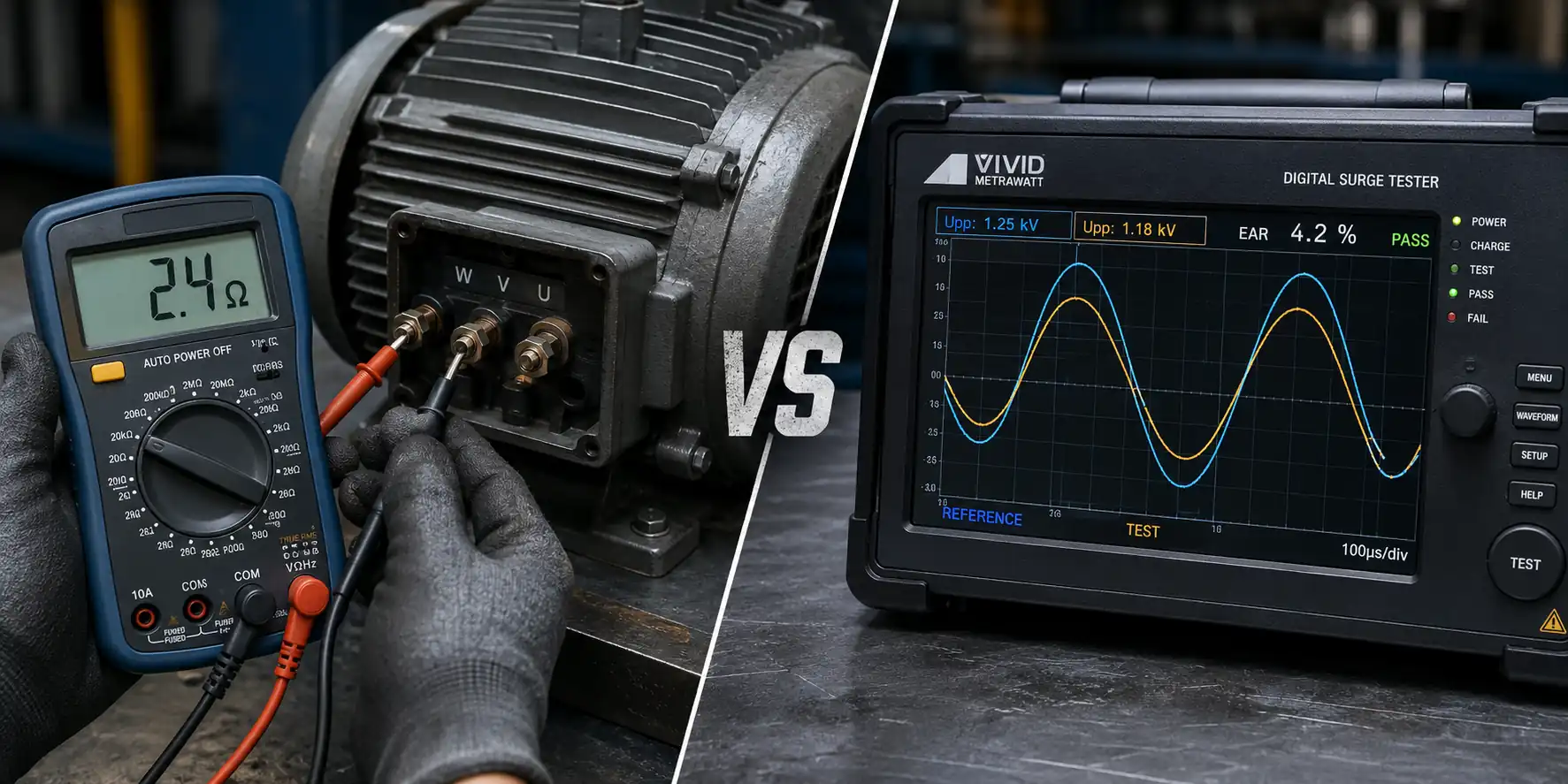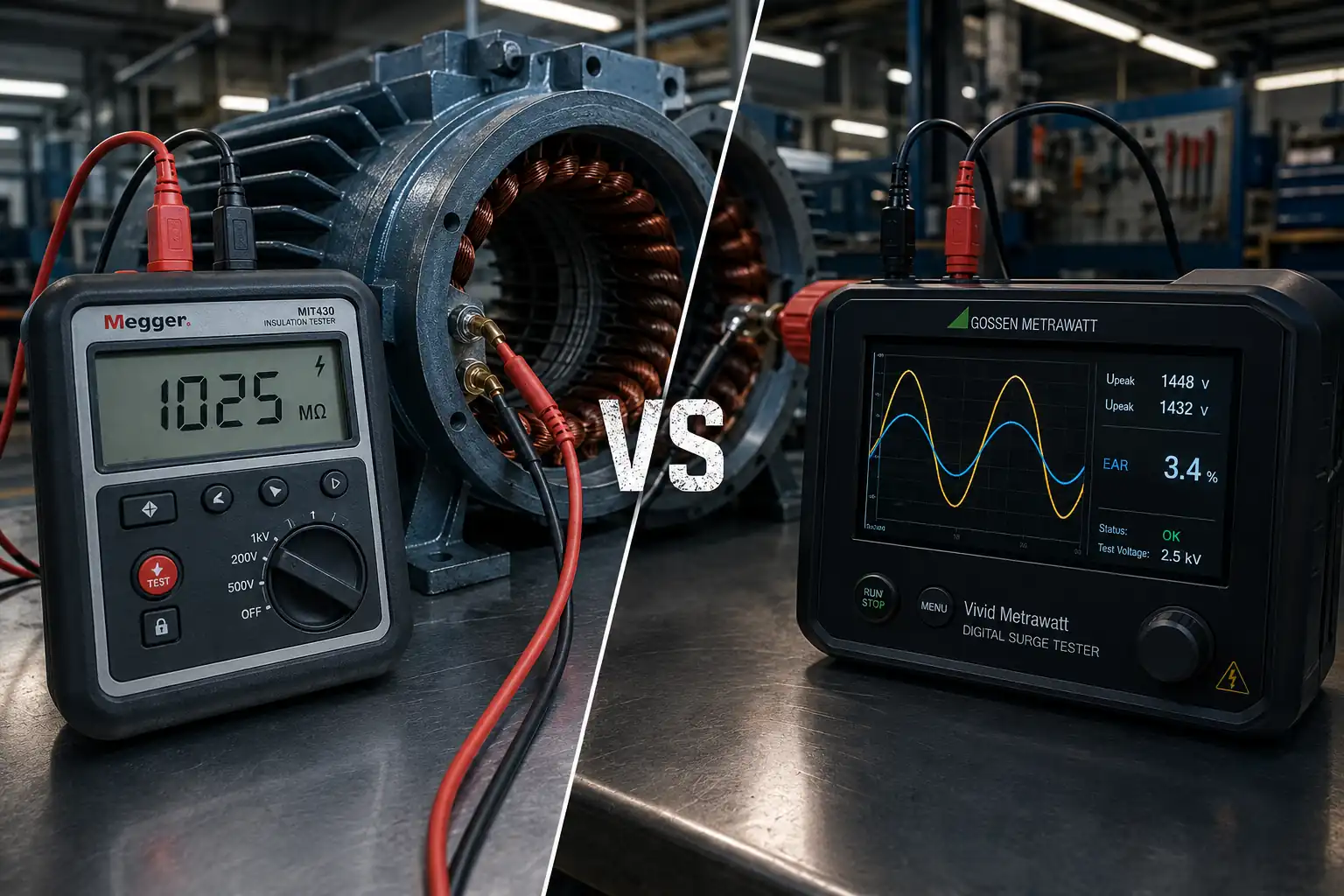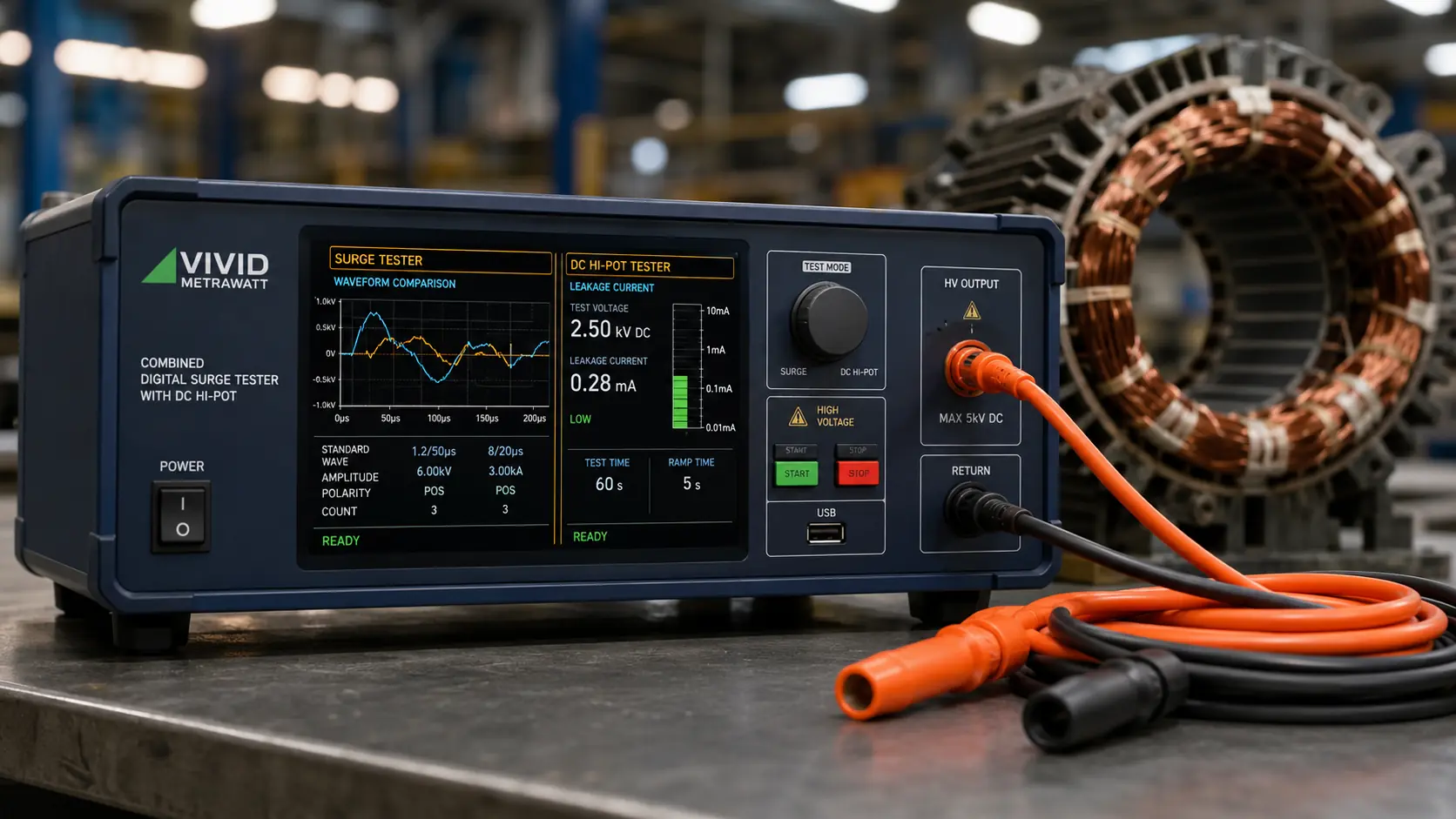

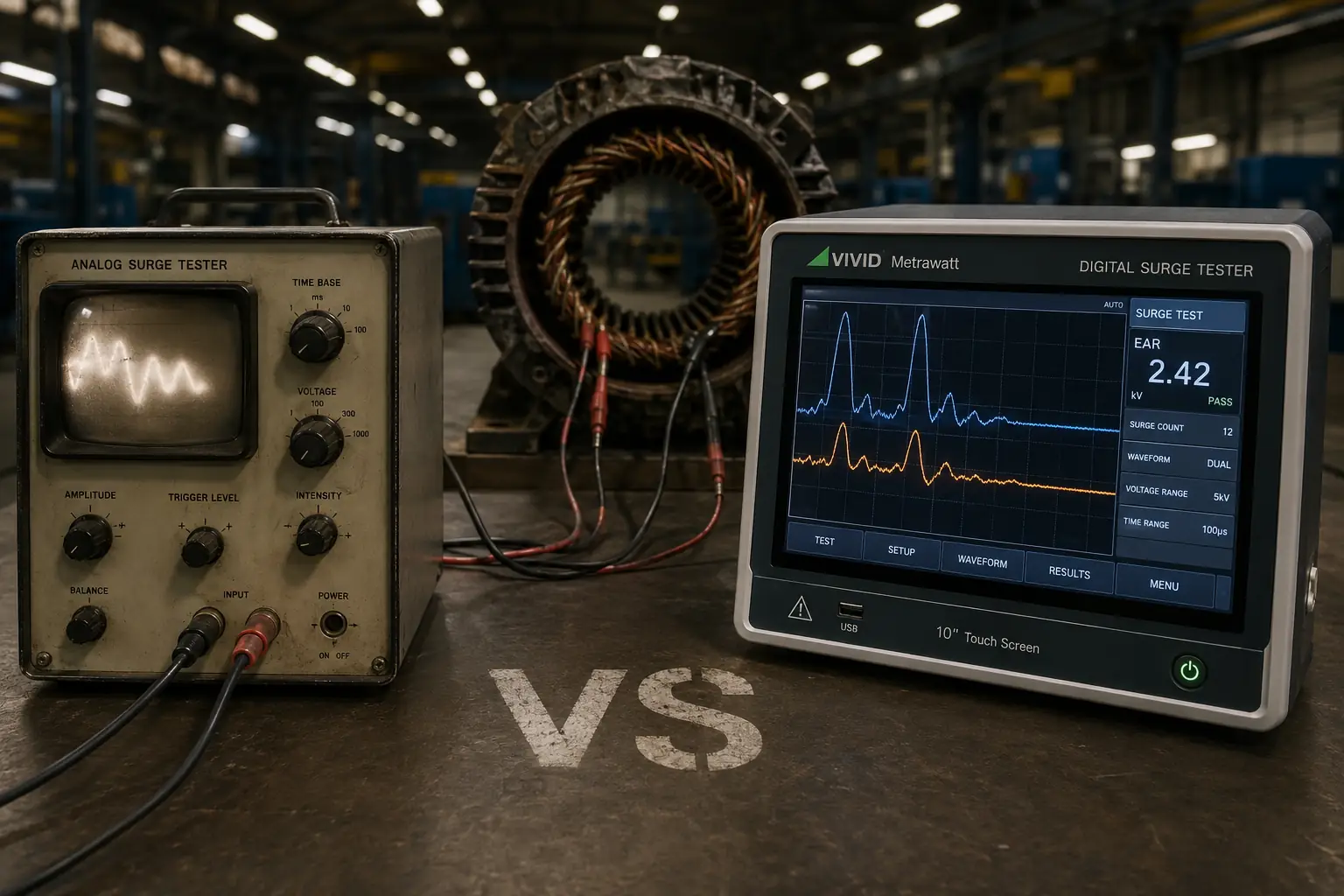
For decades, the analog surge tester was the standard tool for winding insulation testing — and in skilled hands, it did its job. But it also required those skilled hands. The result depended on the operator’s ability to read a phosphor oscilloscope trace, remember what a good waveform looked like, and make a subjective judgement call. A new hire saw the same screen differently. A subtle fault in a high-turn-count winding could look identical to a clean result. And there was nothing to print, store, or attach to a quality certificate. The digital vs analog surge tester question is not really a debate — it is a technical and operational case for why modern motor winding testing has moved from interpretation to measurement. This guide maps every meaningful difference between the two technologies, based on what Vivid Metrawatt’s instruments actually deliver.
Table of Contents
Both analog and digital surge testers share the same fundamental operating principle: a capacitor is charged to a defined voltage and then rapidly discharged into the winding under test, creating a fast-rising oscillating impulse. The winding’s turn-to-turn insulation and inductance determine the shape, frequency, and damping characteristics of the resulting waveform. Comparing the waveforms from matched phases — or against a reference — reveals whether the insulation between turns is intact and uniform.
Where the technologies diverge completely is in how the waveform is captured, displayed, compared, and recorded.
In an analog surge tester, the discharge waveform is fed directly to a cathode ray tube (CRT) oscilloscope, where the electron beam traces the waveform on the phosphor screen in real time. To compare two phases, both waveforms are superimposed on the same screen simultaneously. The operator views the display and judges whether the two traces appear to match or deviate. The result is recorded manually — written in a logbook or marked on a test record sheet.
As confirmed in Vivid Metrawatt’s guide on how surge generators work, this approach requires technicians to visually compare patterns — and while effective in skilled hands, it has fundamental limitations in consistency, sensitivity, and documentation.
In a digital surge tester, the discharge waveform is captured by a high-resolution analog-to-digital converter (ADC) and stored as a digital data array. An embedded industrial computer processes the digitised waveform, calculates the precise mathematical difference between the test waveform and the reference, and produces an objective numerical result — the Error Area Ratio (EAR). The comparison is automatic, instantaneous, and operator-independent. The result, the waveform data, and the test parameters are stored digitally and can be printed, exported, or recalled at any time.
The fundamental shift: Analog surge testing is a visual comparison that depends on operator experience and judgement. Digital surge testing is a mathematical comparison that produces a documented, quantified result independent of who is operating the instrument.
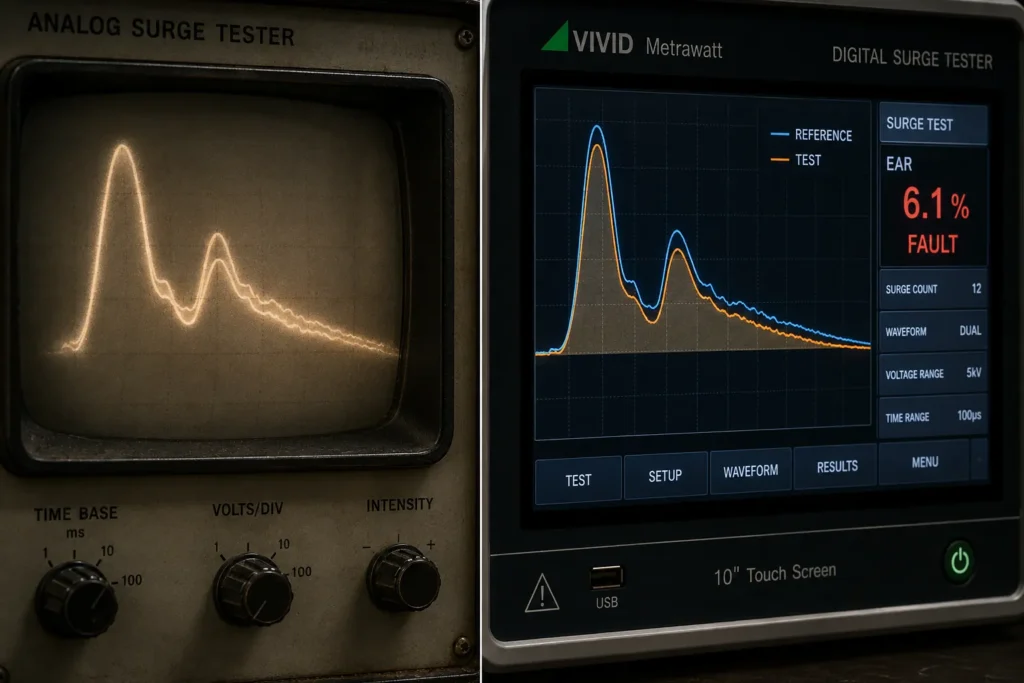
Analog surge testers served the industry for many years and in the hands of an experienced technician who had spent years learning to read CRT waveforms, they produced useful results. But the limitations are structural — they are inherent to the technology, not just the operator:
The analog display shows a waveform on a phosphor screen. Whether two overlaid traces “look the same” or “show a deviation” is a judgement call. Experienced operators learn to recognise what a healthy waveform looks like for a specific motor type. A new operator on the same instrument looking at the same display may reach a different conclusion. This operator-to-operator variability is not a training problem — it is an intrinsic limitation of visual comparison with no quantified threshold.
On a CRT display, a small number of shorted turns in a large winding may produce a waveform deviation too subtle to distinguish from the normal trace width, phosphor blur, or display noise. The deviation exists in the data — but the display does not resolve it. A digital instrument performing the same test detects the same deviation mathematically, with a precision that no human eye reading a phosphor display can match.
The analog test produces no number. There is no EAR percentage, no threshold value, no objective criterion. The pass/fail decision is entirely the operator’s. In a quality management context — where results must be documented, justified, and defensible — this creates a fundamental traceability problem.
An analog surge tester stores nothing. The test result exists only in the operator’s memory and whatever they choose to write in a logbook. There is no waveform to recall, no baseline to compare against on the next test, no trend data, and no ability to prove what the result was on a specific test date.
Comparing a winding against a “master” waveform from a known-good motor — one of the most valuable uses of surge testing — is impractical with an analog instrument. The operator must remember what the master waveform looked like, or test a known-good motor immediately before each test session for a live reference comparison.
Test reports, quality certificates, and maintenance records must be created manually, introducing transcription errors and creating an administrative burden that slows throughput in production environments.
The digital surge tester resolves every structural limitation of analog technology. Based on the confirmed specifications of Vivid Metrawatt’s digital surge tester range — including the 10KV / 12KV / 15KV Digital Surge Tester and the 25KV / 30KV / 40KV Digital Surge Tester — here is what digital technology delivers:
The instrument calculates the Error Area Ratio automatically for every test. The result is a percentage value that can be compared against a defined acceptance threshold — eliminating all subjectivity from the pass/fail decision.
The crisp, high-resolution display with colour-coded waveform traces makes even subtle deviations immediately visible, in stark contrast to the monochrome, low-resolution CRT display of an analog instrument. The touch screen interface enables intuitive, menu-driven operation with no need for extensive oscilloscope reading experience.
An embedded industrial PC runs dedicated surge tester software with LABVIEW integration — enabling surge test waveforms and reports to be stored, recalled, and printed directly from the instrument. Test data can be exported to a computer or connected to a maintenance management system.
Test configurations, motor models, waveform references, and historical test results can be stored and recalled without limit. A motor tested six months ago has its reference waveform available for direct comparison on the next test. This enables longitudinal trending of winding insulation condition — something entirely impossible with an analog instrument.
The flexibility to store and compare against a master reference waveform or conduct simultaneous comparison between two windings gives production and repair environments the exact comparison mode their process requires.
Motor data, test job records, and customer information can be organised directly within the instrument’s software — integrating the surge tester into a complete motor repair or production workflow rather than operating as an isolated test instrument.
The footswitch allows the operator to hold test probes with both hands while triggering the test with a foot press — critical in production environments and repair workshops where simultaneous probe contact and test initiation is required.
Vivid Metrawatt’s high-voltage test leads carry insulation rated to 80KV — providing a safety margin well above even the 50KV peak surge voltage of the highest model in the range.
| Feature | Analog Surge Tester | Vivid Metrawatt Digital Surge Tester |
|---|---|---|
| Waveform display | CRT oscilloscope — monochrome, low resolution, phosphor blur | 10-inch colour touch screen — crisp, high-resolution, colour-coded traces |
| Pass/fail method | Operator visual judgement — subjective, variable | Automatic EAR calculation — quantified, objective, threshold-based |
| Sensitivity to subtle faults | Limited by display resolution and operator perception | High — mathematical comparison detects minimal waveform deviation |
| Data storage | None — no digital storage capability | Infinite model and waveform storage on embedded industrial PC |
| Test report generation | Manual — handwritten logbook entry | Automatic — print, store, and export via LABVIEW software integration |
| Reference waveform storage | Not possible — operator memory only | Full reference waveform library — store and recall for any motor model |
| Operator repeatability | Variable — experienced operators perform significantly better than novices | Consistent — EAR result is identical regardless of operator |
| Trending over time | Not possible — no stored baseline to compare against | Full historical comparison — compare current waveform to past results |
| Production line suitability | Limited — operator-dependent, no automated sequences, slow documentation | High — automatic test sequences, fast cycle, automated pass/fail and reporting |
| Hands-free operation | Not standard | Footswitch included — hands-free test trigger |
| Standards compliance documentation | Difficult — no quantified result to cite in a test certificate | Straightforward — EAR result and waveform data printout provides auditable evidence |
| Test lead insulation rating | Varies by instrument age and condition | 80KV rated insulation — confirmed on Vivid Metrawatt product specifications |
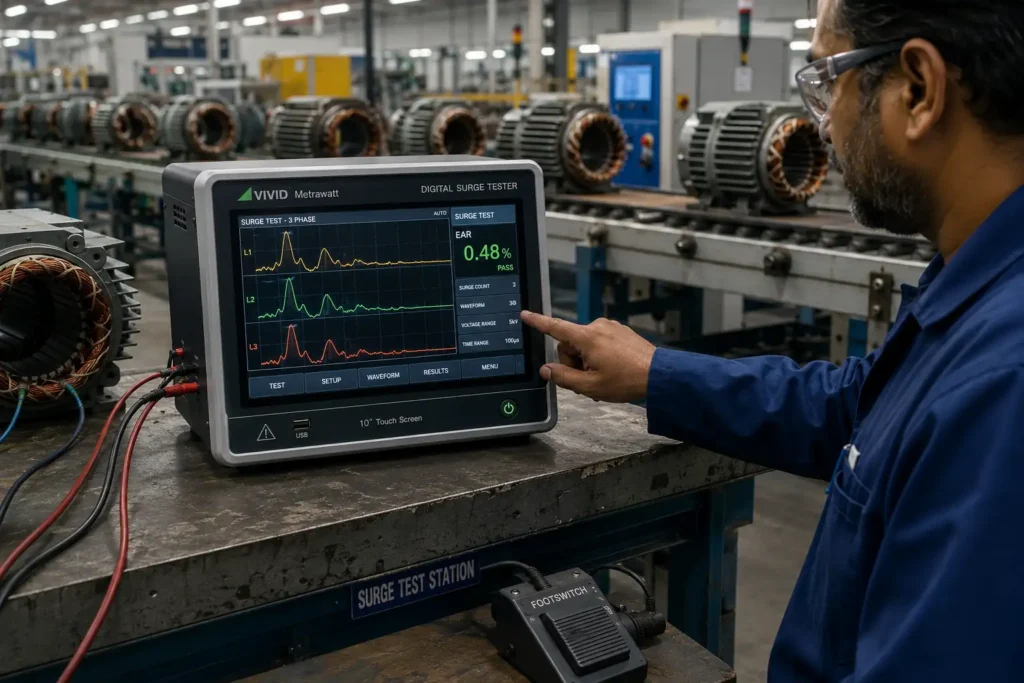
The single most important difference between digital and analog surge testing is not the display technology — it is the Error Area Ratio (EAR). Understanding what EAR is and why it matters explains why digital surge testing is not simply analog testing with a better screen.
EAR is a mathematical calculation performed automatically by the digital surge tester’s embedded processor. It compares two waveforms — the reference waveform and the test waveform — and calculates the proportional area enclosed between the two curves, expressed as a percentage of the reference waveform’s total area. The higher the EAR percentage, the greater the deviation between the two waveforms, and the more significant the insulation fault or winding imbalance.
Why EAR matters:
In practice: On a Vivid Metrawatt digital surge tester, the EAR result is displayed prominently on screen alongside the waveform comparison. The instrument applies the user-defined acceptance threshold and shows a clear green PASS or red FAIL indicator automatically — no operator interpretation required. This result is then stored and can be printed as part of the test report.
In a motor repair workshop or OEM production environment, the surge test result is only as useful as the documentation system around it. A result that cannot be recalled, compared, or reported is a result that cannot support a quality certificate, a warranty claim, or a predictive maintenance programme.
Vivid Metrawatt’s digital surge testers — confirmed from product specifications on their website — include the following software and data management capabilities:
Test waveforms, EAR results, test parameters, and report data can be stored, recalled, and printed directly from the instrument using LABVIEW software integration. This is the same software environment used in professional test and measurement applications across the electrical engineering industry, providing compatibility with a wide range of external data management systems.
There is no practical limit on the number of motor models, winding configurations, reference waveforms, and historical test records that can be stored on the instrument. A motor repair shop with hundreds of motor models in its database can store a reference waveform for each one, enabling direct model-to-model comparison on every test session.
The instrument’s software allows motor data, customer records, and test jobs to be organised and managed directly within the tester — integrating documentation into the testing workflow rather than requiring a separate administrative system.
Waveform traces are displayed in distinct colours for each phase and for the reference vs test comparison. This makes waveform analysis intuitive for operators of all experience levels and makes printed reports immediately legible to any engineer reviewing the test data.
The digital advantage applies in both production and repair environments — but the specific features that matter most differ between them.
In a production environment, the requirements are speed, consistency, documentation, and zero operator-to-operator variability. Every unit must be tested. Every result must be recorded. The test must be completed quickly enough to keep pace with the production line cycle time. The digital surge tester — particularly the automatic variants such as the 5KV Automatic Surge Tester and 3KV Automatic Surge Tester — addresses all of these requirements. Automated test sequences, footswitch operation, automatic EAR pass/fail, and integrated report printing make these instruments production-ready in a way that no analog instrument can match.
In a repair workshop, the requirements are versatility across many different motor types, the ability to compare against stored reference waveforms from previous tests, and the ability to produce a test certificate that documents the post-rewind quality of the motor. Digital instruments with infinite model storage and LABVIEW-based reporting meet these requirements directly. The 6KV Digital Surge Tester with Bar-to-Bar Test is particularly suited to workshops handling both AC stators and DC armatures.
Field teams testing installed motors in situ need portability, ease of use, and the ability to compare current readings against stored baseline results from previous field visits. The 6KV LCD Surge Tester addresses field service requirements with its simplified interface while retaining full digital measurement capability.
Vivid Metrawatt manufactures exclusively digital surge testers — from 1KV to 50KV. Every model in the range delivers EAR-based quantified waveform comparison, digital data storage, and test report generation. All models are CE certified and compliant with IEEE 522 and IEC 60034-15. No analog surge testers are produced or supplied.
| Model | Key Feature | Best For |
|---|---|---|
| 1KV Digital Armature Surge Tester | Low-voltage armature and bar-to-bar test | DC motor repair, small armature testing |
| 3KV Automatic Surge Tester | Programmable automatic test sequences, LCD display | Production line end-of-line testing, 415V–690V motor class |
| 5KV Automatic Surge Tester | Automated production sequences, medium-voltage | OEM production, stator QC up to 2.4KV |
| 5KV & 6KV Digital Surge Tester | Industrial standard medium-voltage model | Stator and HVAC motor testing, MRO facilities |
| 6KV with Bar-to-Bar Test | Dual-mode: stator surge + commutator bar-to-bar | Repair workshops handling AC and DC machines |
| 10KV / 12KV / 15KV Digital Surge Tester | Embedded industrial PC, 10-inch touch screen, LABVIEW integration | Medium-voltage motors and generators, 3.3KV–6.6KV class |
| 25KV / 30KV / 40KV Digital Surge Tester | High-energy pulse, footswitch, 80KV insulated leads | Traction motors, large generators, heavy industry |
| 50KV Digital Surge Tester | Maximum KV range; full digital capability | Power utilities, aerospace, large OEM transformer manufacturers |
For the complete range with full specifications, visit the Vivid Metrawatt Digital Surge Tester page.
Legacy analog instruments remain in service in some older workshops and in markets where they have not yet been replaced. However, no major surge tester manufacturer — including Vivid Metrawatt — produces new analog models. The industry has moved to digital technology because of the objective, quantified, documented results that digital instruments provide and because the operational and quality management advantages of digital testing are unambiguous.
Yes — the fundamental test is identical. Both apply a high-voltage capacitive discharge impulse to the winding and observe the resulting oscillating waveform. The difference is entirely in how that waveform is captured, compared, quantified, and recorded. The digital instrument does all of this automatically, mathematically, and with a precision no human operator reading an oscilloscope screen can replicate.
EAR (Error Area Ratio) is the mathematical measurement of the proportional difference between two compared waveforms, expressed as a percentage. It is calculated automatically by the embedded processor in a digital surge tester. An analog instrument does not calculate EAR — the human operator makes a visual judgement of whether the two waveform traces on the CRT screen appear to match, with no quantified metric and no defined threshold.
Yes. Vivid Metrawatt’s digital surge testers offer infinite model storage — storing motor configurations, reference waveforms, and historical test results without limit. This allows direct comparison of a current test waveform against a stored baseline from any previous test session, enabling longitudinal insulation condition trending. This capability is entirely absent in analog instruments.
The opposite is true in modern digital instruments. Reading and interpreting an analog CRT oscilloscope trace requires significant training and experience. A digital surge tester with an EAR-based automatic pass/fail system and a colour touch screen is operable by trained technicians without requiring oscilloscope expertise. The instrument performs the interpretation; the operator sets up the test and reviews the result.
Yes. All Vivid Metrawatt digital surge testers include the capability to store, recall, and print test reports via LABVIEW software integration. Reports include the test waveform data, EAR result, test parameters, date and time stamp, and motor identification information — providing a complete, auditable test record for every motor tested.
No. Vivid Metrawatt manufactures exclusively digital surge testers, from 1KV to 50KV. All models in the range incorporate digital waveform capture, EAR-based automatic comparison, embedded data storage, and LABVIEW software integration. If you have legacy analog equipment that needs to be replaced or upgraded, contact Vivid Metrawatt’s team for guidance on the right digital replacement model for your application.
Replace Subjectivity with Measurement
If your winding test programme still relies on an operator’s eye and a CRT oscilloscope, it relies on that individual every time. Vivid Metrawatt’s digital surge testers replace visual judgement with quantified EAR — giving you a result that is documented, repeatable, and defensible. CE certified, IEEE and IEC compliant. Trusted by Indian Railways and industrial facilities across more than 30 export countries.
→ Explore the Full Digital Surge Tester Range
→ View 5KV Automatic Surge Tester