
Last updated: August 2026 · Reviewed by the Vivid Metrawatt induction engineering team, Mumbai
Table of Contents
| Parameter | Induction | Resistance |
|---|---|---|
| Energy efficiency | 70–90% | 45–75% |
| Heat generated | Inside the workpiece | In a separate element |
| Contact required | No | Yes (or enclosure) |
| Heat-up time | Seconds to minutes | Minutes to hours |
| Control response | Near-instant | Slow (thermal inertia) |
| Selective heating | Yes, by coil & frequency | Limited |
| Works on non-metals | Only via susceptor | Yes |
| Capital cost | Higher | Lower |
| Running cost | Lower | Higher |
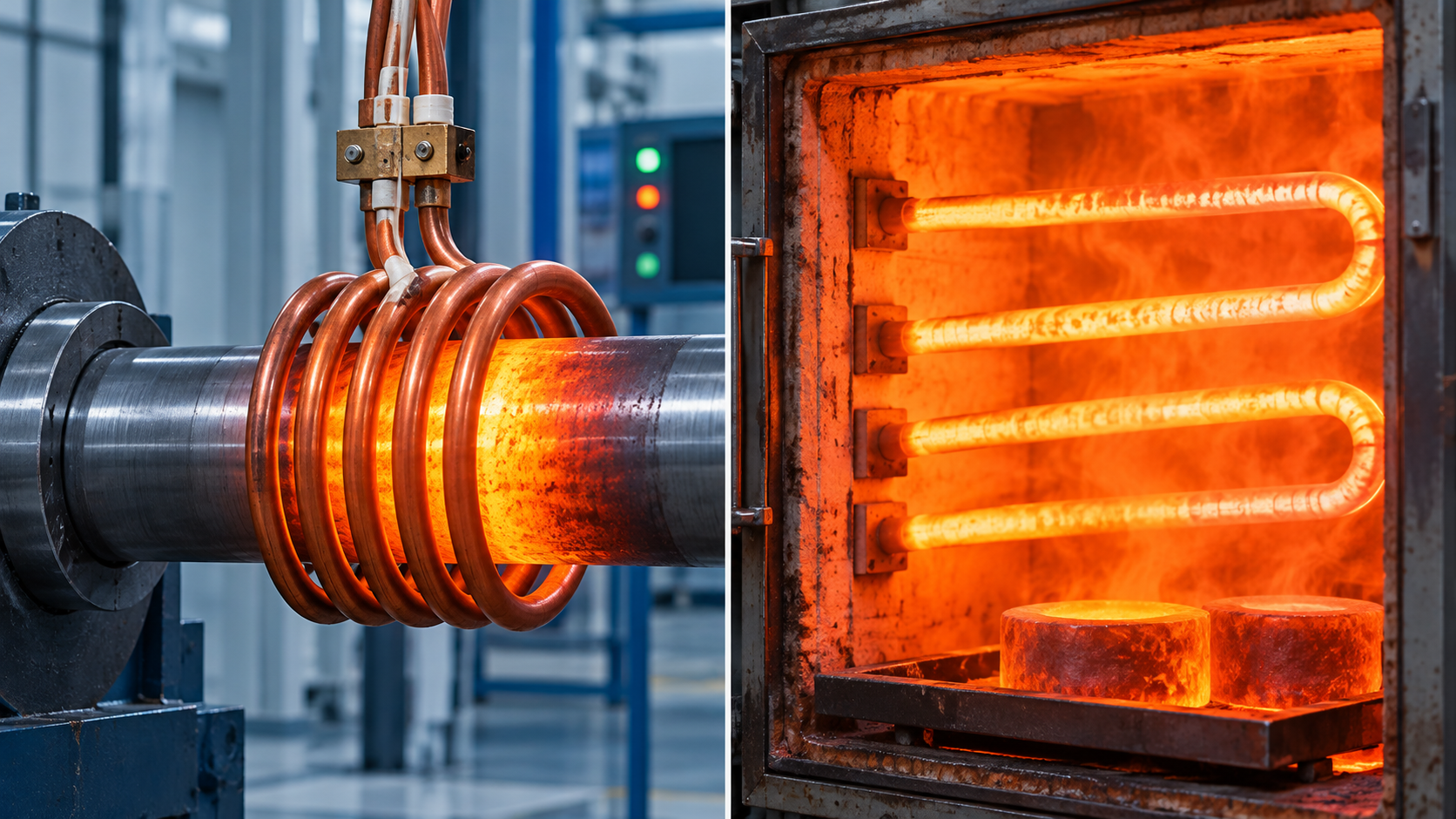
Induction heating generates heat inside a conductive workpiece using electromagnetic induction, typically reaching 70–90% energy efficiency. Resistance heating generates heat in a separate element and transfers it to the workpiece, typically achieving 45–75%. Induction wins on speed, precision and running cost; resistance wins on capital cost, material flexibility and bulk uniform heating.
An alternating current in a coil generates an alternating magnetic field. When a conductive workpiece enters that field, eddy currents are induced inside it. The metal’s own resistance converts those currents into heat. In ferrous materials, hysteresis loss adds a second heating mechanism.
The key property: the workpiece is the heat source. The coil stays cool. Nothing needs to touch the part. The full physics is covered in our guide to how electromagnetic induction works.
Current passes through a resistive element — typically nichrome, Kanthal or silicon carbide. The element heats according to Joule’s law (P = I²R), and that heat travels to the workpiece by conduction, convection or radiation.
The key limitation: heat must travel from element to part. Everything in between — air, furnace lining, fixturing — is heated along the way, and that is where the efficiency goes.
Induction puts energy where you want it. Resistance puts energy near where you want it and waits for it to arrive.
Induction heating typically achieves 70–90% efficiency; resistance heating typically achieves 45–75%.
Why induction wins:
Where resistance loses energy:
A qualification worth stating honestly: these figures describe heating efficiency at the process, not wall-plug efficiency. Induction power supply conversion losses reduce the delivered figure somewhat. Modern SiC and GaN-based supplies have narrowed this considerably — see high-efficiency induction heating with SiC and GaN semiconductors for where that technology now sits.
Induction reaches process temperature in seconds to minutes; resistance requires minutes to hours.
The difference compounds across three separate mechanisms:
What this means for throughput: a plant switching a batch resistance process to induction typically doesn’t just save energy — it removes work-in-progress inventory, frees floor space, and changes the production model from batch to flow. In most business cases we’ve reviewed, the throughput gain outweighs the energy gain.
The honest comparison, laid out:
| Cost element | Induction | Resistance |
|---|---|---|
| Equipment purchase | Higher | Lower |
| Coil / element tooling | Application-specific coils | Standard elements |
| Installation | Power supply, cooling circuit | Simpler |
| Energy per part | Lower | Higher |
| Consumable replacement | Coils last long; occasional rework | Elements degrade and need periodic replacement |
| Standby energy | Near zero | Continuous while hot |
| Scrap / rework | Lower (tight control) | Higher (thermal gradients) |
| Floor space | Compact | Larger footprint |
| Ventilation / cooling load | Low ambient heat rejection | High ambient heat rejection |
The cost most plants forget: rejected ambient heat. A resistance furnace dumps significant heat into the shop floor, which then has to be extracted or air-conditioned. That is a real, recurring operating cost that never appears in the equipment comparison.
Use this structure to build a defensible business case:
Step 1 — Annual energy cost, current process
Current cost = kW drawn × hours/year × ₹ per kWh
Step 2 — Estimated energy cost, induction
Induction cost = Current cost × (current efficiency ÷ induction efficiency)
Example: a process at 55% efficiency moving to 85% consumes roughly 65% of the current energy — about a 35% reduction.
Step 3 — Add the non-energy savings
Step 4 — Payback
Payback (years) = Total installed cost ÷ Total annual saving
What we see in practice: for high-volume, repetitive heating processes, payback commonly lands in the 1–3 year range. For low-volume, intermittent work, it often does not justify the switch — and it is better to say so than to sell a system that will sit idle.
We manufacture induction equipment. We still recommend resistance heating in these situations, because specifying the wrong technology helps nobody:
If your process falls into any of these categories, induction is likely the wrong tool — and a supplier who tells you otherwise is selling, not engineering.
| Application | Why |
|---|---|
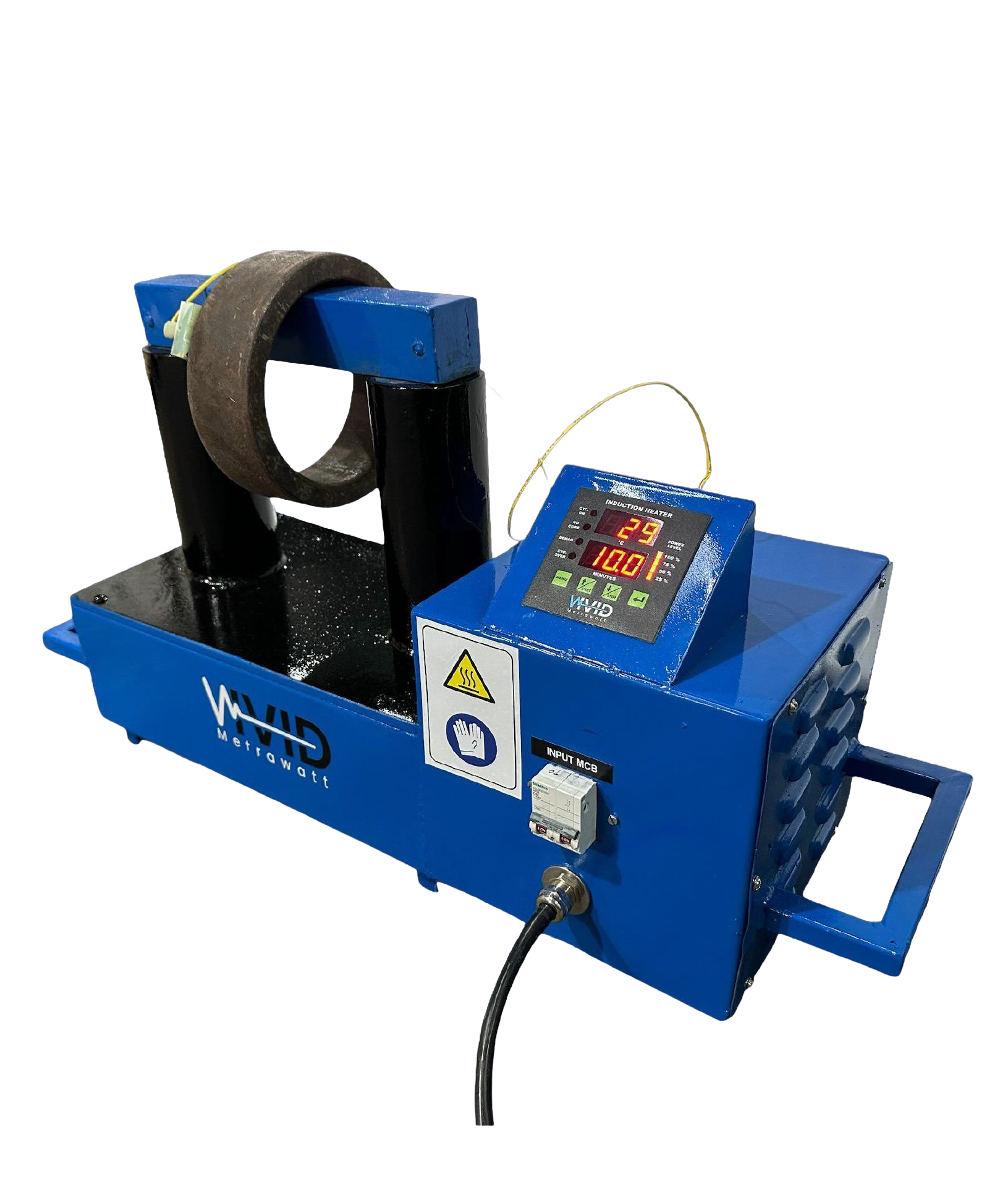
| Bearing mounting / dismounting | Fast, clean, controlled expansion — see bearing induction heating |
| Surface hardening | Frequency controls case depth precisely |
| Brazing and soldering | Localised joint heating without heating the assembly |
| Forging preheat | High power density, rapid through-heating of billets |
| Shrink fitting | Repeatable thermal expansion for interference fits |
| Weld preheat / PWHT | Controlled, uniform, no open flame — see induction preheating |
| Bolt and fastener removal | Targeted heat where a flame would be unsafe |
| Application | Why |
|---|---|
| Ovens and batch furnaces | Uniform soak over long cycles |
| Drying and curing | Gentle, distributed heat |
| Plastics and composites processing | Non-conductive materials |
| Laboratory temperature maintenance | Stability over speed |
| Food processing | Material and hygiene constraints |
| Space heating | Wrong problem for induction entirely |
For a related comparison on the maintenance side, induction heater vs gas torch covers the safety and control arguments where open-flame heating is still common.
Score your application. Three or more “yes” answers in Column A points firmly to induction.
| Column A — favours induction | Column B — favours resistance |
|---|---|
| Workpiece is metallic and conductive | Workpiece is non-conductive |
| High, repeatable production volume | Low or intermittent volume |
| Cycle time is a production constraint | Cycle time is not critical |
| Only part of the component needs heating | The whole mass needs uniform soaking |
| Precise, repeatable temperature control required | Approximate control acceptable |
| Energy cost is a material line item | Energy cost is minor |
| Part geometry is consistent | Geometry varies constantly |
| Flame or oil heating is a safety concern | No safety constraint |
| Floor space is constrained | Space is available |
Frequency selection follows from the same analysis — deep through-heating and surface hardening sit at opposite ends of the spectrum, as covered in low-frequency vs high-frequency induction heating.
Yes, in most industrial applications. Induction typically achieves 70–90% heating efficiency against 45–75% for resistance heating, because heat is generated inside the workpiece rather than transferred to it from an external element.
Not directly. Induction requires an electrically conductive workpiece. Non-conductive materials can be heated indirectly using a metallic susceptor placed in the field, though this adds complexity and reduces efficiency.
Substantially — seconds to minutes versus minutes to hours. The gap widens further in practice because induction has no warm-up period, whereas a resistance furnace may need an hour before processing the first part.
For high-volume repetitive processes, typically one to three years, driven by combined energy, throughput and scrap savings. For low-volume or highly varied work, payback may not be achievable — evaluate honestly before committing.
Generally yes. The induction coil remains cool, there is no open flame or glowing element, and heating stops the instant power is removed. The main hazards are the heated workpiece itself and the magnetic field near the coil.
Yes, but less efficiently than on steel. Non-ferrous metals lack hysteresis heating and have low resistivity, so they require higher power density and careful frequency selection to heat effectively.
Coil geometry and operating frequency. The coil shapes where the field concentrates; frequency determines how deep the current penetrates (skin depth). Together they define the resulting temperature profile.
Evaluate volume, cycle-time constraints and part geometry consistency first. If the process is high-volume, repetitive and metallic, the case is usually strong. If it involves bulk soaking or varied geometry, keep the furnace.
Send us your part material, geometry, target temperature and cycle volume. Our engineers will model the heating requirement, size the system and give you a realistic payback figure — including telling you when induction isn’t the right answer for your application.
Request a Process Assessment Explore Induction HeatersCustom coil design • 8kVA to 44kW systems • Manufactured in Mumbai, supplied worldwide

![Surge Testing for Wind Turbine Generators: Complete Guide [2026]](https://vividmetrawattglobal.com/wp-content/uploads/2026/09/a_wide_cinematic_industrial_outdoor_scene_at_an_o.webp)