
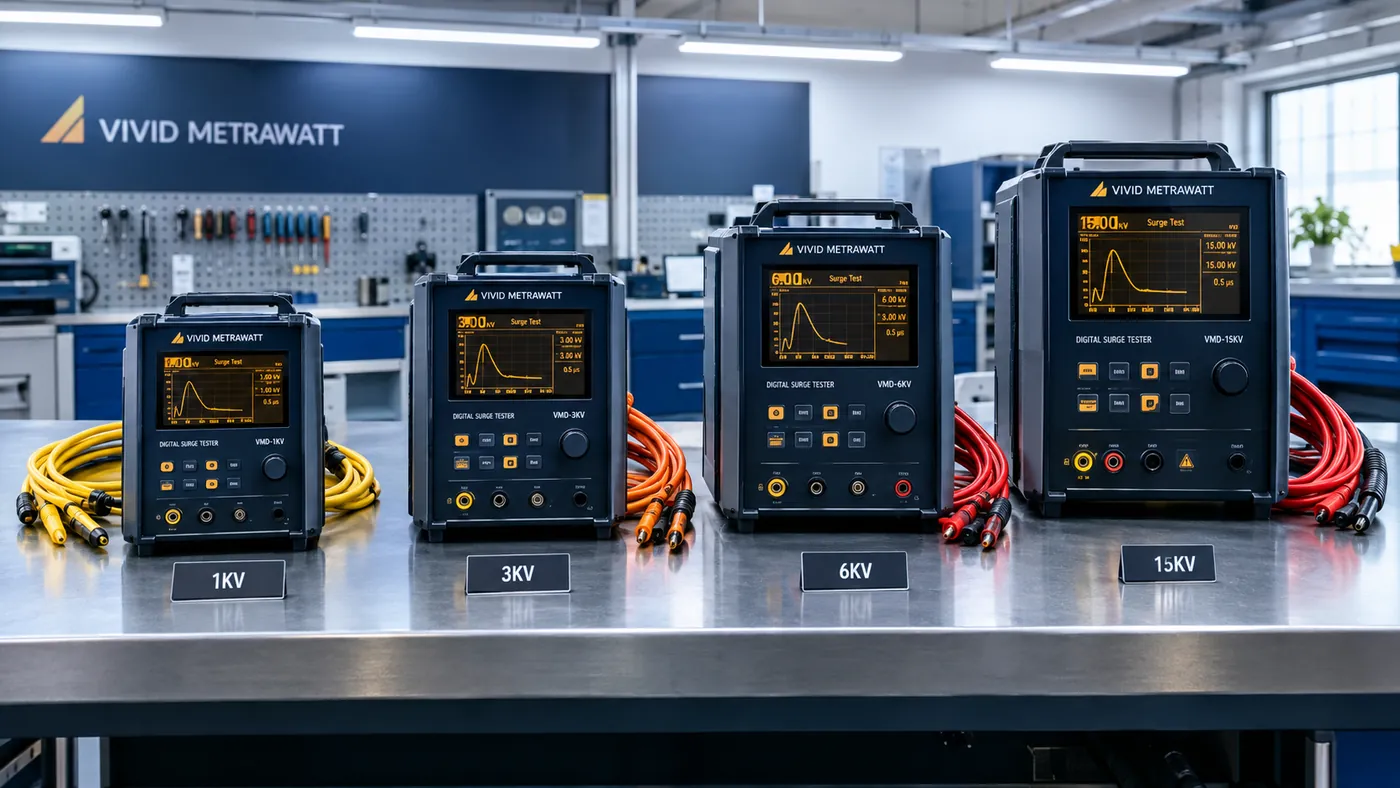
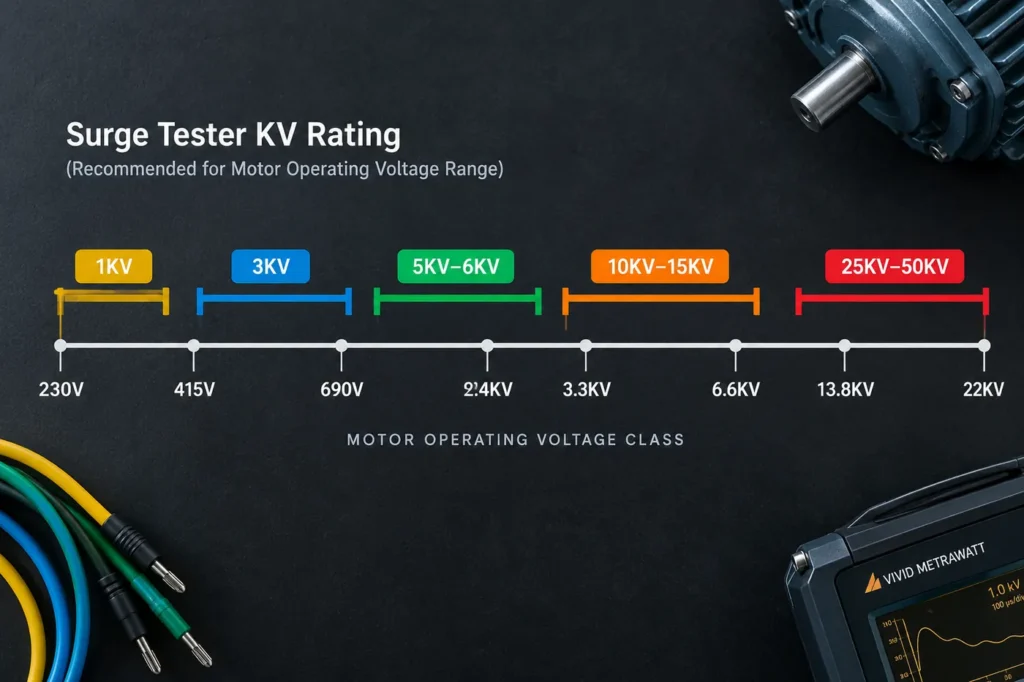
The most consequential decision when purchasing a digital surge tester is not which brand to choose or which software features to specify. It is the KV rating — the peak impulse voltage the instrument delivers to the winding under test. Get it wrong in either direction and your testing programme fails: too low a KV and latent insulation faults pass through quality control undetected; too high and you risk introducing dielectric damage into a healthy winding. Every Vivid Metrawatt surge tester model is designed for a specific voltage class of winding. This guide maps every KV rating in the range — from 1KV to 50KV — to the exact motor voltage class, winding type, and application it serves, so you can make the right selection before you enquire.
Table of Contents
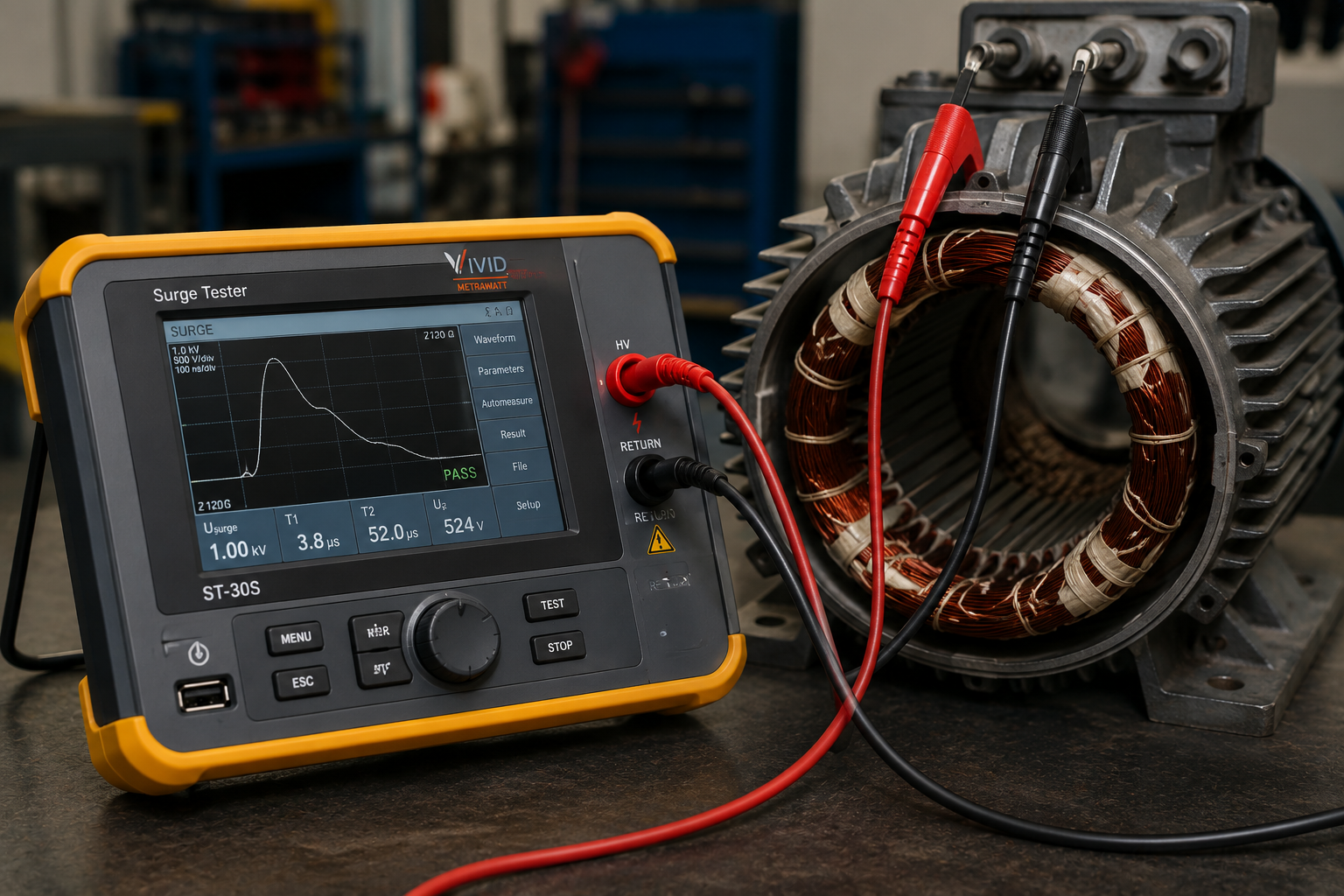
A surge tester works by applying a fast-rising, high-voltage impulse to the winding under test and comparing the resulting oscillating waveform against a reference or matched phase. The turn-to-turn insulation is stressed by this impulse — and whether a latent fault reveals itself depends entirely on whether the applied impulse voltage is high enough to stress that insulation to the point where the fault becomes visible in the waveform.
The standard test voltage formula — per IEEE 522 and IEC 60034-15 — is typically expressed as:
This formula means that a 415V motor requires a surge test voltage of approximately 1,830V — well within the 3KV range. A 3.3KV motor requires approximately 7,600V — meaning a 10KV instrument is the minimum appropriate model. A 6.6KV motor requires approximately 14,200V — placing it firmly in the 15KV class.
The critical point is this: the KV rating of your surge tester must comfortably exceed the calculated test voltage for your highest-voltage winding class. It must also be low enough that when set to the correct test voltage for small windings, the instrument can regulate precisely at that level — not just at or near its maximum output.
Key rule: Never apply a surge test voltage significantly higher than the calculated test voltage for the winding class being tested. Over-voltage stresses healthy insulation unnecessarily. The correct instrument is one whose rated KV provides comfortable headroom above your highest required test voltage — not the highest KV model in the range.
| KV Rating | Model(s) | Winding Voltage Class | Primary Winding Type | Key Differentiator |
|---|---|---|---|---|
| 1KV | VM-1AT | Up to ~230V DC | Small–medium DC armatures; series-wound field coils | Bar-to-bar test; DC traction motors |
| 3KV | VM LCD-3AND/AMS/ANP | Up to ~690V AC (1φ & 3φ) | Fan motors, appliance stators, BLDC, automotive starters | Automatic; detects single turn short; portable |
| 5KV / 6KV | VM-5KHR / VM-6KHR | Up to 660V AC | Low-range AC rotating machine coils and windings | Integrated DC Hi-Pot; 1φ & 3φ switch |
| 6KV | VM-6KA | AC and DC motors | AC stators + DC traction armatures | Bar-to-bar test; dual AC/DC capability |
| 6KV High Power | D-6KH | Heavy-duty AC motor stators | Copper strip windings >8mm cross-section | High pulse current & energy; for thick-conductor coils |
| 10KV / 12KV / 15KV | VM-10K / 12K / 15K | Up to 6.6KV AC | AC motors, stators, transformers, alternators, solenoids | 10-inch touch screen; LABVIEW; 3 voltage variants |
| 10KV / 12KV / 15KV + Hi-Pot | VM-10KHR / 12KHR / 15KHR | Up to 6.6KV AC | Same as above | Surge + Hi-Pot in one instrument |
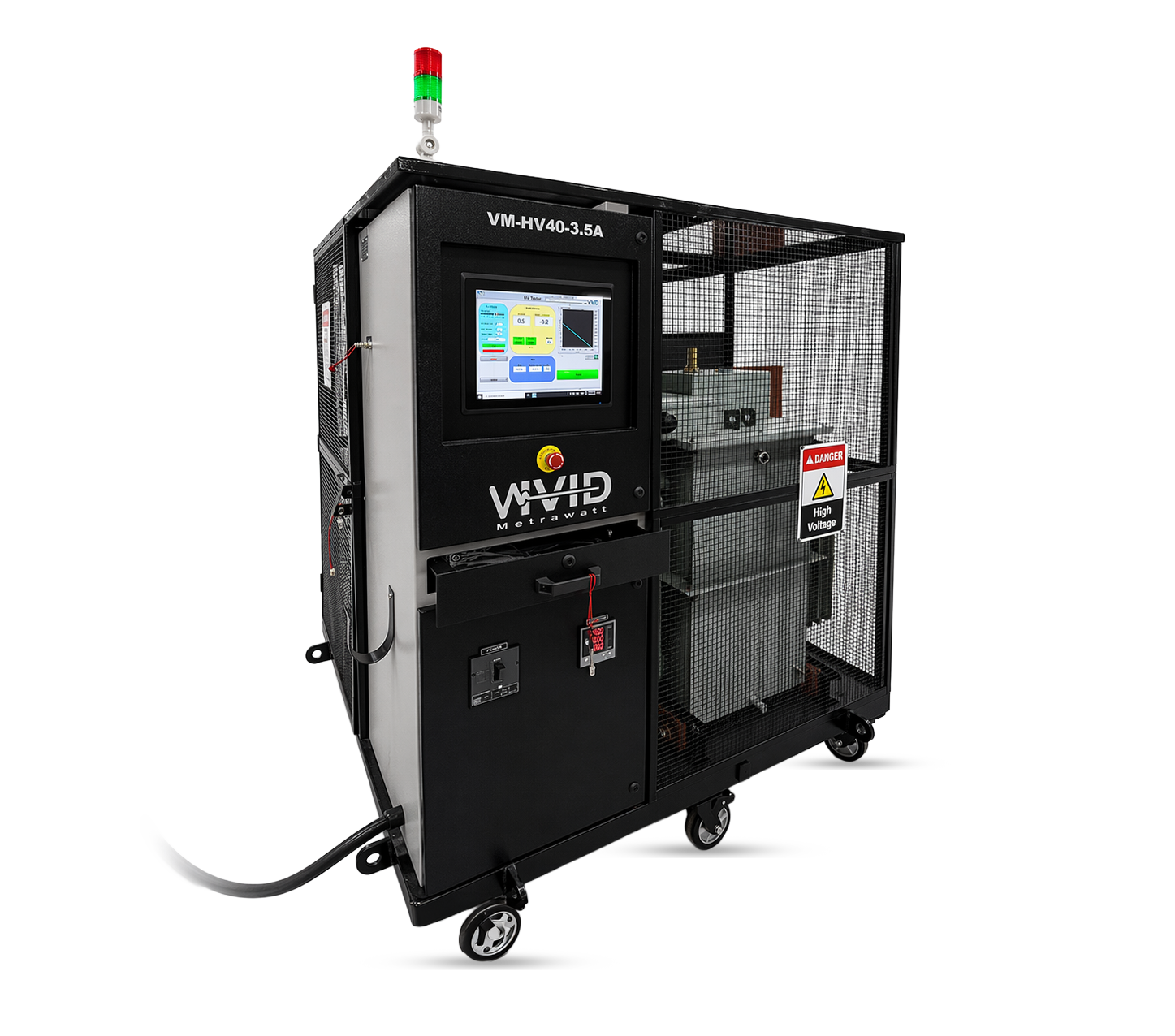
| 25KV / 30KV / 40KV | VM-25K / 30K / 40K | Up to 13.8KV AC | Large traction motors, HV generators, HV transformers | 80KV insulated leads; footswitch; 10-inch touch screen |
| 25KV / 30KV / 40KV + Hi-Pot | VM-25KHR / 30KHR / 40KHR | Up to 13.8KV AC | Same as above | Surge + DC Hi-Pot; 80KV insulated leads |
| 50KV | VM-50K | Above 13.8KV AC | Ultra-HV rotating machines, large power transformers | Maximum KV in the range |
The 1KV model is purpose-built for a specific and clearly defined application: assessing the quality of small to medium range DC armatures. It is not a general-purpose low-voltage surge tester. Its distinguishing feature is the bar-to-bar test — a test mode designed specifically to evaluate the low impedance of series-wound armatures and field coils in DC traction motors.
In a DC armature, individual coils are connected to adjacent commutator bars. The bar-to-bar test applies the surge impulse between adjacent commutator bars and detects turn-to-turn shorts within each armature coil. This test cannot be meaningfully performed by a standard stator surge tester, because the test geometry and impedance levels are fundamentally different from AC stator testing.
Choose the 1KV VM-1AT if:
Do not select the 1KV model if:
Key feature confirmed: Embedded industrial PC with 8-inch touch screen; LABVIEW software integration; LABVIEW for waveform storage, recall, and test report printing; intelligent target voltage recommendation based on motor rating; test leads insulated up to 45KV.
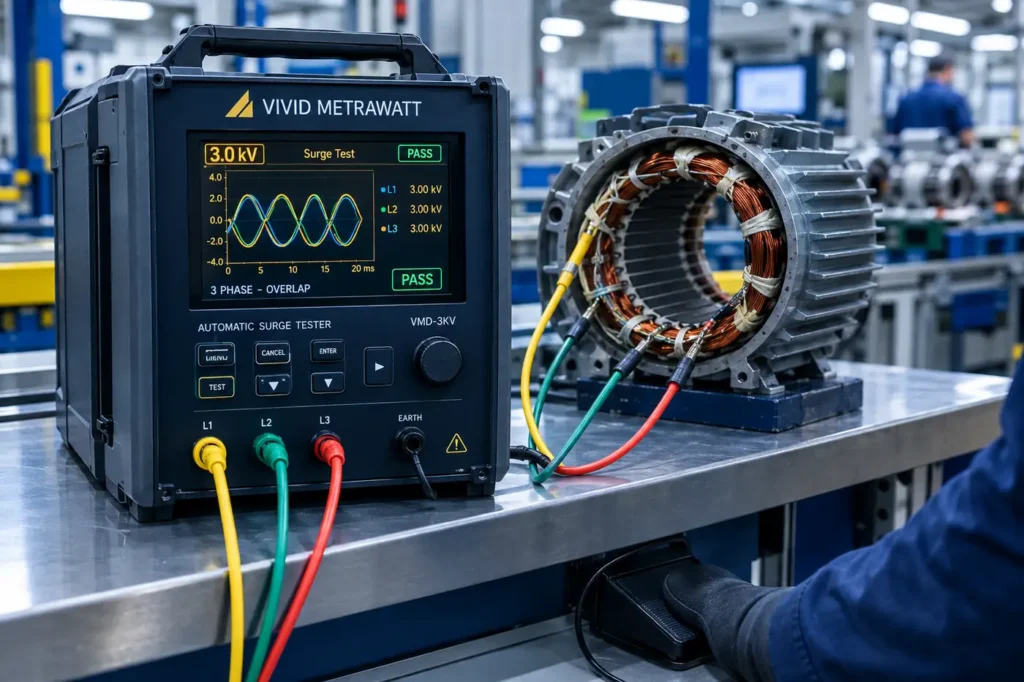
The 3KV Automatic Surge Tester is the workhorse for low-voltage single-phase and three-phase stator winding quality control. It is confirmed for testing in production motor shops — its primary environment — and also for on-field diagnostics.
At 3KV peak, this instrument covers the dominant global AC motor voltage class: 230V single-phase and 415V / 440V / 690V three-phase. Applying the standard IEEE 522 test voltage formula (2 × Vrated + 1000V), a 415V motor requires approximately 1,830V — well within the 3KV envelope. A 690V motor requires approximately 2,380V — also within range with headroom.
Confirmed applications from the product page:
A critical confirmed capability: it detects even a single turn short — the most stringent detection requirement in production quality control, where early-stage faults with only one shorted turn must be identified before the motor leaves the factory.
Three sub-models are available (VM LCD-3AND, VM LCD-3AMS, VM LCD-3ANP), covering different configurations for specific production and diagnostic environments. All are automatic in operation — test sequences are programmed, not manually controlled.
Choose the 3KV model if:
Key feature confirmed: Automatic operation; detects single turn short; footswitch for hands-free operation; test leads insulated up to 45KV; portable for motor shop and field use.
The VM-5KHR and VM-6KHR are confirmed for coils and windings in low-range AC rotating machines up to 660V. This positions them in the same operating voltage bracket as the 3KV model — 415V to 660V AC — but with added headroom and an integrated DC Hi-Pot test function that the 3KV model does not include.
The DC Hi-Pot integration makes this model the correct choice when your testing protocol requires both:
in a single instrument and a single connected test session — without connecting a separate Hi-Pot tester or changing test leads between the two tests.
Key confirmed features:
Choose the 5KV / 6KV with DC Hi-Pot if:
For a detailed explanation of the relationship between surge testing and DC Hi-Pot testing — including why they test different insulation structures and why both are required — see our guide on surge tester vs Hi-Pot tester.
The 6KV class in the Vivid Metrawatt range is the most varied — three distinct product configurations address three distinct application requirements at the same KV level. Choosing between them depends not on voltage but on your specific winding type and testing requirement.
Product page: 6KV Digital Surge Tester with Bar-to-Bar Test
The VM-6KA is confirmed for both AC and DC motors — especially DC traction motors. It is the correct instrument when your facility tests both AC stators and DC traction armatures on the same floor and needs a single instrument that handles both test modes. The bar-to-bar test evaluates the integrity and performance of series-wound armatures and field coils in DC traction motors specifically. The standard surge test mode handles AC stator winding quality control.
Choose the VM-6KA if: You test both AC stators and DC traction armatures, and both require 6KV-level testing. This is common in railway maintenance depots, traction motor manufacturers, and large motor repair shops that service mixed fleets.
Product page: 6KV Surge Tester High Power
The D-6KH is a fundamentally different instrument from the standard 6KV model. It is confirmed as a special high-power surge tester engineered for testing coils and stators of AC motors with copper strips exceeding 8mm in cross-sectional area. It generates a high pulse current and energy — enabling an effective potential drop across the heavy-conductor coils that a standard impulse tester cannot achieve.
This addresses a specific physics problem: when the conductor cross-section is large (thick copper strip windings as used in high-current industrial motors), the winding’s impedance is very low. A standard surge tester at the same KV rating may produce an impulse that is too fast and too low in energy to create a sufficient voltage drop across the turns of a low-impedance, thick-conductor coil. The D-6KH’s high-energy output overcomes this limitation.
Choose the D-6KH if: You manufacture or repair industrial AC motors with heavy copper strip windings (conductor cross-section above 8mm). This includes large HVAC compressor motors, large industrial pump motors, and heavy-duty drive motors where the winding uses flat copper strip rather than round wire.
Summary — 6KV selection: Standard AC stator testing → any standard 6KV model. AC + DC traction armatures → VM-6KA with bar-to-bar. Heavy copper strip windings (>8mm) → D-6KH High Power. AC stator + DC Hi-Pot combined → VM-6KHR.
The 10KV to 15KV class is confirmed for precise testing of coils and windings in AC rotating machines accommodating voltages up to 6.6KV. This is the medium-voltage motor territory — 3.3KV, 4.16KV, and 6.6KV motors that drive compressors, fans, pumps, and conveyors in process plants, utilities, and heavy industry.
Applying the standard test voltage formula to a 3.3KV motor gives approximately 7,600V — meaning the 10KV model provides comfortable headroom. A 6.6KV motor requires approximately 14,200V — placing the 15KV model as the correct choice, with the 12KV model suitable for motors in the 4.16KV to 5KV operating range.
Confirmed applications from the product page:
The system is available in three voltage variants (10KV, 12KV, 15KV), allowing selection of the appropriate test voltage for the specific operating voltage class in your motor population. Both standard (surge only) and Hi-Pot integrated versions are available — the Hi-Pot integrated models (VM-10KHR / 12KHR / 15KHR) add DC Hi-Pot testing alongside surge testing in a single instrument.
Key confirmed features: Embedded industrial PC; 10-inch touch screen display; LABVIEW software integration; infinite model storage; comprehensive job work management; versatile dual-feature testing (master waveform comparison or simultaneous two-winding comparison); advanced colour-coded waveforms.
Choose the 10KV / 12KV / 15KV range if:
For a detailed explanation of why this voltage class matters and how the 10–15KV range relates to ground insulation testing, see our guide on AC Hi-Pot vs DC Hi-Pot testing.
The 25KV to 40KV range is confirmed for precise testing of coils and windings in AC rotating machines accommodating voltages up to 13.8KV. This class covers large traction motors, high-voltage generators, large industrial drive motors, and high-voltage transformer windings — equipment where a 15KV surge tester is insufficient and where the consequences of an undetected insulation fault are operationally and financially severe.
Indian Railways — Vivid Metrawatt’s largest confirmed client, accounting for 89% of Indian Railway surge tester supply — uses instruments from this KV class for traction motor acceptance and maintenance testing, where the operating voltage of traction motor windings places them firmly in the 25KV+ surge test range.
Key confirmed features (all models): 10-inch touch screen; test leads insulated up to 80KV; footswitch for hands-free operation; LABVIEW software integration; detailed analysis tools; automatic report generation in MS Word.
DC Hi-Pot integrated versions add ground wall insulation withstand testing in the same instrument — essential where both surge and Hi-Pot are required in the acceptance test certificate, as is standard for large motor acceptance testing per IEC 60034-1 and equivalent standards.
The VM-50K is the highest KV model in the Vivid Metrawatt range — confirmed for winding voltage classes above 13.8KV, covering the largest rotating machines, very large power transformers, and ultra-high-voltage electrical components. Applications include major power utility generator stators in the 11KV to 22KV operating class, aerospace and defence high-voltage electrical equipment, and large OEM transformer manufacturer coil qualification.
Choose the 25KV–50KV range if:
Use this table as a direct selection reference. Find your motor’s operating voltage in the left column and read across to the recommended surge tester KV rating and the specific Vivid Metrawatt model.
| Motor/Winding Operating Voltage | Calculated Test Voltage (2V+1000V) | Recommended KV Rating | Vivid Metrawatt Model |
|---|---|---|---|
| DC armatures / <230V DC | ~1,460V | 1KV (bar-to-bar) | VM-1AT |
| 230V single-phase AC | ~1,460V | 3KV | VM LCD-3AND |
| 415V three-phase AC | ~1,830V | 3KV | VM LCD-3AND |
| 440V / 480V three-phase AC | ~1,960V | 3KV | VM LCD-3AND |
| 660V AC | ~2,320V | 3KV or 5KV/6KV (with Hi-Pot) | VM-5KHR / VM-6KHR |
| AC/DC traction motors (mixed fleet) | Varies by motor | 6KV with bar-to-bar | VM-6KA |
| Heavy copper strip AC stators (>8mm) | Varies | 6KV High Power | D-6KH |
| 3.3KV AC | ~7,600V | 10KV | VM-10K |
| 4.16KV / 5KV AC | ~9,320–11,000V | 12KV | VM-12K |
| 6.6KV AC | ~14,200V | 15KV | VM-15K |
| 11KV AC | ~23,000V | 25KV | VM-25K |
| 13.8KV AC | ~28,600V | 30KV or 40KV | VM-30K / VM-40K |
| Above 13.8KV AC | Above 28,600V | 50KV | VM-50K |
Once the correct KV class is established, two secondary decisions refine the exact model within that class:
At the 5KV/6KV class and the 10KV–40KV class, Vivid Metrawatt offers both standard (surge only) and Hi-Pot integrated variants. If your testing protocol — whether driven by a quality management system, a customer specification, or a standard like IEC 60034-1 — requires both surge and Hi-Pot test results, the combined instrument eliminates a second setup and a second set of test connections. For a full explanation of why surge testing and Hi-Pot testing complement each other and cannot substitute for each other, see our guide on surge tester vs Hi-Pot tester.
Bar-to-bar testing is required only if you regularly test DC machines with commutators — traction motors, DC drive motors, or other series-wound armatures. It is available at both the 1KV (VM-1AT) and 6KV (VM-6KA) levels. For AC-only stator testing, bar-to-bar capability is not needed.
If your AC motor population includes windings made from copper strip rather than round wire — and particularly where the conductor cross-section exceeds 8mm — a standard surge tester at any KV level may not produce sufficient pulse energy for a reliable test. The 6KV High Power model (D-6KH) is specifically confirmed for this application. For a technical explanation of why conductor cross-section affects test energy requirements, the distinction is covered in our comparison of Megger vs surge test for windings.
The 3KV Automatic Surge Tester is confirmed specifically for fast-paced production motor shops and field diagnostics. For higher-KV applications in production environments, the embedded industrial PC with LABVIEW software across the 10KV–40KV range provides the test sequence management and automatic reporting that production quality systems require.
Only if the instrument can be accurately set to the correct test voltage for that motor — approximately 1,830V — and holds that voltage level precisely during the test. A 15KV instrument operating at less than 15% of its rated output may not regulate the output voltage accurately at low settings. The correct instrument for a 415V motor is a 3KV model, which has the 415V motor’s required test voltage in its comfortable operating range. If you use a 15KV instrument on a 415V motor at its full rated output, you will destroy a healthy winding’s insulation.
Per IEEE 522 for routine production testing: Surge Test Voltage = 2 × Vrated + 1000V. For example: 415V motor → (2 × 415) + 1000 = 1,830V. 3.3KV motor → (2 × 3300) + 1000 = 7,600V. Always select an instrument whose rated KV comfortably exceeds the calculated test voltage for your highest-voltage winding class.
Both cover the 415V–660V operating voltage class for AC windings. The primary difference is the integrated DC Hi-Pot function in the VM-5KHR / VM-6KHR. If your testing protocol requires only surge testing, the 3KV Automatic is the correct, purpose-designed model for that voltage class. If your protocol requires both surge and DC Hi-Pot in the same instrument, the 5KV/6KV with DC Hi-Pot is the right choice.
The D-6KH is confirmed for testing coils and stators of AC motors with copper strips exceeding 8mm in cross-sectional area. It generates a high pulse current and energy — enabling an effective potential drop across low-impedance, heavy-conductor coils that a standard impulse tester cannot adequately stress. If your motors use conventional round-wire windings, a standard 6KV model is the correct choice. If they use thick copper strip windings, the D-6KH is the instrument specified for that application.
The three voltage variants allow selection of the appropriate test voltage for the specific operating voltage class in your motor population. Per the test voltage formula: 3.3KV motors → select VM-10K; 4.16KV to 5KV motors → select VM-12K; 6.6KV motors → select VM-15K. Using the lowest KV sub-model that still comfortably exceeds your required test voltage gives the best precision at your operating test levels.
Only if your facility regularly tests DC machines with commutators — traction motors, DC drive motors, series-wound armatures. The 1KV VM-1AT is the purpose-built armature tester at low DC voltage. The 6KV VM-6KA adds bar-to-bar capability at 6KV for facilities that test both AC stators and larger DC traction motors. For AC-only stator testing at any KV level, bar-to-bar capability is not required.
Yes — they test different insulation structures and cannot substitute for each other. The surge test checks turn-to-turn insulation integrity inside the winding coil. The Megger test checks ground wall insulation resistance — the barrier from winding conductor to motor frame. A motor with a perfect Megger result can have an active turn-to-turn fault that only the surge test reveals, and vice versa. For the complete picture, see our guide on the difference between Megger and surge test for windings.
Vivid Metrawatt supplies 89% of Indian Railway’s surge testers. Railway traction motor testing requires the higher KV range — typically 25KV to 40KV — as traction motor winding voltage classes place their required test voltages in this range. The VM-25K to VM-40K series, and their DC Hi-Pot integrated versions (VM-25KHR to VM-40KHR), are the relevant models for this application class.
Find the Right Surge Tester KV Rating for Your Application
Every Vivid Metrawatt digital surge tester model is purpose-designed for a specific winding voltage class. CE certified. IEEE 522 and IEC 60034-15 compliant. Trusted by Indian Railways and industrial facilities across 30+ countries. Use the table above to identify your model — or contact the Vivid Metrawatt team for a recommendation matched to your motor population and testing protocol.
→ 1KV Digital Armature Surge Tester (VM-1AT)
→ 3KV Automatic Surge Tester (VM LCD-3AND)
→ 5KV / 6KV Surge Tester with DC Hi-Pot (VM-5KHR / VM-6KHR)
→ 6KV Surge Tester with Bar-to-Bar Test (VM-6KA)
→ 6KV High Power Surge Tester (D-6KH)
→ 10KV / 12KV / 15KV Digital Surge Tester (VM-10K / 12K / 15K)
→ 10KV / 12KV / 15KV Surge Tester with Hi-Pot (VM-10KHR / 12KHR / 15KHR)
→ 25KV / 30KV / 40KV Digital Surge Tester (VM-25K / 30K / 40K)
→ 25KV / 30KV / 40KV Surge Tester with DC Hi-Pot (VM-25KHR / 30KHR / 40KHR)