
If you are sourcing a digital surge tester in India right now, you are facing a decision that no single brochure answers cleanly: do you spend five to eight times more on an imported instrument from Baker or Megger, or do you buy Indian — and if you buy Indian, which manufacturer do you actually trust? The market has more noise than signal. IndiaMART listings run to dozens of names. Some are genuine manufacturers; others are traders relabelling Chinese boards with a local sticker. Meanwhile, the two imported brands that engineers actually know — Baker Instruments (now Megger-owned) and Megger itself — are priced for US and European budgets, not Indian factory floors. This guide cuts through it. We compare the brands that are genuinely worth evaluating — their specifications, credibility signals, support reality, and price positioning — and give you a clear framework for making the right call for your application, voltage class, and budget.
Table of Contents
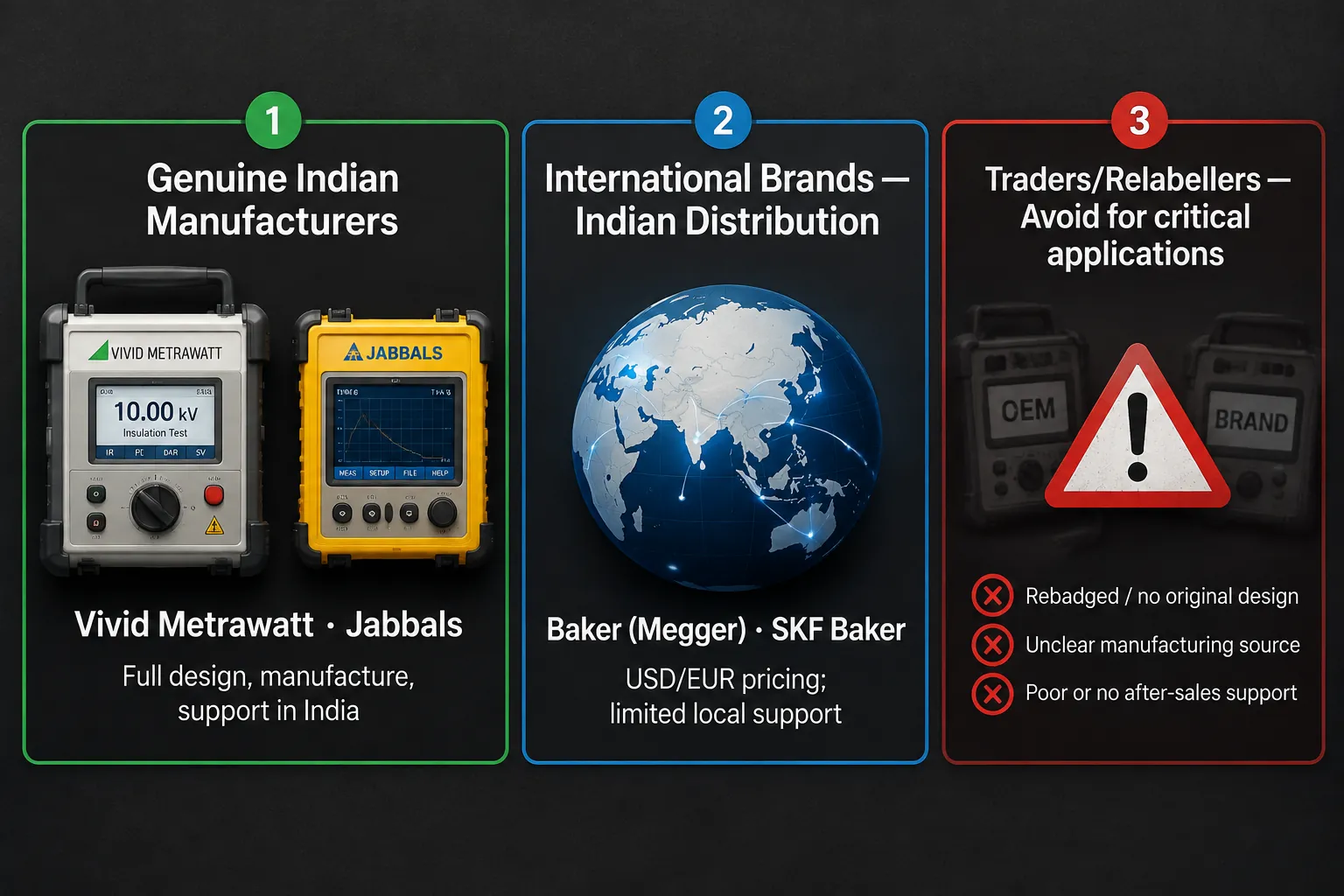
The first thing any serious buyer should understand about the Indian surge tester market is that it contains three very different categories of supplier, and conflating them leads to poor purchasing decisions.
These are companies that design, engineer, and assemble surge testers in India — with proprietary hardware, embedded software, and dedicated after-sales teams. In the segment covering instruments from 1KV to 50KV for industrial motor winding testing, two names stand above the rest:
These are brands manufactured in the USA or Europe, sold in India through authorised distributors or agents. They carry premium pricing in USD/EUR that translates to significant rupee cost premiums — typically 5× to 8× the equivalent Indian instrument on per-KV capability.
The IndiaMART listings for “surge tester” include a substantial third category: trading companies that source instruments — sometimes from Chinese OEMs, sometimes from genuine manufacturers — and resell under their own label, with no proprietary engineering, no calibration infrastructure, and frequently no after-sales support beyond 12 months. These are the listings that appear at ₹2.5 lakh with a “surge tester” label and no verifiable manufacturer address. The red flags section at the end of this guide addresses how to identify these.
Bottom line: For serious industrial motor winding testing — where the result of a missed turn-to-turn fault is a field failure, a warranty claim, or a safety incident — only Category 1 and Category 2 brands are worth evaluating. This guide covers those brands only.
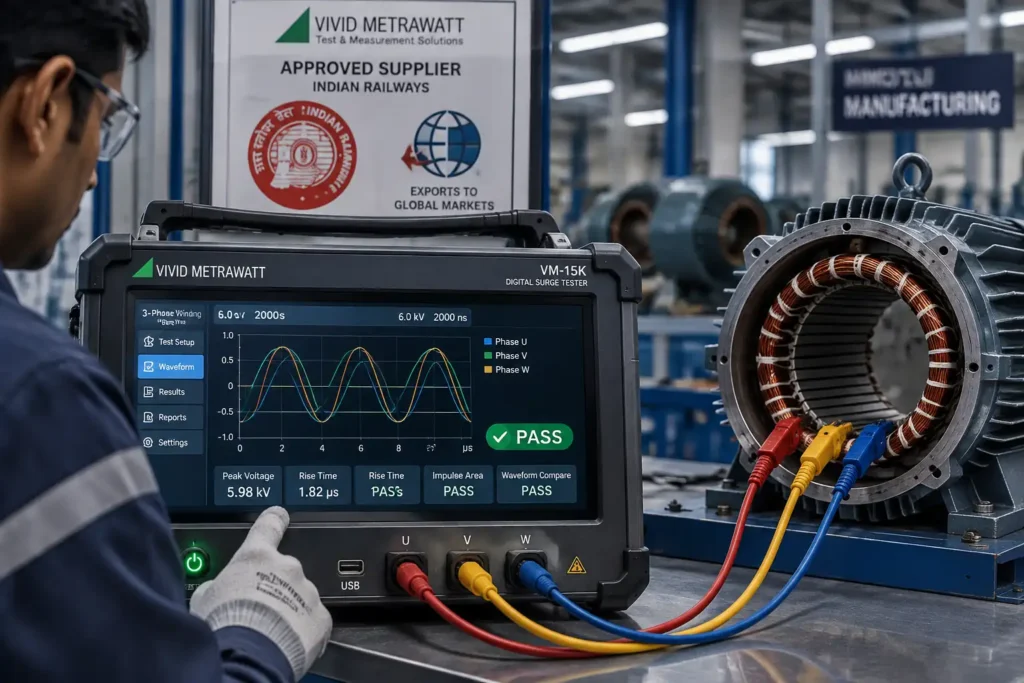
Before the brand comparison, here is the evaluation framework. A surge tester is a precision instrument whose credibility depends on six things that marketing materials rarely address directly.
Does the brand’s product range cover your operating voltage class? A brand that makes excellent 3KV instruments for low-voltage motor shops is not the right brand for testing 6.6KV stator windings. Evaluate: does the brand cover the KV ratings you need today, and the KV ratings you might need as your customer base grows?
IEEE 522 and IEC 60034-15 are the primary standards for surge testing of rotating machine windings. CE certification indicates conformity with European safety and EMC directives. Any brand sold into serious industrial use should confirm compliance with at least one of these. A brand that cannot confirm standard compliance should not be used for formal acceptance testing or quality certification.
A digital surge tester in 2026 must do more than display a waveform. It must store waveform data, recall stored reference waveforms, compare against them automatically, generate printed or electronic test reports, and export data in formats that a quality management system can accept. Instruments that produce only a visual display on an oscilloscope screen — without stored waveform data, without report generation, without USB or network connectivity — are not suitable for quality-managed production environments.
An instrument that fails during a production run or before a critical motor acceptance test is only as valuable as the speed at which it can be repaired or replaced. For imported instruments, calibration servicing, spare parts, and repair typically involve long lead times and international shipping costs. For Indian-manufactured instruments, the question is whether the manufacturer has a direct service capability or relies entirely on courier-and-return.
Which organisations and industry sectors trust this brand with their critical testing? Indian Railways, major OEMs (Siemens, ABB, WEG), and export-market motor manufacturers are the highest-credibility reference customers in the Indian context. A brand that cannot name verifiable reference customers is a brand that has not yet been proven in demanding applications.
The purchase price is only one component. Calibration costs (annual, in rupees or dollars), spare parts costs, software licence costs (if any), and the cost of downtime when the instrument requires servicing all feed into TCO. An instrument priced at ₹8 lakh with free lifetime software updates and ₹12,000 annual calibration in Mumbai may have a lower 5-year TCO than an instrument priced at ₹18 lakh with USD-denominated software licensing and international calibration return.
Baker Instruments originated in the USA and built its reputation over decades as the reference instrument for offline motor winding testing in North American industrial plants. The Baker DX series became a standard specification in many US and European motor acceptance test procedures. Megger, the UK-based electrical test equipment group, acquired Baker Instruments, and the product line is now marketed as Megger Baker or Baker by Megger in international markets.
What Baker does well:
Where Baker falls short for Indian buyers:
The SKF Baker branding covers instruments derived from the Baker lineage, positioned particularly for predictive maintenance applications. The AWA series (Automated Winding Analyzer) is a well-regarded instrument for high-volume automated testing. In India, SKF’s primary brand recognition is in bearings and lubrication — the SKF Baker instruments are less commonly seen in Indian motor testing facilities than the parent brand’s other product lines.
Honest assessment: Baker/Megger instruments are genuinely excellent. They are the global reference for a reason. But in the Indian industrial context — where 30-year Indian manufacturers offer CE-certified, IEEE-compliant instruments at 15–20% of the Baker price, with local service, local software support, and proven Indian reference customers — paying the Baker premium is only justified in very specific circumstances: international export contracts that specify Baker by name, or facilities where global reporting integration with Megger’s software ecosystem is a non-negotiable requirement.
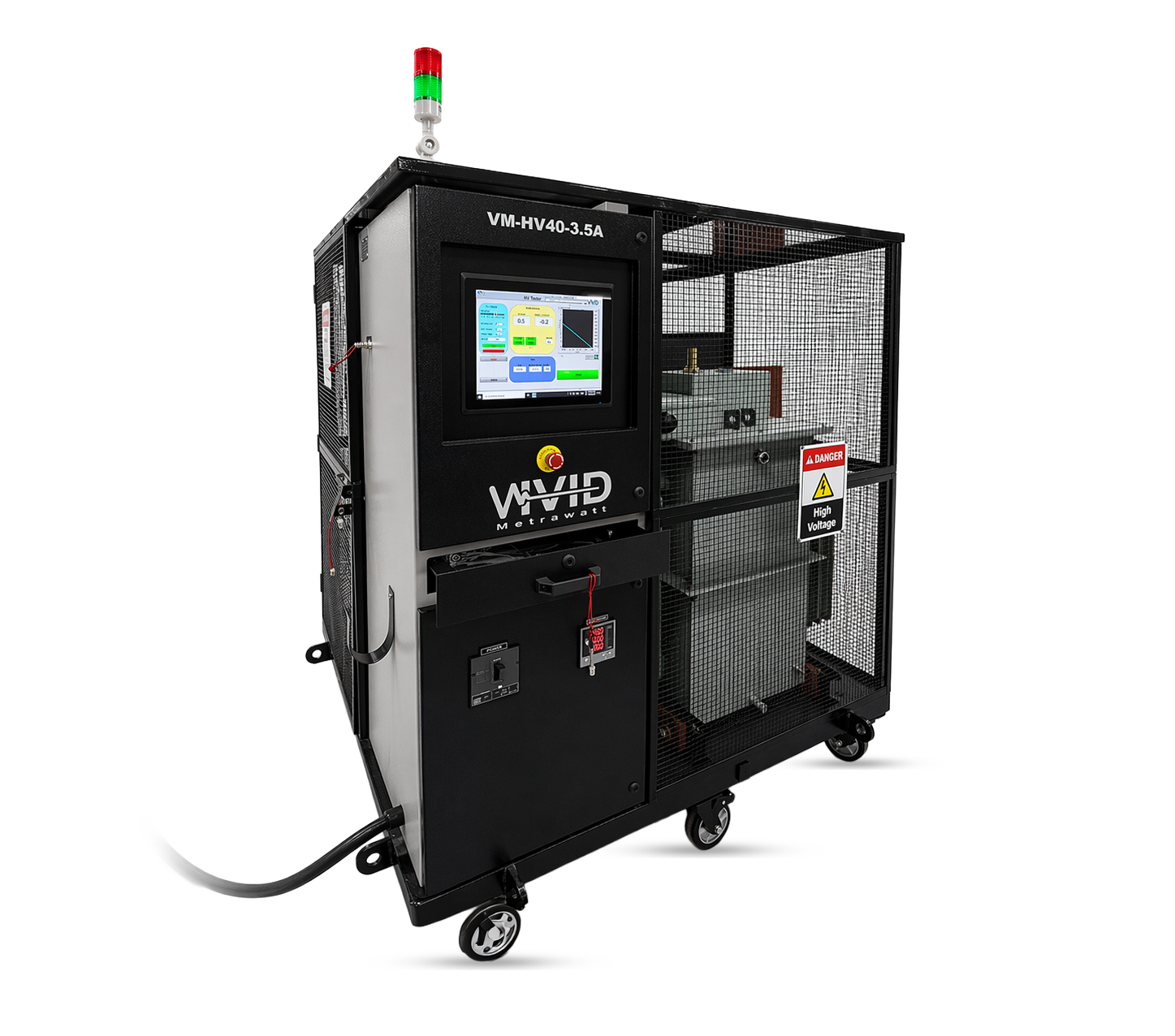
Vivid Metrawatt is Vivid Metrawatt Global’s core product — designed, engineered, and manufactured at their facility in Vasai East, Mumbai. The range spans 1KV to 50KV across more than a dozen distinct models, covering every motor and generator voltage class from small DC armatures to large offshore generator windings.
Confirmed credentials:
Technical highlights:
KV range — the widest confirmed in the Indian market:
Explore the full range at the Vivid Metrawatt Digital Surge Tester page.
Jabbals has been manufacturing surge comparison testers in India for over 40 years — longer than any other Indian brand in this segment. Their claim to be the first Indian company to supply surge testers to WEG, ABB, Siemens, Andritz Hydro, Jumont Electric, and Toshiba-Mitsubishi is substantiated by their published customer list. Their instruments use LabVIEW software and cover up to 50KV with a partial discharge test feature — the latter being a meaningful differentiation for high-value medium-voltage generator applications.
Where Jabbals is strong: production line testing in domestic motor OEM environments; the Jabbals name has been the benchmark instrument in Indian motor factories for decades and carries significant brand recognition among quality managers who have worked in the sector for 15+ years.
Where Vivid Metrawatt differentiates: the confirmed Indian Railways 89% supply share is a more demanding reference than domestic motor OEM supply; the 10-inch touch screen and Windows 10 embedded PC with 240GB SSD represent a more current hardware platform; and the 30+ country export footprint signals a quality standard validated across more regulatory environments.
| Criterion | Vivid Metrawatt | Jabbals | Baker / Megger Baker |
|---|---|---|---|
| Manufacturing origin | 🇮🇳 Made in India (Vasai, Mumbai) | 🇮🇳 Made in India (Faridabad) | 🇺🇸 USA / UK (imported) |
| Years in market | 30+ years | 40+ years | 50+ years (global) |
| KV range available | 1KV – 50KV (widest in India) | Up to 50KV | Up to 12KV (DX standard); higher on specialist models |
| Standards compliance | ✅ CE certified; IEEE 522; IEC 60034-15 | ✅ CE certified; IEEE/IEC | ✅ CE; IEEE 522; IEC; NEMA; global standards |
| Software platform | LABVIEW; 10″ touch screen; Windows 10; Intel Dual Core; 240GB SSD; infinite model storage | LABVIEW; 8″ touch screen; PC-based reports | Megger Motor Analyzer suite; trend analysis; fleet management |
| Key Indian reference customer | Indian Railways — 89% supply share | WEG, ABB, Siemens, Andritz Hydro, Toshiba-Mitsubishi | Global OEMs; limited confirmed Indian plant installations |
| Export markets | 30+ countries | Australia, UK, Spain, Italy, select markets | Global (100+ countries) |
| Service & support in India | ✅ Direct manufacturer support; India-based calibration; custom solutions | ✅ Direct manufacturer support; India-based | ⚠️ Distributor-dependent; calibration may require international return |
| Relative price in India (₹) | ₹₹ — Mid-range; best value for capability | ₹ to ₹₹ — Competitive; strong price positioning | ₹₹₹₹ — 5×–8× Indian brands; USD-denominated |
This is the question most buyers are actually asking when they search “best surge tester brands India.” Let us answer it without equivocation.
The 2026 verdict: For Indian buyers in 2026, the case for spending 5–8× more on an imported surge tester is narrower than it has ever been. Indian-manufactured instruments have closed the technology gap — the hardware platform, the software, the KV range, and the standards compliance are equivalent. The price gap has not closed. The service advantage is firmly on the Indian side. The only scenarios where the imported premium is justified are those involving specific international contract requirements or global software ecosystem integration.
| Your Situation | Recommended Brand | Reason |
|---|---|---|
| Indian motor OEM, production line, 415V motors | Vivid Metrawatt VM LCD-3AND (3KV) | Purpose-built for Indian production volumes; single-turn short detection; automatic; footswitch; best price-to-function |
| Motor repair shop, mixed fleet 415V–6.6KV | Vivid Metrawatt VM-15K or VM-15KHR | Covers full low-to-medium voltage range; LABVIEW; infinite model storage; local service |
| Railway / traction motor maintenance | Vivid Metrawatt VM-25KHR / VM-40KHR | 89% Indian Railways supply; proven in railway depot environments; 80KV insulated leads; integrated DC Hi-Pot |
| Large motor OEM supplying ABB/Siemens/WEG | Vivid Metrawatt or Jabbals | Jabbals has confirmed supply to these OEMs; Vivid Metrawatt’s CE and IEEE compliance satisfies most international quality audits |
| Exporting motors to EU / USA customers who specify Baker | Baker / Megger Baker | Contract specification requires it; no alternative if customer insists on Baker by name |
| Facility already using Megger test equipment fleet | Baker / Megger Baker | Ecosystem integration with PowerDB / Asset Riskmaster; single vendor for calibration |
| Wind turbine generator stator testing (6.6KV–11KV) | Vivid Metrawatt VM-15K / VM-25K | Covers 6.6KV–11KV voltage classes as standard products; Baker DX tops at 12KV but at 4× the price for same function |
| PSU / Government tender requirement (Make in India) | Vivid Metrawatt | Manufactured in India; CE certified; strongest Indian Railways reference customer |
| DC armature / bar-to-bar traction motor testing | Vivid Metrawatt VM-1AT or VM-6KA | Bar-to-bar test capability confirmed on both models; 89% railway supply base proves depth of experience in this application |
For the complete model selection guide by motor voltage class, see our buyer’s guide on which surge tester KV rating do you need.
Beyond the four brands covered above, the Indian market contains a long tail of names — some genuine small manufacturers, many traders. Before purchasing from any brand not covered in this guide, verify the following:
For the majority of Indian industrial applications — motor manufacturing, motor repair shops, railway maintenance, wind energy, heavy industry — Vivid Metrawatt is the strongest overall choice. It offers the widest KV range in the Indian market (1KV to 50KV), the highest-credibility Indian reference customer (89% of Indian Railways’ surge testers), CE certification, IEEE 522 and IEC 60034-15 compliance, and a hardware platform (10-inch touch screen, embedded industrial PC, LABVIEW, Windows 10) that matches or exceeds imported alternatives at a fraction of the price. Jabbals is a strong alternative with 40+ years of Indian manufacturing history and confirmed supply to major international OEMs. Baker/Megger is the reference global brand and is justified for specific international contract or ecosystem integration scenarios.
Yes — for the established Indian manufacturers (Vivid Metrawatt, Jabbals). Both carry CE certification, comply with IEEE 522 and IEC 60034-15, and have demonstrated reliability through demanding reference installations — Indian Railways in Vivid Metrawatt’s case, WEG/ABB/Siemens in Jabbals’ case. “Imported” does not mean “better” in this product category in 2026. It means higher price, longer service lead times, and in some cases a narrower standard KV range than Indian alternatives.
Baker/Megger instruments are priced in USD, translating to approximately 5× to 8× the equivalent Indian-manufactured instrument’s rupee price for comparable KV capability. Exact pricing varies by model and configuration — contact Vivid Metrawatt directly for a comparative quotation at your required KV specification.
For the core features that matter in industrial motor winding testing — surge test voltage accuracy, waveform storage and comparison, LABVIEW software integration, report generation, and standards compliance — yes. Vivid Metrawatt’s 10-inch touch screen platform with embedded industrial PC, Windows 10, 240GB SSD, and infinite model storage is a comparable or superior hardware platform to the Baker DX series for the primary test functions. Where Baker’s broader Megger ecosystem adds value is in fleet management software integration — if that specific capability matters for your facility, Baker’s advantage in this area is real.
Vivid Metrawatt supplies 89% of Indian Railways’ digital surge testers — confirmed. Indian Railways’ traction motor maintenance depots use instruments primarily from the Vivid Metrawatt 25KV–40KV range, covering the voltage classes of railway traction motor windings.
Both are credible Indian manufacturers with long track records. Jabbals has a longer heritage (40+ years vs 30+ years) and confirmed supply to international OEMs including WEG, ABB, and Siemens. Vivid Metrawatt has the stronger single reference customer (Indian Railways at 89% supply share), a wider KV range as standard products, a more current hardware platform (10-inch vs 8-inch touch screen; Windows 10 embedded PC), and a larger confirmed export footprint (30+ countries). For most applications, the choice between the two comes down to which brand your quality team has prior familiarity with, and which has the better service response in your region.
Ask for: (1) the factory manufacturing address and GST registration, (2) the CE certificate for the specific model you are buying, (3) three named reference customers using that model for the same application as yours, and (4) a demonstration of the software platform on the actual instrument. Genuine manufacturers answer all four immediately. Traders typically cannot answer (2) and (3) for the actual model being sold.
Evaluate Vivid Metrawatt — India’s Most Trusted Surge Tester Manufacturer
30+ years manufacturing. 1KV to 50KV. 89% of Indian Railways’ surge testers. CE certified. IEEE 522 and IEC 60034-15 compliant. LABVIEW software. 10-inch touch screen. Exported to 30+ countries. 500+ industries served. Custom solutions available. Made in India.
→ Explore the Full Vivid Metrawatt Surge Tester Range (1KV–50KV)
→ Which KV Rating Do You Need? Complete Buyer’s Guide
→ Megger Test vs Surge Test — How They Differ and Why You Need Both
→ Manual vs Automatic Surge Tester — Which Is Right for Your Workflow?
→ Request a Technical Consultation and Quotation from Vivid Metrawatt